



The KWV Co-operative was formed in 1918 by South African wine farmers to serve the local wine industry with respect to marketing and production. In 1997 the company converted to a group of companies, and its production company known as KWV South Africa is the main supplier of wines and brandies to KWV International.
The KWV factory in Paarl is one of a handful of production facilities located in the Western Cape region of South Africa. It is here that the entire process from vinification to maturation, blending and packaging is covered. The plant also has extensive research and development facilities.
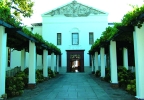
Before the decision was taken to automate one of the three bottle-labelling lines at the KWV factory in Paarl, it was operated with a fair amount of operator intervention and its maximum capacity was around 8000 bottles per hour. As the demand for premium wines increased, the need for a higher output of wine bottles arose.
It was important that the automated line process would be implemented without any accumulation before the labelling machines. As the line is also not restricted to one type of bottled product, a very high degree of adaptability was required.
For Henry Jooste, the system integrator on the KWV plant, the decision to base their solution on the S-Max controller and the Interbus fieldbus system from Phoenix Contact was vital to the success of the project. Previous tests had proven to him that Interbus was the only fieldbus system that could meet his application's demanding response times. The machine controller S-Max from Phoenix Contact combines PC platform, Soft-PLC, Interbus fieldbus master as well as operating, monitoring and visualisation functions.
Phoenix Contact was also able to supply KWV with a full suite of products to ensure efficient project implementation. These included remote digital inline I/O modules, analog input modules, Interbus motor drives in IP67 protection degree and the S-Max. Because of its diverse functionality the S-Max would provide the processing power and flexibility for the application.
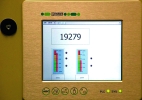
The integrated HMI/scada functionality of the S-Max device added even more reason to make use of it, without any need for other or separate devices and the Ethernet programming facility has also been helpful to amend the control software without being present on the plant.
Because of the fast response time of the Interbus system, the drives on the line could react to change instructions quicker, thereby reducing pressure on the line thus minimising scuffing of the glass bottles. The design of the drive casings also ensured optimal heat dissipation so as to avert drive failure. In the past, drives from other manufacturers had sometimes failed due to high ambient temperatures and humidity.
The products from Phoenix Contact were found to be user-friendly and all steps from planning, installation, development and commissioning were completed without problems.
Henry Jooste, the system integrator, commented that extreme attention had been paid to the installation's earthing and believes that this attributed to trouble-free implementation. Testament to this is the fact that the signal quality feedback indication - an integrated feature of the Interbus fieldbus system - has never once failed since the commissioning of the line.
As a result - after the project completion - the maximum rated line speed for the line has increased to 11 500 bottles per hour, a 44% increase in maximum line speed. This impressive achievement has been realised using only 10% of the S-Max's resources. This gives enough room for future extensions.
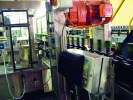
S-Max provides processing power and flexibility
The machine controller S-Max from Phoenix Contact combines PC platform, Soft-PLC, fieldbus master as well as operating, monitoring and visualisation functions - built in a single housing. The machine control itself is an ideal application field for PC-based solutions. When implementing a machine control S-Max, the user selects the operating system and the fieldbus master, and Phoenix Contact supplies a preconfigured and tested integrated HW/SW solution.
The base of the S-Max machine control is formed by a panel PC. This panel PC is located in a compact aluminium housing with a robust front panel and small assembly dimensions. The built-in TFT colour monitor as well as the three Ethernet interfaces is part of the standard equipment.
The visualisation software of the S-Max enables intuitive operation as well as dynamic representation of the objects and multiple usable object instances facilitate efficient work. The OPC interface (OLE for process control) enables integration of objects into existing projects - simple and fast. The integrated Soft-PLC loads the control programs, works its way through them and offers debugging functionalities for programming, commissioning and maintenance for the PLC controlled machines. A fieldbus master - eg, for Interbus, Profibus, DeviceNet or CanOpen completes the capabilities of S-Max - it enables the connection to the 'outside world'.
For more information contact Phoenix Contact, 011 801 8200, info@phoenixcontact.co.za
| Tel: | +27 11 801 8200 |
| Email: | sbritz@phoenixcontact.co.za |
| www: | www.phoenixcontact.co.za |
| Articles: | More information and articles about Phoenix Contact |






© Technews Publishing (Pty) Ltd | All Rights Reserved
 printer friendly version