



In the last 20 years electronic communication and data aquisition systems have become an intergral part of our daily lives. As vital as these systems have become, there is still a total lack of awareness of the standards in the field of lightening protection.

Companies and property owners who have installed external lightning protection in accordance with SABS IEC codes are unaware that their computer and data communication systems still remain vulnerable to lightning. Very few people are aware that there is a difference between external building protection and the protection of internal electronic equipment.
A single lightning strike to a well-designed and installed external protection system can cause significant financial loss to a company. What is even more important is that the consequential losses, such as loss of production and recapturing of data is often four or five times greater than the actual loss of hardware.
When the public, including some consulting engineers, specifying authorities and insurance companies, buy lightning protection, they believe that the internal component protection is included when buying structural protection. At present there is no SABS code for the protection of very low voltage electronic systems. The existing SABS IEC code 16431-1 is for ‘surge arresters’ for low voltage distribution systems only. In other words, this means for power systems below 1000 V.
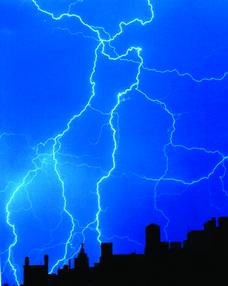
The SABS has now adopted the IEC code of practice. Surge Technology, local manufacturer and installer of lightning and overvoltage protection devices and systems, has been working strictly to the IEC recommendation for many years. By adopting these standards, Surge Technology has achieved great success in the protection against lightning damage and is able to offer its clients guaranteed lightning protection.
Surveys undertaken in both Germany and USA show that transient over-voltages or surges account for 88,5% of all power problems, 0,5% due to power failures, and the remaining 11% to power fluctuations. The IEEE-587 has released similar statistics showing that damaging interference and surge levels between 1000 and 3000 V occur 60 to 150 times per year. In most cases companies, insurance loss assessors and consulting engineers fail to identify lightning and other sources of surges as the cause of failure and damage, particularly if the installation is new and has some form of external protection.
Another major misconception is that it is only direct lightning that can cause damage. In actual fact, lightning up to 1 km away, through electromagnetic induction, can cause severe damage to networks. With the rapid growth in computers and computer networks, the incidence of damage due to lightning has increased significantly. In South Africa the average lightning flash density is around four to seven lightning strikes per square kilometre per year. It is therefore an obvious fact that the larger the network system or the longer the telemetry line, the greater the risk of lightning damage.
The SABS IEC recommendation provides a risk assessment to enable companies to determine exactly how great their threat is from lightning. The recommendations explain, in detail, lightning induced surges and provides guidelines on how to implement the protection concept.
The correct choice of protection equipment is of utmost importance as surge protectors vary widely in design and capability. Companies buying protection equipment must confirm that the surge arrester will reduce surge currents and over-voltages to acceptable levels. There are, for example, power protectors on the market of the metal oxide type that can control severe lightning induced transients of 10 kV to below 900 V. At the same time, there are also gapped-silicon carbide types on offer that have a let-through voltage of between 1800 and 3000 V.
Insulation breakdown levels are specified by the supplier of the equipment and will only differ slightly according to the type. Over-voltages should be limited to less than twice the normal operating voltages on data and communication lines and below 1000 V on the 50 Hz mains. A clear distinction must also be made between lightning surge current arresters which are installed where electrical circuits enter the building and surge voltage arresters which are installed at the equipment to be protected.
Both screening and shielding are other areas to be totally neglected. The use of correctly screened cables and the earthing of the screens, as well as the use of steel conduits for the shielding of sensitive cables, plays a vital role in the overall protection system. The structural steel in the building has to be incorporated into the potential equalisation earthing system. This is essential in limiting the surge current rate of rise inductive effects on the equipment within the building during a direct strike. In terms of the SABS external lightning protection code, this is a must.
The cost of protecting equipment depends on the building layout and on the type of device and quantity.
For modern commercial buildings with a single three-phase power supply the protection of the supply with surge current arresters would cost around R650 plus an installation fee. A large industrial complex with various power supplies would require protection at each power inlet. All data and signal lines entering or leaving the building will need protection using the type designed to withstand severe surge currents without damage or disrupting the signal.
Awareness of potential lightning damage is far greater in countries such as Germany, Holland and Italy, even though they have a much lower lightning flash density per square kilometre than South Africa. Studies undertaken in European countries and presented at the last International Committee on Lightning Protection, indicated the presence of secondary lightning currents within the building. These would be no greater than 10 kA but more likely to be in the 3000 A region.
For complete safety, protection much be installed at both the main power distribution panel as well as secondary and local panels such as those feeding sensitive areas such as computer rooms, as well as on all signal data cables connected to the equipment.
At the main LV distribution panel, protection stops lightning surge currents from entering the power system. At secondary local panels, protection will prevent switching surges generated within the building from causing damage or disrupting vital pieces of equipment. The protection of local panels acts as second tier protection against lightning surges thereby lowering the let-through or residual voltage even further.
Contrary to claims made by certain UPS manufacturers, UPS are not designed to prevent lightning damage. In most basic UPS, the neutral conductor is not galvanically separated from the raw power. Any lightning or switching surge will travel straight through the UPS neutral and damage the connected equipment. Furthermore, most UPS are not fitted with lightning protection. Protection of raw power to the UPS protects the computer equipment from surges during static or maintenance bypass, as well as protecting the UPS from lightning surges during normal operation.






© Technews Publishing (Pty) Ltd | All Rights Reserved
 printer friendly version