



Organisations today have complex, heavyweight information and communication requirements. Voice data and telephony; access control and the tracking of people and cars; environmental monitoring; recording, storage and distribution of high-quality digital images. And all of it available via both wired and wireless interfaces.
Is your infrastructure up to speed, or are you spending more and more energy trying to integrate a hornet's nest of disparate networks and systems? Trying to maintain availability - not to mention making sure that the systems can talk to one another in some way? How complex can you go before the whole thing falls to pieces?
Siemens believes that its Open Transport Networks can make things simple again.
OTN is a flexible private communication network based on fibre-optic technology. It allows the user to integrate and manage all systems and tools (including PABX, PLC, CCTV and LAN) on a single network, with speed and efficiency, as well as a high availability. Siemens believes that its OTN is probably the most powerful and effective solution for large private business environments with mixed communication needs - such as the mining industry.
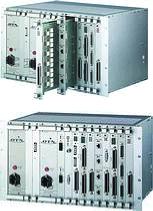
Open Transport Networks is what its name implies:
Open
The network infrastructure can handle nearly all existing physical interface standards. It also provides for very specific communication protocols in special environments, via its interface cards.
Every OTN node provides for between four and eight interface cards. These cards are used to connect all peripherals (such as PBXs, analog and digital telephones, host computers, data terminals, scada systems, PLCs, CCTV equipment, and many more) to the network, and can be switched in and out at any time, without disturbing network operation.
Types of interface cards include:
* Data applications: RS232, RS422, RS485, G703, V-series, point-to-point, multipoint, multidrop.
* Voice applications: 30B+D, UP0, S0, G703 Digital, E & M, public address, 2 Mbps, analog (2/4 wire).
* Local area networks: Ethernet IEEE 802.3.
* Video: PAL/NTSC, CVBS, M-JPEG compression, fixed/switched.
Transport
OTN carries a variety of information types (such as data, voice, LAN and video) throughout the network. This is done with transparency and high availability.
Network
The network itself is built up with nodes interconnected via a dual fibre-optic ring. It can span any distance required - from a few hundred metres to several thousand kilometres, without any need for additional transmission equipment.
Easy to manage from a single PC
Keeping an eye on the OTN is simple. The management interface runs on a single PC, giving the operator a clear picture of the network. It provides extended fault management capabilities and allows the network manager to establish a service (eg, audio, video etc.), or load a new network configuration in a matter of minutes. The user could even have a standby network management system, if required.
Key technical facts
* Dual fibre-optic ring.
* 150/600 Mbps.
* Modular nodes.
* Four or eight universal interface slots (mini node with four slots available).
* Hardware concept.
* Distributed architecture.
* Time division multiplexing (TDM).
* Flexible bandwidth allocation.
* One step multiplexer.
Solutions for industry
Mines
Fibre-optic transmission systems are the ideal solution for the support of underground and surface services. Typical applications include:
* Monitoring and control of water, compressed air and electrical reticulations.
* Monitoring and management of fire detection systems and gas alarms.
* Combining automation systems with communication solutions, such as paging, leaky feeder radio communication, emergency telephony, PBX, LAN and video surveillance.
OTN offers full support for mining communication backbone needs:
* Openness - support for all current equipment, whilst allowing for future expansion in terms of interfaces and bandwidth. Compliance with various interface standards.
* Deterministic characteristics - deep level mining is a hazardous business. Problems that could occur include heat exhaustion, pressure bursts, groundfalls and seismic events - and a network with predictable response times is an absolute necessity. The time division multiplexing (TDM) system has proved itself to be superior in handling delay-critical or timing-sensitive applications such as realtime voice and video.
* Support for multimedia - the use of video and multimedia have gained momentum over the past few years, bringing about a myriad new applications and products, all contributing to a safer environment, better working conditions and improved control of operations. OTN goes one step further, allowing you to connect any video equipment (cameras, monitors, recording equipment, quads, multiplexers) to the same communication network.
* Redundancy - round-the-clock availability.
* Diagnostics and easy configuration - easy fault identification/isolation and alarming. System configuration is straightforward, but flexible.
* Use of fibre-optics - the mining environment is one of extremes. High temperatures, dust and humidity are particularly destructive to electronics, necessitating the highest quality equipment. (In the South African context, problems are further exacerbated by the threat of copper cable theft.) Under such conditions, fibre-optics have proven very effective for the interconnection of PLCs, for data, telephone and radio communication, as well as LANs and video transmission.
Summary of benefits
* Support all types of communication services, including data transport from automation and process control systems.
* Used in several mining projects, typically for the interconnection of scada control units, data communication between different processes, telephone and radio communication, and the interconnection of LANs and video transmission. OTN ensures that all this information reaches its destination in a fast, transparent and reliable way.
* Self-healing fibre-optic rings allow cables to be installed via independent routes, also ensuring maximum availability should a cable break or system unit fail.
* Transmission and switching of high-quality video signals (CVBS or S-video) using M-JPEG allows the operators in the control room to view the different mining facilities (excavators, shafts, moving vehicles) in realtime.
For more information contact Keshin Govender, Siemens Southern Africa, +27 (0)11 652 2412, [email protected], www.siemens.co.za
| Tel: | +27 11 652 2000 |
| Email: | [email protected] |
| www: | www.siemens.co.za |
| Articles: | More information and articles about Siemens South Africa |






© Technews Publishing (Pty) Ltd | All Rights Reserved
 printer friendly version