


Temperature Measurement


Exact temperature measurement with pairs of thermoelectric voltage terminals

June 2001 Temperature Measurement

Where exact measurements are crucial to process engineering and laboratory technology, the installation of the measuring circuit can be as important as the selection of the measurement instrument. For sensitive measurement technology, accuracy and reliability are of fundamental importance.

In these sectors temperature measurements are often taken using thermocouples. These are low-cost and robust and are notable for their tight measurement tolerances.

In a process environment often several measurement points have to be monitored in parallel, whether in the case of analog evaluations or because the temperature difference between two points is of importance for a particular procedure. These readings, which have to be obtained from differing locations, often with very difficult access, come together at a central measuring station, where they are evaluated. Between the measurement point and the measuring device there has to be a constant and absolutely trouble-free connection, in order to avoid the possibility of measurement errors.
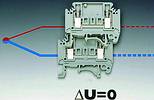
The thermoelectric voltage terminals from Phoenix Contact

How does a thermocouple work?

A thermocouple simply consists of two wires made of different metals, for example copper and constantan (Figure 1). These are joined at the end (either twisted together or welded) and are run to the measuring device insulated from each other.
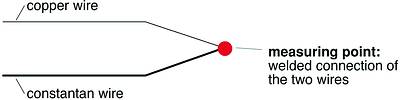
Figure 1. Structure of a thermocouple for the temperature range from -200 to +600°C

Under the effects of heat on the twisted or soldered connection point a direct voltage (thermoelectric voltage) is created between the two metals, which can be measured and provides an indication of the temperature (Figure 2). Thermocouples are used in measurement ranges between -200 and +1600°C.
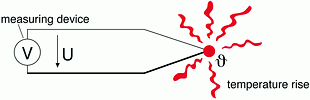
Figure 2. The thermocouple in operation

Different thermocouples are used for various temperature levels, since certain combinations of metals supply thermoelectric voltages of quite different characteristics. There are many different variants of thermocouples: for example the combination nickel-chromium/nickel is used for measurements from 0 to 1200°C, while in the range between -200 and +600°C the copper/constantan combination is preferable (Table 1 and Table 2).
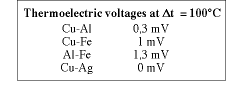
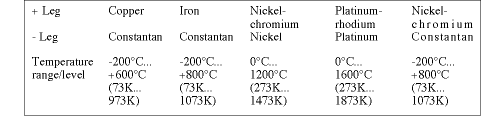
Table 1. With differing materials different thermoelectric voltages occur

Table 2. The DIN 43710 standard regulates thermal pairings

For the measurement process the thermocouple is run to the location to be measured, and then the measuring device linked to the thermocouple evaluates the temperature readings. The transmission path of the thermocouples, in other words the distance between the measurement point and the measuring device, is limited by the design of the device. In order to deal with long distances it is necessary to lengthen the path by the use of a thermal compensation cable, with a modular terminal block being used as the connection element.
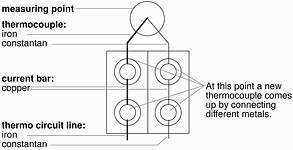
Figure 3. A standard modular terminal block is not suitable for connecting thermocouple and thermal compensation cable

The 'special' connection

Thermoelectric voltage terminals from Phoenix Contact offer a stable connection between a thermocouple and its 'extension' (Figure 4). Commercially available modular terminal blocks cannot perform this function, as the conductive current bar or the current-bearing parts are made exclusively of copper. The meeting of the two differing metals at the connection points would create an undesired new thermocouple, giving an erroneous measurement result (Figure 3).
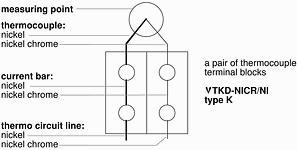
Figure 4. Thermoelectric voltage terminals connect thermocouple and thermal compensation cable

Unlike normal commercially available modular terminal blocks, because of the way they are constructed, thermoelectric voltage terminals are offered only in pairs. The current bars are a pair of terminal blocks consisting of different metals, which are individually matched to the materials of the thermocouple to be used. This means that the combinations of metals of the temperature-measuring components can be continuous, without any need for a break. Using this principle, all thermocouples can transmit their signals over relatively great distances, using suitable connection terminal blocks, without creating significant measurement errors.

Given the wide variety of combinations of metals, thermoelectric voltage terminals are available from Phoenix Contact for the following types:

* Copper/constantan, CU/CUNI, type T.

* Iron/constantan, FE/CUNI, type J.

* Nickel-chromium/nickel, NICR/NI, type K.

* Platinum-rhodium/platinum, Pt-Rh 10% Pt, type S.

* Nickel-chromium/constantan, NICR/CUNI, type E.

By setting up pairs of thermoelectric voltage terminals it is possible to take exact temperature measurements even over relatively great distances. All types of thermocouples can be fitted with suitable combinations of pairs of thermoelectric voltage terminals and thus wired up without difficulty.


Credit(s)


Share this article:
Share via emailShare via LinkedInPrint this page

Further reading:

Cybersecurity for potentially explosive areas
Phoenix Contact IS & Ex
The Cellulink outdoor cellular router product range from Phoenix Contact is being extended. New versions are now also available that have been specially developed for use in Zone 2 potentially explosive areas.

Read more...
Infrared solutions for glass manufacturing challenges
Instrotech Temperature Measurement
In the glass industry, infrared temperature monitoring is crucial for maintaining product quality and process efficiency. Instrotech has infrared sensors and cameras which provide non-contact temperature measurements, making them ideal for these high-temperature environments.

Read more...
Advanced Layer 2 switching capabilities
Phoenix Contact Electrical Power & Protection
The Raptor EP4200 and EP5200 series switches provide advanced Layer 2 switching capabilities with high performance and availability tailored for demanding critical infrastructure and energy applications.

Read more...
Simplifiying assembly and installation of heavy-duty connectors
Phoenix Contact Electrical Power & Protection
The new Heavycon series click-in module carrier frame from Phoenix Contact simplifies the assembly and installation of heavy-duty connectors significantly.

Read more...
Decarbonising a heat and power plant
Valmet South Africa Temperature Measurement
Valmet is delivering a boiler fuel conversion for a combined heat and power plant in Poland. After modernisation, coal will be replaced entirely with certified forest biomass supplied by local providers.

Read more...
High-precision fill quantity control in food supplement production
Temperature Measurement
Vital Products was looking for a precise and efficient solution to check the weight and ensure the completeness of its products. Minebea Intec, a specialist in industrial weighing and inspection technologies, was able to provide a solution.

Read more...
Terminal blocks with Push-X technology for wiring from 0,34 mm2
Phoenix Contact Electrical Power & Protection
The Push-X product range is growing. With the new XT 1,5 terminal blocks, Phoenix Contact is extending the series to include versions for conductor cross-sections from 0,34 to 2,5 mm2.

Read more...
Intelligent process stabilisation in injection moulding
Temperature Measurement
A new benchmark in precision temperature control for plastics processing is being set by technotrans.

Read more...
New temperature transmitters with Profibus connectivity
Temperature Measurement
Siemens is enhancing its temperature measuring device portfolio with the transmitter duo, Sitrans TH420 PA and Sitrans TF420 PA. Both devices feature Profibus connectivity, advanced safety functions and expedited commissioning all in one unit.

Read more...
Enhancing industrial efficiency through advanced temperature control
Iritron Temperature Measurement
Iritron has been offering modular smart thyristor drives to the local and international mining, minerals and metals market, including the latest new leading innovations in temperature control technology. These drives combined with advanced proportional-integral-derivative (PID) control will change the way large industries manage their heating processes, reducing costs and extending equipment lifespan.

Read more...


While every effort has been made to ensure the accuracy of the information contained herein, the publisher and its agents cannot be held responsible for any errors contained, or any loss incurred as a result. Articles published do not necessarily reflect the views of the publishers. The editor reserves the right to alter or cut copy. Articles submitted are deemed to have been cleared for publication. Advertisements and company contact details are published as provided by the advertiser. Technews Publishing (Pty) Ltd cannot be held responsible for the accuracy or veracity of supplied material.


© Technews Publishing (Pty) Ltd | All Rights Reserved

