



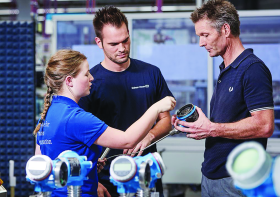
How does one invent a product that optimises processes in the plant over the long term? In addition to the traditional approach, we describe the ‘Steve Jobs’ method that led to the Liquiphant level detector. Taking a look at the development department and how it deals with what is called the ‘critical chain’ gives an in-depth idea of how much effort goes into the variety of products at Endress+Hauser. Putting effort in at the beginning of a product design is worth it: functional safety in the design saves a lot of time in the plant.
There are two ways to invent something. The most common form of developing new products is simply consulting users. Where are solutions needed? What part of daily working life do we want to make easier? These product ideas cater to the customer. They are created based on real needs and provide customers with efficient help. Every measuring device manufacturer relies on this procedure for developing their product portfolio. Endress+Hauser is no exception and develops products with this method.
Then there is the other method. Interviewing users to find out what they want is not going to help much here. If they had conducted a user survey in the 1990s, none of us would have indicated that we needed to have online friends or that we would want to combine our mailbox, phone, calendar and computer into one device that we control with swiping movements. Before Facebook or the iPhone existed, if you had asked users whether they needed those things, the majority would probably have said they did not. At this point in time, each person has their own views on the benefits of these things, but there is no denying the fact that they have irreversibly changed our behaviour and our requirements for intuitive user guidance. Sometimes you need nothing more than the vision to try out what is technically possible and the time to test whether you can get users excited about it.
Pioneers for a new measuring principle – Vibronics
In the late 1970s, Georg H. Endress, the founder of Endress+Hauser, had a vision. His goal was to abandon the pitfalls of the capacitive measuring principle and develop an all-metal sensor that would be permanently leak-proof. He did not want to just optimise. He wanted to rethink for customers and deliver a completely new concept. A new measuring principle was born: Vibronics for liquids. The concept soon became a sales hit for Endress+Hauser. The Liquiphant, featuring a vibrating metal fork, is still known today as a reliable and durable switch. It works as a solution in practically any application without calibration to the media. There are currently six million Liquiphant units, installed in plants around the world, doing their jobs reliably. The fourth generation of the product will soon be hitting the market. It will feature Bluetooth, self-diagnostics, verification without removing the device and a test wizard.
Guided through the plant by a HoloLens
The idea of testing what is technically possible early on is a principle that Endress+Hauser has followed for a while now. What is different today, however, is that customers are incorporated into the process at an early stage and asked for their opinions. When Microsoft launched the HoloLens smart glasses featuring what is called ‘mixed reality,’ which is a feature that takes the reality we all see and superimposes a virtual reality, the developers and product managers saw its potential. What if you used it to streamline commissioning, training sessions and maintenance? When the initial version of the newly developed VisionBlue application was being created, customer input was received very early on in the process and affected how the product was designed and what it would actually be used for. It was the opinion of test customers that led to the decision to give VisionBlue users a display of a safe route through the Ex zone to the device, all within HoloLens. The virtual reality that is placed over the real image shows the user each individual step that he has to carry out to set-up or maintain the measuring device.
There are currently so many technical possibilities on the horizon that developers are thinking several steps ahead. They are trying new things and getting customers involved in testing from the get-go. In addition to the major concepts the developers are working on for Industry 4.0 solutions and the digital twin, there are always small practical products that crop up along the way. Their latest accomplishment: an adaptor for field devices that allows data to be transferred from the field over WirelessHART or Bluetooth to a cloud for diagnostics or analysis.
These days, the idea of developers working in quiet isolation just does not cut it anymore. ‘Thinking ahead’ for customers, in a technical sense, means working with customers early on to test how much added value everyday applications really have and to see whether there is more potential in the technology than initially thought. Collaboration with other companies also helps. Endress+Hauser is working with Daimler to support a project at the Technical University of Berlin. The project involves researching artificial intelligence for production and product development. Daimler and Endress+Hauser are setting up the application cases and validating the methods and tools of the machine-learning algorithms based on specific tasks. This means that product developers and design engineers will benefit from the support of artificial intelligence down the road.
The critical chain and attention to detail
In addition to the major advancements in high-tech options, day-to-day work focuses on small-scale optimisations. For example, a certain level measuring device may need to handle future applications at temperatures as low as -52°C, or maybe there is a pressure measuring instrument in need of a high-pressure design. In these cases, marketing employees draft their requirements. The development department creates the design and, finally, translates it into technically feasible specifications.
For each product family, there are around two billion theoretical product combinations for the level and pressure measuring devices. Endress+Hauser has capitalised on an extremely high variety of product versions from day one. This has allowed the company to offer the best custom solution for each individual application. Endress+Hauser remains true to this principle today. Maintaining such a large portfolio means having to optimise organisation in order to manage everything, despite having so many employees working in development. R&D achieves this by relying on new methods in product design: Eliyahu M. Goldratt invented the Theory of Constraints with a focus on the critical chain. Counter-productive multitasking is avoided. You select a few projects that you want to give priority to and have individuals focus on. Buffers are built into the schedule for safety, but they are shorter and placed at the very end. This way, those working on the project will not fall victim to ‘student syndrome’, otherwise known as procrastination. The result: the employees involved end up finishing more projects in the same time frame than they would using the conventional procedure.
This working method requires many people to change their way of thinking. German engineers are famous for their attention to detail and for their tendency to experiment and cram as many technical features as possible into one product. These days, however, there is a greater need for straightforward user guidance and reducing complexity. A lot has changed in development in this respect, too. A greater portion of software developers these days are utilising their eye for detail to create straightforward and intuitive operating concepts. The software developers work according to agile methods like Scrum, which means they develop in short sprints while testing, verifying and optimising very quickly.
Functional safety in the design
Measuring devices for safety-relevant SIL applications serve as an example of how putting effort into every detail pays off now and again. Traditionally, plant operators buy measuring devices that are suitable for SIL applications and test them in the actual application – effectively as ‘proven in use.’ The international standard IEC 61508 for functional safety and electronic safety-related systems allows measuring devices to comply with the standard entirely as early as the development phase. The developers design hardware and software in such a way that all types of systematic errors are avoided. The hardware also requires a monitoring system for accidental errors and a calculation for the quantitative probability of error. This allows users to buy ‘SIL straight from the factory’ along with the corresponding documentation, so that they can ensure transparent and traceable production. The effort put in by developers initially, pays off later thanks to significantly more reliable workflow.
For more information contact Natlee Chetty, Endress+Hauser, +27 11 262 8000, info@za.endress.com, www.endress.com
| Tel: | +27 11 262 8000 |
| Email: | info.za.sc@endress.com |
| www: | www.endress.com |
| Articles: | More information and articles about Endress+Hauser South Africa |






© Technews Publishing (Pty) Ltd | All Rights Reserved
 printer friendly version