



There are few applications where the demands for material testing and quality assurance are more challenging than in the aerospace industry. Ensuring the safety of passengers, crew and cargo through adequately inspected materials and components is no simple task. Genesis Systems Group is a robotic systems integrator, supporting the manufacturing, transportation and aerospace markets. The company specialises in robotic non-destructive inspection (NDI) systems to cater to the special testing requirements of large components for aircraft, satellites and rockets. Even for experienced professionals, manual inspection of such components has been a challenge until now, because they have to move around the parts and at the same time ensure complete material testing in compliance with the highest accuracy requirements. Automated with PC and EtherCAT-based control from Beckhoff, the inspection systems from Genesis now perform these tasks with the required precision, yet at a much faster rate.
Robotic systems designed for the ultimate test
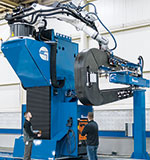
The NSpect line of NDI solutions from Genesis is designed to check large-surface aerospace components for material defects and compliance with manufacturing specifications. For that purpose, Genesis integrates robots with ultrasonic process equipment to conduct through-transmission ultrasound testing using a sender and a receiver. Common ultrasound test types include pulse echo, phased array and shearography. Other techniques are also supported. The range of materials that can be inspected is vast, but most commonly involve steel, aluminium and composite materials.
An important component in these systems is a 6-axis articulated robot paired with a virtual encoder called the Genesis Blitz Module. Through extensive C++ programming, the module can take all robot positions and create a virtual encoder with six degrees of freedom in around 200 microseconds. This is intended for grid sizes that are measured in increments of 1 mm or less. This position feedback ensures seamless inspection of the large-surface components. “In the inspection world this is called pulse-on-position (PoP),” explained Ryan Steckel, automation systems engineer, Genesis Systems Group. “The Blitz Module takes the inspection data from the material under test and correlates the data with the position of the instrument or sensor. The faster the pulses can be sent, the faster the robot can run and the more productive the NDI systems are as a result.”
The recognised standard to send these pulses is 10 ms, while the module developed by Genesis can send pulses in just 1 ms. In this context, EtherCAT also promotes extremely accurate measurements and highly precise system synchronisation, which is critical for test and measurement applications.
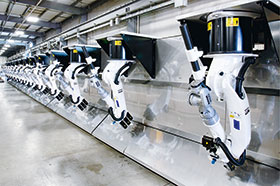
Another new development from Genesis is called the RoboPogo, a parts holding system with multiple articulated robots for components undergoing NSpect NDI testing. The RoboPogo solution sets itself apart because a single system can handle complex parts with multiple geometries, according to Whitney Moon, director Aerospace Division, Genesis Systems Group. “In 2017 Genesis took on a project that required the fixing of especially large parts for NDI. Doing this with traditional hard tooling, or manually adapted fixtures, would be very cumbersome and expensive,” he explained.
When holding parts that are between 3 and 30 metres long, such a solution is ideal because the articulated robots offer the required degrees of freedom to accommodate multiple part geometries, varied processes or applications, and can even enable dynamic repositioning during the ongoing inspection process. This is all precisely synchronised with the inspection robots of the NSpect series.
PC-based control simplifies system integration
“The applications we address with solutions like the RoboPogo are very complex, so we need automation systems that simplify our designs,” added Moon. “PC-based control systems are ideal because we can solve all tasks with one integrated platform from a single source.”
Genesis Systems integrates all functions into one Beckhoff CX2030 Embedded PC. This powerful device can run the PLC, safety PLC, motion control, HMI software, Windows OS and essentially any inspection software used by Genesis. “We use the CX2030 Embedded PC networked over EtherCAT on our systems with 20 robots, and we still only use about 25 percent of the CPU capacity,” explained Steckel. “Gathering all the NDI data and maintaining communication with 20 different Kuka robots within a millisecond is impressive, a testament to the value of PC-based control and EtherCAT.”
System programming and runtime is handled using TwinCAT 3 software, which simplifies deployment further. “The engineering environment accommodates structured text and object-oriented programming (OOP), which helps us grow the RoboPogo concept – as some systems have four robots, while others have as many as 20,” said Moon. Steckel added that OOP allows Genesis to implement existing code libraries in new systems: “To start up a new system, it is much easier just to set basic parameters rather than rewriting every line of code.”
EtherCAT cuts automation effort, boosts safety
On the networking side, RoboPogo and other NDI systems from Genesis communicate via EtherCAT, which is widely accepted by major robot manufacturers around the world. Genesis Systems was also an early adopter of EtherCAT P and One Cable Automation (OCA) technology. “As Genesis Systems began to work with more commercial aeroplanes and spacecraft, many applications extended for long distances,” said Moon. “Having to run the numerous cables involved back to enclosures is especially time-consuming and expensive in these cases. That’s why Genesis Systems Group uses EtherCAT P technology to route the power and EtherCAT network around entire fixtures without running lines way back to a main enclosure from each stand.” To reduce these cable runs, a large percentage of the I/O devices deployed by Genesis Systems are EtherCAT P Box and EtherCAT Box modules with IP67 protection, combined with servomotors and drives with One Cable Technology (OCT).
Integrated safety technology in the EtherCAT I/O system takes the form of TwinSAFE, which provides additional benefits. “Using TwinSAFE we’ve reduced our required number of traditional safety relays by 90 percent,” said Moon. “EtherCAT diagnostics also help boost the safety in our systems with built-in tools that can identify the exact location of any error from a device connected to the network.” TwinSAFE offers another benefit. “It also allows our safety zones to be reconfigurable on the fly. For example, we can have one established safety zone, where an operator can close a gate resulting in two different zones. Safe loading can happen in one zone, but the system continues running in the other. This was previously not possible with other PLCs and safety interfaces we worked with,” explained Steckel.
Significant savings with increased accuracy and productivity
“By adding OCA technology, Genesis can reduce NDI system cabling by up to 50% for drives, motors, sensors, actuators and pneumatic valves,” said Steckel.
“We also reduced cabling and installation time of all electronic components by 50%,” concluded Moon. “Additionally, we reduced the space needed in our electrical cabinets and enclosures by 20%.”
For more information contact Michelle Murphy, Beckhoff Automation, +27 11 795 2898, [email protected], www.beckhoff.co.za
| Tel: | +27 11 795 2898 |
| Email: | [email protected] |
| www: | www.beckhoff.com |
| Articles: | More information and articles about Beckhoff Automation |






© Technews Publishing (Pty) Ltd | All Rights Reserved
 printer friendly version