



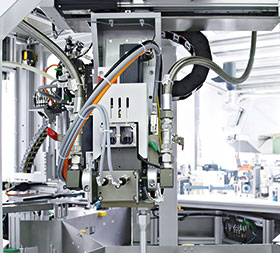
For more than 25 years, Scheugenpflug AG, based in Neustadt, Germany, has created machines and production lines for dispensing and metering equipment used in the automotive industry. High-end-automation – with PC-based control and CNC technology from Beckhoff – enables finely-tuned processes and production results with high repeat accuracy.
A recent example is a production line deployed for an automotive industry supplier that makes heaters for hybrid and electric vehicles. Ulrich Böhm, team leader of development control and drive technology at Scheugenpflug, explains: “In contrast to combustion engines, electric motors don’t generate heat that can be used for warming the passenger compartment, which means an electric heater is needed.”
Compact rotary indexing system for complex processes
The heater production line includes a rotary dispensing system, whose key elements include a loading station with sensors and a scanner, a plasma treatment station, the metering system and two further stations for joining and fastening the electronics housings. Scheugenpflug COO, Johann Gerneth, illustrates the specific benefits of the system: “We demonstrated that the complex, high-precision dispensing process can not only be realised as a conventional in-line solution, but also as a highly-compact rotary indexing system. A prerequisite for this was the application of high-performance, modular and flexible control technology from Beckhoff.”
Rainer Bröckl, team leader of mechanical engineering, describes the process sequence. ”Three different dispensing materials are introduced into the workpiece as it passes through the rotary indexing system three times. In other words, the dosing system applies sealing material at three different production stages and at different points. Before the sealing material is applied, the workpiece is subjected to plasma treatment, which involves cleaning and activation of the housing material to ensure the best-possible adhesion. In the joining station, the components are then assembled and secured with screw connections. Since all these sub-processes are interdependent, a rotary indexing system represents the ideal solution.”
Open control technology: the ideal basis for modular machine design
As specialists for customer-specific production machines and systems, Scheugenpflug is able to meet wide-ranging customer demands, especially in terms of automation technology. Gerneth explains: “A crucial factor for us was that we support a modular and customisable control platform from one source, enabling us meet as many customer requirements as possible. This was the only way we could develop the advanced machinery we have today. Modularity – in our electrical, mechanical and software components – was a prerequisite for our successful development from a small, special-purpose machine manufacturer into a comprehensive solution provider using modular product architectures.”
Böhm added: “We were particularly impressed by the openness of the PC-based control technology from Beckhoff and the company’s ongoing development and innovation. A good example is the high-performance drive technology, which enables us to integrate advanced servomotors in our machines. We generate substantial benefits from the engineering and design of One Cable Technology (OCT) here because OCT and the compact motors themselves help save valuable installation space. Moreover, a wide performance range is available for different requirements. In addition to AM8023 servomotors, we use the AM8533 version with increased rotor moment of inertia in the new dispensing system.”
CNC solution seamlessly integrated into standard control technology
TwinCAT CNC software ensures high-precision motion control in the dispensing system. Böhm describes the benefits of this CNC solution, which is seamlessly integrated into standard PC-based control technology: “In addition to system continuity, the PC-based CNC offers further advantages. On the one hand, it is very fast and efficient. On the other hand, we benefit immensely from the openness and flexibility of the CNC for functional extensions, which helps us achieve optimum application-specific functionality. Further benefits offered by TwinCAT include the powerful high-level interface (HLI) between the CNC kernel and the PLC, as well as the customisable parameter interface. The CNC parameter sets can be generated directly from the PLC project, enabling quick and flexible response to different requirements. In this way, the functionalities commonly requested by customers can simply be mapped as software modules, facilitating a high degree of parametrisation and more efficient software development.
“We use TwinCAT CNC to control measurement runs, for referencing and for user-specific functions, such as stop, hold and end of program run, for example. Additional features include transformations and a fifth motion axis, which relates to the tool or the dispensing needle itself, to apply the sealing material to sloping surfaces, for example. In addition to the functionality of a conventional 3-axis kinematic system, it enables rotation of either the complete tool or just the dispensing needle. The same principle applies to the plasma station, where just a different tool is used.”
The Beckhoff C6920 Industrial PC forms the core of the control system. Together with five two-channel Aservo drives and two single-channel Aunits – each equipped with a TwinSAFE card – it provides 12 dynamic and precisely-positioned servo axes via the servomotors. A total of 21 EtherCAT Terminals, 15 TwinSAFE Terminals, 21 EtherCAT Box modules and a TwinSAFE-EtherCAT Box provide comprehensive data acquisition and safety functionality.
In addition, the dispensing system offers a high degree of ergonomics for machine operators. Three CP3915 multi-touch control panels ensure that machine operators have access to all required information at any time from any angle. A 3-D visualisation of the dispensing contour can be used to check the results of the G-code programming before starting the actual dispensing process.
High-performance, open data communication
For Böhm, EtherCAT plays a key role in the control technology for several reasons: “EtherCAT has become established as a global standard, supported by numerous third-party suppliers. Moreover, the installation and electrical connections are straightforward. Another important factor is that the data transmission rates are very high, so we don’t have to worry about bandwidth capacity limits. A further benefit is the XFC technology, used for fast and precise tool measurement via the EtherCAT Box with two-channel timestamping function.”
According to Gerneth, the openness of the PC-based control technology and its communication capabilities are also central aspects from an Industry 4.0 perspective: “Our machines, with PC-based control technology, offer a high degree of flexibility and openness for interfacing with MES and ERP systems through the use of ADS, TCP/IP or OPC-UA communication, based on customer requirements. To enable traceability, universal communication is particularly critical in the automotive industry, and will become even more important in the context of Industry 4.0.”
For more information contact Michelle Murphy, Beckhoff Automation, +27 11 795 2898, michellem@beckhoff.com, www.beckhoff.co.za
| Tel: | +27 11 795 2898 |
| Email: | info@beckhoff.co.za |
| www: | www.beckhoff.com |
| Articles: | More information and articles about Beckhoff Automation |






© Technews Publishing (Pty) Ltd | All Rights Reserved
 printer friendly version