



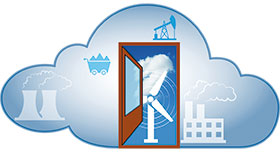
Partly in response to overall automation market conditions, but largely in response to evolving user challenges and requirements, major suppliers are expanding their automation-related service capabilities from project and engineering services through services for operations and maintenance. At the same time, the Industrial Internet of Things (IIoT) now provides an enabling platform for a new generation of IIoT-enabled remote support services. These span the plant lifecycle, from system engineering and design ‘in the cloud’, to data as a service for operating process plants.
These services can be quite sophisticated, involving complex analytical capabilities. On the other end of the spectrum, smaller ‘micro services’ are particularly easy to use and deploy and provide quick, easy to access information about key plant assets.
Suppliers are boosting their services business through acquisitions, partnerships, and by developing their own organic capabilities. The small to medium sized system integrators continue to be attractive targets for acquisition; but technology companies that enable traditional automation suppliers to provide an IIoT-based solution are also fair game.
To date, the IIoT message for manufacturers and other industrial organisations has focused largely on unlocking asset information to support the move toward condition-based and predictive maintenance strategies. Others see the IIoT as a path to help improve plant operations, operator training services, and more. This brings new concerns and questions regarding how the automation suppliers will provide remote services for asset management and monitoring, particularly around who owns the plant data and how that data gets shared. Cybersecurity is another primary concern.
However, despite these concerns, as owner-operators continue to struggle with the mass exodus of experienced talent in the workforce, automation suppliers have a prime opportunity to expand their respective service businesses with new service delivery approaches and capabilities. Owner-operators today are leveraging automation supplier-provided services to improve operational excellence and manage their migration and modernisation projects, as well as the increasing incursion of commercial IT technologies on the plant floor. As the market begins to recover and capital projects once again fill the pipeline, end-users will also require more services related to project management and engineering.
IIoT breathes new life into remote services
Automation suppliers are aggressively targeting IIoT-enabled services for remote monitoring and support of their customers’ plant assets. The ability of the IIoT to take large amounts of plant and asset data and put it into the cloud for analysis provides a relatively simple, secure, and cost-effective way for the technology suppliers’ experts to perform predictive analytics and provide guidance on how to improve plant operations, increase maintenance effectiveness, and avoid unplanned downtime.
The IIoT also makes it much easier to provide simple ‘micro services’ that provide real-time feedback on the condition of certain classes of plant assets, from sensors to control valves to pumps and heat exchangers. These micro services can also incorporate ‘lightweight’ analytics models that can present information in very simple ways on mobile devices. More complex and far reaching services can incorporate sophisticated models and analytical tools to optimise the performance of thousands of individual assets or classes of assets across an entire plant, multiple plants, or the entire enterprise.
Hybrid product/service model
These new types of IIoT-enabled services could not exist without the appropriate products and applications. The new breed of connected products go hand-in-hand with connected services. Services are going to become a much bigger component of the overall automation space, which previously focused largely on products and hardware. Some owner-operators are also moving to a model where they don’t even purchase the equipment. The equipment itself can be provided as part of an outcome-based service agreement that includes the software and monitoring services. Many industries have had success with this model, with GE’s airline ‘turbines as a service’ model probably the most well-known example.
Supplier service capabilities can reduce project costs
Owner-operators also face significant pressures to reduce the cost and complexity of automation projects. Here, next-gen services go hand-in-hand with a new generation of products, such as configurable and characterisable I/O and cloud-enabled system engineering environments that allow for late binding of the automation system software to the hardware.
Most major suppliers started building their main automation contractor (MAC) capabilities approximately a decade ago as it became clear that shrinking end-user resources and the EPCs’ diminishing focus on process automation were creating burgeoning demand for a single point of responsibility for all of the automation related aspects of a project. Today, the supplier MAC capabilities incorporate these new technologies and drastically reduce the time to project completion and minimise customisation costs associated with automation projects.
ARC’s recently updated Supplier Provided Automation Services report can provide a good starting point for owner-operators to evaluate supplier capabilities and market presence by industry, region, and types of products and solutions supported.
For more information contact Paul Miller, ARC Advisory Group, +1 781 471 1141, [email protected], www.arcweb.com






© Technews Publishing (Pty) Ltd | All Rights Reserved
 printer friendly version