At the August Technology Evening, Busisiwe Zikalala from WIKA gave a presentation titled: Sensor protection methods.
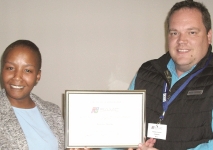
Juaandre Heyneke (right) thanks Busisiwe Zikalala for the presentation.
Process sensors come in many forms. In addition to the big four: temperature, pressure, level and flow, process sensors are used in many applications and are designed to take accurate measurements of the process. Busisiwe’s presentation covered the following issues:
Selecting a protective method: The amount of harmful exposure a sensor receives from the environment and harmful constituents in the measuring process depends on what is being sensed and the environment itself. Different packaging is required to cope with and survive the specific application. Two major considerations for protection are at the sensing element/transducer level or at the sensing module level.
Limiting factors of protective methods: The characteristics of a sensor developed for a given application are strongly determined by the requirements of the application and by existing sensor science and technology.
Thermowells: These protect sensors from damaging effects of the measured substance and allow removal of the sensor without compromising the process or environment. The well dimensions should provide sufficient strength to withstand stresses imposed by vibration, pressure and flow. However, sufficient immersion length is necessary for accurate temperature measurement and a large diameter increases response time. It is thus a question of striking the best balance.
Wake frequency: The biggest cause of thermowell failure is vibration due to flow of gas or liquid perpendicular to the thermowell (‘von Karmann effect’). The natural resonant frequency of the thermowell (function of mass, diameter and length) should be kept well below the wake frequency of the fluid/gas. If the two frequencies coincide, the resultant vibration can cause mechanical failure.
ScrutonWell design: This design reduces the amplitude of oscillation by more than 90%, which allows easy and fast installation of the thermowell without expensive and time-consuming rework on site. Thus no Wake frequency calculation required.
General sensor issues: Incorrect readings due to improper mounting; sensor drift due to build up; complete sensor failure; slow response due to dead time or blockage; and mechanical damage.
SAIMC: From the office of the CEO SAIMC
SAIMC
The INSPIRE Conference 2026 brought industry and academia together to explore advances in automation, AI, mechatronics and engineering. It also marked a new direction for the SAIMC as it works to build future-ready engineering talent and strengthen South Africa’s automation industry.
Read more...SAIMC Durban takes to the skies SAIMC
SAIMC
SAIMC Durban members went behind the scenes at the ATNS facility at King Shaka International Airport. The visit offered a fascinating look at the sophisticated technology and highly trained people keeping South Africa’s skies safe.
Read more...SAIMC: Durban branch SAIMC
SAIMC
At the SAIMC Durban branch September 2026 technology meeting, Werner Das of SICK explored how deep learning is moving industrial machine vision beyond rule-based systems into practical, everyday quality control on the factory floor.
Read more...SAIMC: From the office of the COO SAIMC
SAIMC
The recognition of mechatronics and computer engineering has created both an opportunity and a responsibility. Recognition means little without participation, professional registration without professional conduct, and technical knowledge without the mentorship, implementation and measurable value that industry needs.
Read more...SAIMC: Johannesburg branch SAIMC
SAIMC
Hendrik Spies of SICK Automation Southern Africa presented at the SAIMC Johannesburg Technology Evening on 12 August 2026, covering the digital journey from condition monitoring to predictive maintenance.
Read more...SAIMC: Durban branch SAIMC
SAIMC
The SAIMC Durban branch hosted S’yabonga Langa, systems performance engineer at eThekwini Electricity, who presented on applying substation automation to improve operational efficiency and service quality in modern power distribution networks.
Read more...SAIMC INSPIRE 2026 brings together industry, robotics and research
SAIMC
The inaugural SAIMC INSPIRE Conference will bring together the industrial automation, robotics and academic communities for two days of presentations, panel discussions and networking, and will explore developments in smart manufacturing, mining, robotics
While every effort has been made to ensure the accuracy of the information contained herein, the publisher and its agents cannot be held responsible for any errors contained, or any loss incurred as a result. Articles published do not necessarily reflect the views of the publishers. The editor reserves the right to alter or cut copy. Articles submitted are deemed to have been cleared for publication. Advertisements and company contact details are published as provided by the advertiser. Technews Publishing (Pty) Ltd cannot be held responsible for the accuracy or veracity of supplied material.










 printer friendly version