



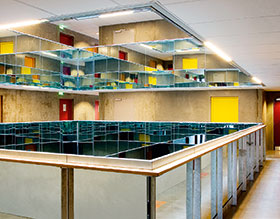
As part of a project to explore energy monitoring and smart metering technologies, Grundfos, Microsoft and Beckhoff equipped the ‘Grundfos Kollegiet’ student dormitory in the Danish town of Århus with intelligent PLC systems that transmit data to an energy monitoring system in Microsoft’s Azure cloud computing platform.
The dormitory is near the town’s port district and was built in accordance with the most advanced energy efficiency standards and equipped with the latest building automation technology. The energy monitoring system creates a database for optimising building operations. By including the residents of the ‘Living Lab’ in the project itself, the building owners can increase efficiency without reducing the residents’ comfort.
The first version of the Grundfos project was implemented as early as 2012 by installing a special server infrastructure and database in the building. As the monitoring cycles grew shorter and the amount of data needed for the seamless analysis of current and historical conditions larger, administering this IT infrastructure became increasingly expensive in terms of both money and personnel. Protecting access to all this data by various groups of users also required increasingly complex systems. In order to meet these requirements in the future, the parties involved decided in 2015 to redesign and integrate the server into a cloud-based system. As part of this change, Beckhoff’s highly scalable control technology demonstrated its flexibility, providing a seamless retrofit of the local building automation platform with a link to the cloud. The PLCs and I/O subsystems now transmit the energy data to the cloud-based system via TwinCAT IoT software, which is easy to configure and does not require programming.
Fast scalable infrastructure
Microsoft’s Azure cloud platform provides everything necessary to create a fast, scalable infrastructure for processing and storing the data. Access to the energy monitoring data from the ‘Living Lab’ can be defined and enabled for a wide range of user groups. The information is made available to the building’s residents and management, as well as to the research and technology department of Grundfos. By conducting various studies in connection with the residents and the building management system, Grundfos hopes to use the data to identify new usage options for its current products, as well as for new product offerings and business models. Also involved is the University of Århus, which analyses the connection between resident behaviour and energy usage.
The energy monitoring system is used to store and analyse all energy consumption data, as well as for managing alarms. The 12 floors of the building house 156 residential units, with 3000 sensors that collect energy data every three seconds and transmit them to the higher-level system. The sensors are linked to Beckhoff BC9191 bus couplers and CX9020 Embedded PCs. A central Beckhoff Industrial PC runs the TwinCAT IoT Data Agent software to collect sensor data via OPC-UA and functions as the gateway to Microsoft’s Azure cloud, in particular the Azure IoT Hub. The TwinCAT IoT Data Agent effectively separates the PLC systems from the cloud environment. Thanks to the publisher/subscriber mechanisms and communication via the Azure IoT Hub as a central message broker, there is no need for the devices and services involved in the communication process to divulge their addresses to each other. They communicate exclusively via the central broker, which handles all message addressing functions. From the perspective of the firewall placed in front of the gateway PC, the data communication provides an encrypted link for both transmitted and received messages, and the firewall makes it possible to completely block all incoming communications, thus preventing any unwanted access from the outside. This protects the residents’ personal data, the companies’ intellectual property and building operations from accidental or intentional manipulation.
Easy configuration and forwarding
The Data Agent’s graphical user interface (GUI) makes it easy to configure the sensor data for transmission to the Azure IoT Hub. Through various parameters, the administrator can also define when the transmission will be initiated: cyclically, when certain values change or when certain actions are executed. Internal buffering mechanisms also ensure that any missing sensor data will be transmitted after a power failure. If the connection fails, the TwinCAT IoT Data Agent records a timestamp. As soon as the connection has been restored, the Data Agent retrieves the missing data from its internal memory and sends it to the Azure IoT Hub.
As a central and secure message-based connectivity service, the Azure IoT Hub is responsible for receiving and forwarding the energy data to all participating cloud services within Microsoft Azure. Further analysis of the energy data is possible with the help of the Microsoft IoT Suite, which administers the devices and collects raw data for processing via the Azure SQL Data Warehouse and PowerBI. Azure Stream Analytics and Azure Machine Learning are used to detect anomalies. Special algorithms in these services recognise whether the values detected by the sensors over a specific period fall outside the normal range or could possibly not be recorded. If such an event occurs, the system issues an alarm via email.
In addition, the various user groups such as the student residents can access the energy data via a special programming interface to develop their own apps or algorithms, as part of a project or to meet college course requirements, for example. The programming interface, which includes a function for retrieving historical energy data, is based on the Azure Service Fabric. The data is protected via Azure’s Active Directory and Application Insights services, which authenticate the various user groups.
As this project demonstrates in impressive detail, the Data Agent can be used to easily retrofit older, existing control systems with new technologies and connect them to the cloud. This is all possible without having to modify the actual TwinCAT automation project, protecting the investments made in existing systems. Using cloud-based services also makes it possible to flexibly adapt systems to changing needs without having to invest in your own hardware or software, which also significantly reduces operator costs.
For more information contact Kenneth McPherson, Beckhoff Automation, +27 (0)11 795 2898, kennethm@beckhoff.com, www.beckhoff.co.za
| Tel: | +27 11 795 2898 |
| Email: | info@beckhoff.co.za |
| www: | www.beckhoff.com |
| Articles: | More information and articles about Beckhoff Automation |






© Technews Publishing (Pty) Ltd | All Rights Reserved
 printer friendly version