



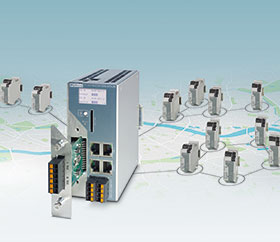
Phoenix Contact’s new Ethernet extender system allows managed and unmanaged extenders to be connected with, for example, a control centre over a distance of up to 20 kilometres. The devices cater to the needs of a great variety of industrial sectors and offer many advantages including ease of use as well as plug-and-play operation.
In scenarios that involve bridging wide distances via Ethernet, many users first think about using radio communications technology or fibre optic cables. However, setting up IP networking after the fact can quickly turn into a financing nightmare. While data transmission based on mobile communications generates regular monthly fees, laying new cables may require specialist contractors and often takes a long time to implement. Therefore, it makes sense to consider another alternative altogether – the combined use of existing self-owned copper wires and Ethernet extenders. This solution is as simple to realise as it is economically viable.
Wide reach of up to 20 kilometres
At present, various extender systems are available based on different technologies. One of these technologies is called VDSL (very high speed digital subscriber line). It is used both for on-premise cable networks as well as for setting up Internet access to the public telephone network. In these scenarios, VDSL is perfect, as it provides a high transmission rate of 100 Mbps. However, the receiving end must be located within a radius of 3000 metres. SHDSL-based (symmetrical high speed digital subscriber line) solutions are also popular, but their use is not allowed within the public communications grid. SHDSL offers a high reach of up to 20 kilometres and supports virtually all topologies – including point-to-point, line, star and ring arrangements.
For several years now, Phoenix Contact has been selling a device of this kind that has proven highly successful, not least owing to its easy setup via plug-and-play. This is particularly advantageous for applications that rule out the use of specialist technicians. For example, it enabled a farmer in southern Germany to wire the network for his newly installed biogas facility all by himself, including laying the cables and setting up the Ethernet extender.
Suitable for use in rugged industrial surroundings
While network systems located on the operator’s own soil predominantly need to provide easy handling, the main considerations in other areas are industry-grade ruggedness and interference immunity. This includes deployment in the railway sector, where the heating systems for rail switching are controlled via Ethernet extenders. If the heating systems were to fail, this could have disastrous consequences during the cold season.
A chemical park in Dormagen, Germany, was also looking for a solution that offers both simplicity and a robust design. The purpose of the system was to interconnect various data concentrators installed throughout the 360-hectare area.
Additionally, the required communications and surge protection modules were to be sourced from the same manufacturer so that when voltage surges arise, the components would be ideally matched in order to minimise system downtime. This is why the established SHDSL transmission system is being complemented with devices from the Trabtech range of surge voltage protectors.
Ultimately, the reasons for choosing this solution were to ensure failsafe Ethernet transmission and the ability to non-reactively expand the application during ongoing operation. This is achieved through the Ethernet extenders’ plug-and-play-compatible design and their redundant ring function.
Easy handling via plug-and-play
Economic considerations play a big part in why even some cities and municipalities are thinking about setting up Ethernet networks if they can find a cost-efficient yet reliable solution. With the deregulation of the power sector, public utility providers are under increasing competitive pressure. Also, market communication generates ever-growing data volumes, while legal requirements such as the German Energy Act force them to make new investments. This caused one public utility based in the Weserbergland region to explore some new possibilities.
“In business, I follow the same set of principles as in my private life,” says Frank Jakob, head of network control technology and energy data management at Stadtwerke Bad Pyrmont, in reference to the unrelenting cost pressure experienced by cities and municipalities. Thanks to his foresight, Stadtwerke Bad Pyrmont already sounded out the market three years ago to find a solution that would allow the public utility to leverage synergies. The challenge was to create a single communication system for handling energy management data as well as process data for network control. Moreover, easy operation was defined as one of the key decision factors.
Central monitoring from the control centre
When looking at the Bad Pyrmont power grid, it becomes apparent that the water infrastructure, gas distribution and heat and power generation are not always located in close proximity to the centralised control and communication system, but rather tend to be several kilometres removed. In the 1980s, control and monitoring tasks were still handled using a centralised control and communication system. Jakob and his team realised early on that a connection failure between the central system and substations would cause the entire substation to go offline – and this risk increased as the network grew in size. For this reason, the Bad Pyrmont authorities decided as early as 2003 to operate the substations using local control systems.
In order to keep downtimes and personnel costs down over the long term, the city worked out a local control concept and implemented this in several steps. The new approach is based on local control systems, with the individual substations still being monitored from the central control centre. So far, a serial protocol based on IEC 60870-5-101 has been used for this purpose. However, a clear trend toward IP/Ethernet communication has been emerging in recent years. Reasons for this include a steady increase in data volume and the slowing effect that this has on serial data exchanging.
Laying fibre optic cables generates excessive costs
Today, the central control centre monitors the local stations mostly via TPC/IP using IEC 60870-5-104. The entire communication network currently extends over roughly 115 kilometres. Modern IP transmission and the growing power network soon presented the public utility with additional challenges. For example, Ethernet communication has become much faster but still requires specially shielded Ethernet cables that can only cover distances up to 100 metres. “Fibre optic cables surely would have made for a good solution due to the fast transfer rate they offer,” says Thorsten Hamann, network control technology and energy data management technician with Stadtwerke Bad Pyrmont. “But especially with a view to future developments, we were not able to determine how costly this would have become. It would have involved laying the fibre optic cables from scratch, which is very expensive because of the high associated material and personnel costs.”
More and more private electricity producers feed their excess power into the public grid of Bad Pyrmont. In order to maintain a stable grid, the public utility must monitor this carefully and take corresponding meas-ures where needed. To this end, Stadtwerke Bad Pyrmont has consistently opted for modern technology when retrofitting or setting up new installations. In the area of monitoring private contributors, for example, they have been using unmanaged Ethernet extenders from Phoenix Contact since 2014. Approximately 30 kilometres of SHDSL pathways have been installed to date. In addition, it became apparent that less than a third of the maximum transmission rate provided by the SHDSL line – 15 Mbps – is needed for capturing the monitoring data.
Combined operation of unmanaged and managed Ethernet extenders
The managers of the public utility were also quite taken by the easy handling of the unmanaged Ethernet extenders. “Thanks to plug-and-play and the ability to expand the system during ongoing operation, we were able to install the Ethernet extenders ourselves,” says Hamann. Communication is implemented using phone lines, some of which already exist. With the exception of gas distribution, the public utility is by now deploying SHDSL in all its other areas as well. The network is being expanded step by step alongside the development of IEC 60870-5-104 as the communications protocol of choice.
One of Stadtwerke Bad Pyrmont’s next big projects is a system for monitoring the 10 kV medium-voltage grid. Jakob and his team are planning on using the managed Ethernet extenders that Phoenix Contact presented at Hannover Messe 2016. These new devices will facilitate even better monitoring and transparency of the transmission network. They can also be added to the network via plug-and-play and they can provide diagnostics for all pathways and connected Ethernet extenders based on their IP addresses.
Besides on-site diagnostics using the built-in display, this opens up many other possibilities to the operator. Unmanaged and managed Ethernet extenders can be combined within a network to automatically send status, warning, and error messages to the control centre via SNMP (Simple Network Management Protocol). Such an orchestrated use of new and existing devices goes a long way toward simplifying the system and reducing the costs associated with it.
For more information contact Sheree Britz, Phoenix Contact, +27 (0)11 801 8200, sbritz@phoenixcontact.co.za, www.phoenixcontact.co.za
| Tel: | +27 11 801 8200 |
| Email: | sbritz@phoenixcontact.co.za |
| www: | www.phoenixcontact.co.za |
| Articles: | More information and articles about Phoenix Contact |






© Technews Publishing (Pty) Ltd | All Rights Reserved
 printer friendly version