



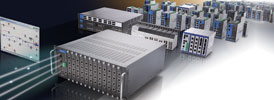
The installation of an Ethernet network in process automation is a complex issue. When planning a new network, it is important to assess the specific needs of each network layer and then select the appropriate components. They must provide the network infrastructure with the best possible performance and scalability, making it future-proof across all layers, from the core backbone layer (layer 3) to the distribution or routing layer (layer 2) to the network edge (access layer).
Moxa’s broad switch portfolio facilitates three-layer hierarchical network deployment – from top to bottom and from the core layer to the distribution and edge layers. This level by level design helps customers evaluate the specific demands of each layer, making it easier to select devices that provide optimum infrastructure performance and scalability. These edge-to-core Ethernet switches have exceptionally high reliability as well as extensive power and network redundancy for non-stop operation.
Core switches
Core switches operate at the upper end of the network hierarchy. They serve as a high performance backbone for the network and are responsible for connecting to the data centre, the heart of the data collection, storage and analysis function.
Core switches deliver converged data, video and voice signals for demanding network requirements. They provide layer 2 and layer 3 switching and routing intelligence to ensure full wire-speed performance , as well as scalability for critical networking applications such as those found in process automation. Moxa’s ICS-G7000 series of full Gigabit modular industrial switches leads the way in easy application for large scale industrial networks.
The first Industrial Ethernet switch with four 10 GbE ports
Moxa’s ICS-G7000 switches provide support for up to four 10 GbE uplink ports and up to 48 Gigabit connections. Working at the top of the hierarchical network, they serve as the high-speed backbone of the network to enable end-users to connect with the data centre.
With a rack mount form factor, they are available in 4U modular and 1U stackable configurations with up to 52 ports. This wide selection of port configurations allows maximum flexibility and cost-effective scalability for most mid-sized and large-sized networks. To reinforce the scalability, the switches incorporate Moxa’s turbo ring and turbo chain technology, which enables highly expandable multi-ring topologies with self-healing in less than 20 ms to ensure high availability. To provide the exceptionally high performance required in process automation, the ICS-G7000 core switches are equipped with highly resistant mechanisms and functions. These include fanless energy saving operation; 50 ms recovery time; dual imaging; a hot-swap feature; and isolated redundant power inputs with a universal 110/220 VAC power supply range.
Distribution switches
Distribution switches forward data packets from multiple access switches to core layer networks. Typically, a distribution switch needs full mesh connectivity and intelligent routing and switching between segmented VLANs. Moxa offers a full suite of high density Gigabit Ethernet switches in both DIN rail modular and easy-to-scale rackmount form factors, both of which deliver port-to-port service between multiple layer networks with resilient connections and L2/L3 switching functions. These switches are capable of high Gigabit data rates yet remain flexible and easy to deploy thanks to high modularity. The layer 3 switch models can efficiently consolidate traffic from subnets or VLANs into a core backbone.
Distribution switches usually have Gigabit and/or Fast Ethernet ports and support full line-rate Gigabit Ethernet as well as redundancy. Advanced built-in management and security features enable reliable, safe operation. Power over Ethernet (PoE) distribution switches are available which facilitate hard-to-wire applications with a total of 120 watts of stable and cost-effective electricity over an Ethernet cable for PoE powered devices.
Edge switches
Moxa’s compact, cost-effective edge switches operate on two different network layers, providing reliable, safe connection of terminals to the network for optimal port-to-port connectivity. They cover a wide range of application scenarios: from entry-level unmanaged switches to advanced managed switches, Fast Ethernet to Gigabit Ethernet, and five to 19 ports. Featuring a DIN-rail form factor, the switches are designed to withstand harsh weather, with a temperature range of -40 to 75°C.
Network intelligence
Moxa’s advanced network management software system MXview can centrally manage up to 2000 networked devices and can automatically configure and manage the hardware. This creates a multi-layered live topology map of the network and simplifies diagnosis and troubleshooting.
For optimum network performance and reliable, safe and easy operation, the user-friendly MXview is designed to analyse, monitor, configure, and troubleshoot remote network connections formed by Moxa’s managed Ethernet switches, wireless AP/bridge/client, and other SNMP networked devices. MXview visualises the physical wiring map of the network via a simple, user-friendly web browser for remote management. This allows the user to track real-time network status, identify failure points quickly and reduce the troubleshooting response time of complex and critical network operations.
With Moxa’s SNMP Inform, the user is reliably informed of events in advance and can react quickly. The network management software uses OPC to convert SNMP traps into OPC tags that can be seamlessly integrated into OPC compatible HMI/SCADA systems. This powerful function allows an HMI to be linked to the control network to act as a remote monitoring tool for network traffic and status.
Network efficiency
Future-proof networks are characterised by high quality components. Moxa’s switches have been certified as IPv6 Ready by the global IPv6 Forum and can support IPv4 and IPv6 dual stack service to offer better addressing and security in large networks, thus protecting the investment.
Another factor contributing to efficiency is seamless integration with existing automation applications. Moxa switches support Modbus/TCP for classical SCADA/HMI integration as it is widely used in process automation. EtherNet/IP compatible Rockwell devices and Profinet compatible Siemens devices are also supported, as well as the IEEE 1588 PTP time protocol for time synchronisation.
Moxa’s managed Ethernet switches support many other useful features available for modern edge-to-core switches. These include IGMP snooping and GMRP for filtering provide multicast traffic; IEEE 802.1Q VLAN and GVRP protocol to ease network planning; Quality over service (QoS, IEEE 802.1p/1Q) and TOS/DiffServ for improved determinism; RMON for efficient network monitoring; and port trunking for proactive optimum bandwidth utilisation. In addition the IEEE 802.3ad link aggregation protocol (LACP) provides flexible network connections and a redundant path for critical devices; SNMPv1/v2c/v3 supports different levels of network management; and DHCP Option 82 allows a replacement device to be assigned the same IP address as the previous one to reduce system downtime and maintenance efforts.
Integrated cyber security
Security is one of the most important factors for protecting the structure of mission-critical infrastructure networks. Moxa switches are compatible with many of the security features which are available to protect the network against unauthorised external access. These include Radius, TACACS+, IEEE 802.1X, HTTPS and SSH for port-based authentication. The Port Lock function ensures access to authorised MAC addresses. In exceptional cases there is automatic alerting via email or relay output. At the network level management, SNMPv3 provides security for SNM encryption, message integrity and authentication, while VPN/firewall/NAT protects critical devices within the network.
Moxa’s managed switches offer a seamless integrated network security solution to secure industrial network data.
For more information contact Rob Wright, RJ Connect, +27 (0)11 781 0777, [email protected], www.rjconnect.co.za
| Tel: | +27 11 781 0777 |
| Email: | [email protected] |
| www: | www.rjconnect.co.za |
| Articles: | More information and articles about RJ Connect |






© Technews Publishing (Pty) Ltd | All Rights Reserved
 printer friendly version