Control loop: Case History 149 - Classic examples of badly optimised loops.
July 2016
Editor's Choice
Problems on a flow control loop
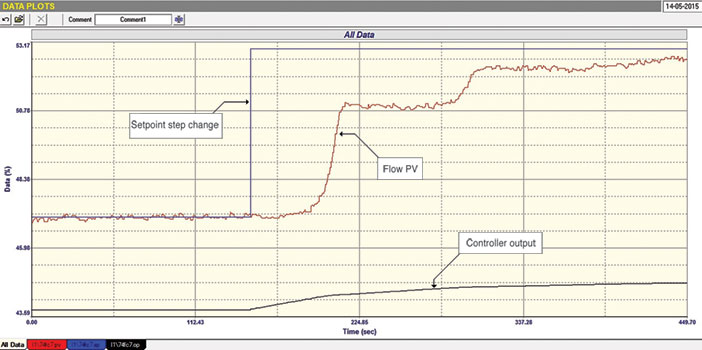
The first example is that of a flow control loop on a liquid flow. Figure 1 shows a closed loop test with a step change of setpoint.
Figure 1.
Three problems immediately stand out:
1. The tuning is terribly slow.
2. The valve is sticking badly. It takes a long time to move then sticks several more times as it opens.
3. The valve is probably extremely oversized which can be seen by the huge step in PV as compared with small step in the controller output.
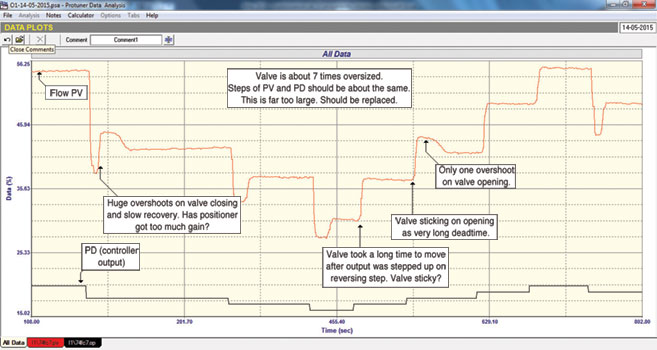
Figure 2 shows the open loop stepping test. This confirms deductions 2 and 3 made from the closed loop test. In particular it shows that the valve is at least 7 times oversized. In addition another extremely serious problem has been uncovered, namely that the valve overshoots really badly, particularly in the closing direction, and the positioner takes an extremely long period to correct the overshoot. These factors make good control almost impossible.
Figure 2.
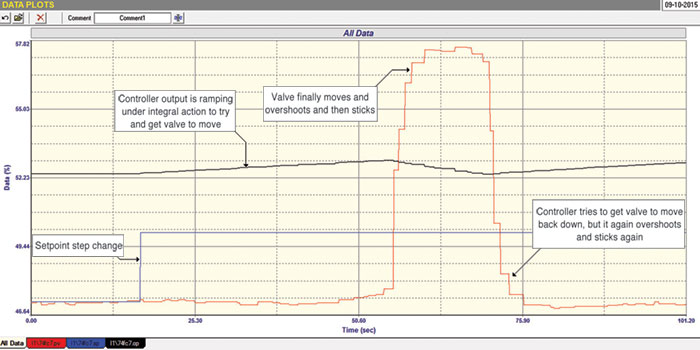
This is confirmed in Figure 3 which is closed loop and shows a setpoint step change made with much better tuning, which was kept as slow as possible to try and overcome the problems of sticking and overshoot. However, it did not help as the valve stuck and then hugely overshot. The controller tried to bring it back, but the same thing happened in reverse and the valve is now in what could be described as a terribly slow stick-slip cycle.
Figure 3.
Problems on a pressure control loop
The second example is an interesting pressure control loop. The operators were always complaining about this loop, which they had to try and control in manual as it did not control in automatic.
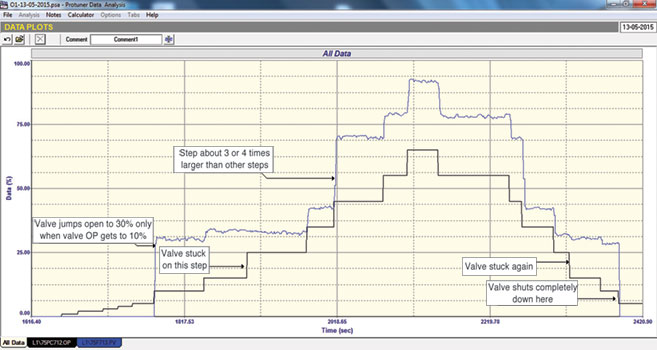
A closed loop test with the existing tuning parameters was tried, but nothing seemed to happen when a setpoint step change was made. Very fortunately there was a flowmeter in series with the valve, which allowed us to examine the valve performance. The open loop stepping test showing the flow versus the controller output is shown in Figure 4.
Figure 4.
The following extremely serious valve problems were revealed:
1. There is no valve movement until the controller output gets above 30%.
2. The valve is very sticky.
3. When making the same size steps on the controller output the valve response is very erratic and non-repeatable with big movements in some places, and small in others. At times it didn’t move at all. This makes any reasonable control impossible.
However, further testing of the actual pressure loop showed it to have extremely slow dynamics, and in fact crude but reasonable pressure control was obtained, by running the loop with “ON/OFF” control, that is with the valve either fully open or closed. This is equivalent to controlling the temperature in a bath, as opposed to “throttling” control when controlling the temperature of a shower.
Michael Brown is a specialist in control loop optimisation with many years of experience in process control instrumentation. His main activities are consulting, and teaching practical control loop analysis and optimisation. He gives training courses which can be held in clients’ plants, where students can have the added benefit of practising on live loops. His work takes him to plants all over South Africa and also to other countries. He can be contacted at Michael Brown Control Engineering cc, +27 (0)82 440 7790, [email protected], www.controlloop.co.za
Further reading:
SEW-EURODRIVE’s expanded local engineering capability
SEW-EURODRIVE
Editor's Choice Motion Control & Drives
At Electra Mining Africa, SEW-EURODRIVE demonstrated how its expanded local engineering capability, digital technologies and lifecycle support strategy help customers improve reliability, energy efficiency and total cost of ownership across the full life of their drive assets.
Read more...
Calcamite partners with Schneider Electric and 4Sight for smart water management
Schneider Electric South Africa
Editor's Choice
Schneider Electric, AVEVA and 4Sight OT Automation are helping South African wastewater specialist, Calcamite, digitalise its modular treatment plants through a scalable edge-to-cloud automation platform, with the award-winning Gourikwa pilot now scaling to hundreds of remote sites.
Read more...
Paper might carry the message but pressure carries the process
VEGA Controls SA
Editor's Choice
Accurate pressure measurement is critical throughout pulp and paper production, from chemical pulping to steam drying and wastewater treatment. VEGA’s VEGABAR transmitter range offers South African mills robust, precise monitoring for these demanding conditions.
Read more...
BMG integrates conveyor drive technology to improve mining reliability and availability
Bearing Man Group t/a BMG
Editor's Choice
BMG supplies engineered turnkey drive packages for belt conveyors and feeders in mining and bulk materials handling, bringing the motor, drive, couplings, gearbox, lubrication and condition monitoring together as one integrated system to protect conveyor availability.
Read more...
Economy drive system closes the drive gap in the entry-level segment
Beckhoff Automation
Editor's Choice Motion Control & Drives
Beckhoff has launched an economy drive system pairing its new AX1000 servo drive and AM1000 servomotor with the AF1000 dual-axis variable frequency drive on a shared EtherCAT platform, targeting series machines and price-sensitive markets without sacrificing TwinCAT integration or functional safety.
Read more...
South Africa’s space balls
Editor's Choice News
South African engineers are preparing to take low-frequency radio astronomy to the Moon with three locally developed B.A.L.L.S. spheres aboard China’s Chang’e-8 mission. This could pave the way for a 55-antenna lunar array and marks another step in the country’s growing space engineering capability.
Read more...
Practical tips to build a successful engineering career
Editor's Choice
Award-winning civil engineer, Tinashe Mukalela of AvenirHoldings shares ten practical tips for young engineers navigating a competitive job market, from professional registration and mentorship to emotional intelligence and leadership development.
Read more...
Why mining operations need local lightning early warning
Senseca
Editor's Choice Electrical Power & Protection
Lightning can develop into a serious mining hazard before the first local strike, leaving crews little time to stop work and reach safety. Local early-warning technology can provide valuable lead time, allowing mines to connect developing storm conditions to defined trigger actions that protect people, explosives and equipment.
Read more...
XPlanar aids innovation in laser processing
Beckhoff Automation
Editor's Choice Motion Control & Drives
Aalborg University is among the first in the world to test Beckhoff’s XPlanar intelligent transport system in advanced laser processes, achieving micrometer-precise workpiece positioning and dramatically shorter lead times compared with traditional tool-based manufacturing.
Read more...
The wireless route to safer, more efficient mining operations
Emerson Automation Solutions
Editor's Choice Sensors & Transducers
Modern wireless level measurement technologies are helping mining operations improve process control, increase safety and reduce installation costs. Emerson’s Rosemount 3408 wireless non-contacting radar level transmitter uses 80 GHz frequency-modulated continuous wave radar with HART communication to reach remote assets where cabling is impractical.
Read more...











 printer friendly version