Inline analytical technology for liquor process control
May 2019Analytical Instrumentation & Environmental Monitoring
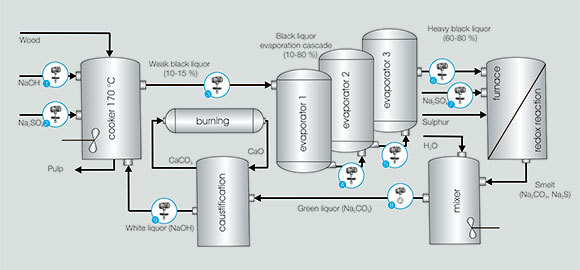
One of the most important processes in the pulp and paper industry is the alkaline sulphate process, where lignin is separated from the fibrous material. Recycling of the chemicals used is vital for environmental and economic reasons. During the recycling process, black liquor will be concentrated and burnt to remove organic materials like lignin. This recovery process generates – in addition to energy – a smelt with high salt content, the base material for green liquor. Through causticising with lime, the sodium carbonate in green liquor is converted to sodium hydroxide and reused in white liquor for the next pulping process. LiquiSonic analysers ensure each process step is inline monitored and set in an optimal way. The analyser system provides optimised quality control and productivity, especially through fast process monitoring during liquor recycling.
LiquiSonic measuring technology in the sulphate process
Black liquor
The base materials in the kraft or sulphate process are wood chips and alkaline cooking liquor, which mainly consists of recycled white liquor, hot caustic soda (NaOH) and Na2SO4. The cooking at typically 170°C is also known as the delignification process, where lignin is separated from the fibrous material and pulp. The resulting black liquor contains NaOH, Na2SO4, lignin, carbohydrates and hemicellulose. In multiple black liquor recovery evaporators, the dry matter is increased from 10-15% up to 70%. LiquiSonic provides robust and accurate concentration monitoring and enhances operational safety due to high-water content that interrupts the burning process. PFA coated flange sensors work maintenance and drift free with no cleaning adaptor needed, even for alkaline hot liquids with high coating tendencies.
Green and white liquor
In the black liquor furnace process an inorganic salt-rich smelt is formed. The molten salts sediment on the ground of the recovery boiler and must be diluted by water or weak white liquor, resulting in green liquor, rich in Na2S and Na2CO3. Green liquor is often collected in a separate stabilising tank before it is clarified. During clarification of green liquor, dregs must be removed. Clarified green liquor is used for causticising, a recycling step, where CaO lime is used to regenerate NaOH for white liquor. LiquiSonic provides quality improvement, like real-time green liquor concentration monitoring for optimally regulated lime dosage in causticizing. This increases the recovery process efficiency, lime burning recycle numbers and white liquor quality.
Advantages of LiquiSonic technology
• Robust and maintenance-free even for hot (up to 200°C) and high coating liquors.
• Layer-free, no steam wash system necessary.
• No frequent mounting and dismounting for maintenance and cleaning.
• Reduced laboratory costs.
• Highly accurate inline concentration measurement of green, black and white liquor (up to 0,1 wt%).
• Ideal lime dosage in causticising.
• Enhancement of operational safety.
For the high demands that are placed on sensor technology in the pulp and paper industry, LiquiSonic analysers have been built to withstand the harsh working environment and can be adapted to existing process conditions.
Getting the chemistry right
Analytical Instrumentation & Environmental Monitoring
Grace’s European production site has relied on analogue compression load cells from Minebea Intec for decades, with the long-proven measurement concept now serving as the reference for new silo projects as the company expands its capacity.
Read more...Why measurement matters in smelting Endress+Hauser South Africa
Analytical Instrumentation & Environmental Monitoring
South African smelters returning to operation after energy constraints face new demands for tighter control, better visibility and environmental compliance. Endress+Hauser explains how modern measurement technology supports safer, more efficient furnace operation and local beneficiation.
Read more...Sun tracking with pinpoint precision Senseca
Analytical Instrumentation & Environmental Monitoring
Senseca has introduced the SEMS-2000 solar energy measurement system, a 2-axis solar tracker with pinpoint sun-pointing accuracy that automatically monitors direct, global and diffuse irradiance for unattended outdoor solar installations.
Read more...AMETEK expands 993X gas analyser series with explosion-proof enclosures
Analytical Instrumentation & Environmental Monitoring
AMETEK Process Instruments has added ATEX and IECEx Zone 1-certified explosion-proof enclosures to its 993X series of gas analysers, enabling reliable installation in Zone 1 hazardous locations where purge gas is unavailable.
Read more...Why medical device leak testing matters for South Africa's MedTech future ATEQ South Africa
Analytical Instrumentation & Environmental Monitoring
As South Africa works to grow local medical technology manufacturing, non-destructive leak and flow testing is becoming a strategic quality assurance tool, helping manufacturers verify device integrity, meet regulatory requirements and improve production efficiency.
Read more...Moving forward with reverse osmosis
Analytical Instrumentation & Environmental Monitoring
Rising water costs and pressure on infrastructure are changing the way industries view reverse osmosis. G-Chem Aquacare is developing tailored, containerised solutions that make the technology more accessible for South African industry.
Read more...Meteorological data logger with up to 32 analogue sensors Senseca
Analytical Instrumentation & Environmental Monitoring
Senseca has introduced its advanced data acquisition system for environmental monitoring, which has a universal data logger for up to 32 analogue, pulse and smart digital sensors.
Read more...Importance of gas analysis in the petrochemical industry Elemental Analytics
Analytical Instrumentation & Environmental Monitoring
Gas analysis plays a critical role in petrochemical operations, supporting process optimisation, product quality and plant safety. As an experienced and expert gas analysis supplier, Elemental Analytics can provide the correct analyser and sample system package to meet individual plant requirements.
Read more...Fully integrated standalone thunderstorm warning system Senseca
Sensors & Transducers Analytical Instrumentation & Environmental Monitoring
Senseca South Africa has introduced its BTD-1 fully integrated, standalone thunderstorm warning system, which detects lightning by monitoring the background quasi-electrostatic field. The system can generate alerts before the first lightning strike, with a detection raterange of up to 83 km.
Read more...Environmental monitoring with testo Saveris 1
Analytical Instrumentation & Environmental Monitoring
The testo Saveris 1 environmental monitoring system has been in continuous use since 2010 at Jungbunzlauer, a biotechnology company in Germany, providing seamless temperature and humidity data for audit-ready, GxP-compliant processes across laboratories, warehouses and production areas.
While every effort has been made to ensure the accuracy of the information contained herein, the publisher and its agents cannot be held responsible for any errors contained, or any loss incurred as a result. Articles published do not necessarily reflect the views of the publishers. The editor reserves the right to alter or cut copy. Articles submitted are deemed to have been cleared for publication. Advertisements and company contact details are published as provided by the advertiser. Technews Publishing (Pty) Ltd cannot be held responsible for the accuracy or veracity of supplied material.










 printer friendly version