



Various techniques and devices have been used throughout time in an effort to measure and compare temperature conditions. For example, fire and ice are hot and cold elemental extremes. Boiling water is a fixed temperature as is melting ice.
In the early days of ceramics manufacture the craftsman used materials which indicated through deformation that a certain higher temperature had been reached. A baker on the other hand, used a piece of paper: hotter ovens turned the paper brown faster. It was known that specific materials changed state at set temperatures, and this is what temperature measurement was based on.
It was not until the development of the first thermometers, a little over 400 years ago, that actual temperature conditions could be measured exactly. Today, thermocouples are used to produce a temperature-dependent voltage through the thermoelectric effect. Commercial thermocouples can be used in a wide range of temperature applications, but their main limitation is accuracy, they have to be in contact with the high temperature and system errors of less than 1°C are sometimes difficult to obtain.
Infrared extends the possibilities
The discovery of infrared (IR) radiation by the physicist Wilhelm Herschel at the beginning of the 19th Century opened up new possibilities for measuring temperature without contact, thus without affecting the object being measured and the measurement device itself.
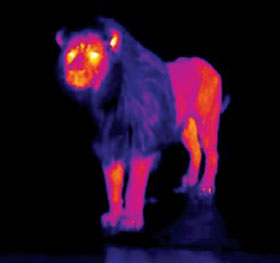
An IR thermometer can be compared to the human eye. The lens of the eye represents the optics through which the radiation (flow of photons) from the object reaches the photosensitive layer (retina) via the atmosphere. Simple single point IR temperature measurement has evolved into units that now display thermal images, used in applications as diverse as monitoring the temperature of molten steel in real time, to deciding if a batsman is out or not based on a ‘hotspot’ on the bat.
The advantages of IR thermometers include: fast measurements (milliseconds), measurements on moving or difficult to reach objects, temperatures in excess of 2000°C and feedback-free-measurement.
To assure accurate noncontact IR temperature measurement the following should be kept in mind:
• Distance to target (spot) ratio.
• Field of view.
• Environmental conditions.
• Ambient temperatures.
• Emissivity.
Distance to target (spot) ratio: The optical system of an IR sensor collects energy from a circular measurement spot and focuses it on the detector. Optical resolution is defined by the ratio of the distance from the instrument to the object, compared to the size of the spot being measured. The larger the ratio the better the instrument’s resolution allowing smaller spot sizes to be measured from greater distances. A recent innovation is the addition of a Close Focus feature, which provides accurate measurement of small target areas without including unwanted background temperatures.
Field of view: Make sure that the target is larger than the spot size the unit is measuring. The smaller the target, the closer the instrument should be to it. When accuracy is critical make sure that the target is at least twice as large as the spot size.
Environmental conditions: Watch for environmental conditions in the working area. Steam, dust, smoke, etc, can prevent accurate measurement by obstructing the unit’s optics. Noise, electromagnetic fields, or vibration are other conditions that should also be considered before installation begins. A protective housing, air purging and/or water cooling can protect the sensor and ensure accurate measurements. For that reason some Raytek products, such as Thermalert and Marathon series sensors, include air purging.
Ambient temperature: If the thermometer is exposed to abrupt ambient temperature differences of 20 degrees or more, allow it to adjust to the new ambient temperature for at least 20 minutes. Raytek fixed-mounted sensors are specified for performance within certain ambient temperature ranges. For example, the Raytek MIH can withstand ambient temperatures (without water or air cooling) up to 180°C. For high ambient temperatures, Raytek offers air cooling and water cooling options, as well as accessories such as a Thermojacket.
Emissivity: The measure of an object’s ability to emit infrared energy. Emitted energy indicates the temperature of the object. Emissivity can have a value from 0 (shiny mirror) to 1.0 (blackbody).
For more information contactR&C Instrumentation, 086 111 4217, [email protected], www.randci.co.za
| Tel: | +27 11 608 1551 |
| Email: | [email protected] |
| www: | www.randci.co.za |
| Articles: | More information and articles about R&C Instrumentation |






© Technews Publishing (Pty) Ltd | All Rights Reserved
 printer friendly version