


Electrical Power & Protection


Africa’s largest rotor pole ­refurbishment

July 2017 Electrical Power & Protection

In the largest repair of this nature in Africa, Marthinusen & Coutts recently refurbished 11 of the full set of 14 rotor poles of Motor Generator Unit Three at Eskom’s Ingula Pumped Storage Scheme on the Drakensberg escarpment. The rotor poles were extensively damaged during a fault condition at the station, and the return to service of the unit was of national importance.

Working closely with stakeholders, an extensive local programme of testing, dismantling, inspection and repair was conducted by Marthinusen & Coutts within extremely tight time-frames to accommodate the criticality of the project. A technical audit confirmed that facilities at the company’s 8000 m² main workshop in Cleveland, Johannesburg, and its 12 000 m² Power Generation division in Benoni, were up to the daunting task. All 14 main rotor poles were then collected from Ingula Pumped Storage Scheme and dispatched to the Benoni works. Each pole weighed 12 tons, with the coil alone weighing in at over two and a half tons.

It was vital that Marthinusen & Coutts determined not just the electrical status of the windings, but the health and physical integrity of each entire rotor pole (body and coil). They were therefore subjected to insulation resistance and inter-turn insulation tests, comprising both impulse and power frequency inter-turn insulation tests. Extensive visual inspections were also conducted. The test results were analysed, resulting in the decision to refurbish 11 of the 14 poles; two coils were accepted as healthy and the station owned a spare universal coil.

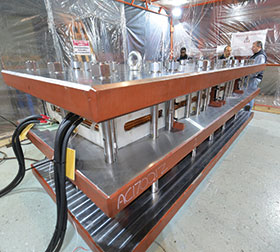
To facilitate the grinding procedure necessary to remove the support side brackets from the main rotor poles, a customised heavy duty jig was manufactured. After the severity of the damage was determined, various techniques and repair concepts were tabled and discussed in detail. It was finally agreed that the coils be stripped of their existing inter-turn insulation layers and the coils be reinsulated, heat cured using 2500 A, including pressing at up to 1000 tons, and re-assembled to the main poles. To fast track the process, Marthinusen & Coutts prepared custom parallel operations at the two facilities by separating the dirty and clean processes, with full clean conditions areas for the critical pressing and heat curing processes.

Manufacturing the tools and equipment for the work demanded substantial engineering and sourcing capacity. Among the items to be custom made were various tables and jigs to help move the coils in and out of the burn-out oven. A coil removal rig to remove coils safely from the main pole body was built, as well as two heavy duty consolidation rigs with a set of 1000 ton hydraulic jacks and their dedicated power control unit.

Marthinusen & Coutts also designed and constructed a dimensionally accurate dummy pole centre to help ensure correct fitment of coils to the main poles. Other items included a 2500 A direct current controlled rectifier to assist with the curing cycle, heavy duty turning rigs, lifting assemblies and a magnetic link for inter-turn insulation testing.

The scope of work included pyrolising the coil insulation in a controlled oven environment at 300°C and removing the existing insulation. The copper stacks were cleaned and polished, new insulation was pressed and prepared, and all new insulation kits were manufactured with pre-impregnated Aramid paper. All pole coils were reinsulated and thermo-electrically cured with a 1000 ton consolidation pressure, after which they were cleaned and tested.

Work on the main pole bodies included removing the existing insulation and checking and testing the copper damper winding and series connectors. Weld scars were cleaned and polished and new insulation kits were supplied and fitted. In the final assembly and test stage, Marthinusen & Coutts repaired the existing support brackets to as-new OEM specification and tested them to meet international standards. Coils were fitted to the rotor poles and the coils sealed onto the main poles. Finally the finished rotor poles with coils were tested, crated and transported back to Ingula by Marthinusen & Coutts. Unit 3 is now operating to full capacity. The entire project was carried out under extreme pressure, in record time, and according to all the OEM specifications and requirements for new rotor poles.

For more information contact Richard Botton, Marthinusen & Coutts, +27 (0)11 607 1700, [email protected], www.mandc.co.za


Share this article:
Share via emailShare via LinkedInPrint this page

Further reading:

Overcoming the bottling industry’s fragmented visibility
Schneider Electric South Africa IT in Manufacturing Electrical Power & Protection
Beverage bottling facilities are among manufacturing’s most energy-intensive environments, yet many still operate without granular insight into where that energy goes. Rezolia Muller-Potluri of Schneider Electric explains how tiered metering architecture and advanced

Read more...
Schneider Electric introduces next-generation BlokSeT switchboard
Schneider Electric South Africa Electrical Power & Protection
Schneider Electric has launched its next-generation BlokSeT low-voltage switchboard in West Africa, offering high reliability, predictive maintenance capability and digital integration for critical infrastructure and industrial applications.

Read more...
Powering South Africa’s renewable energy expansion
Electrical Power & Protection
ACTOM Distribution Transformers, the sole NECRT contract holder for Eskom, is powering South Africa’s renewable energy expansion through robust neutral earthing transformer solutions deployed across solar and wind projects in southern Africa.

Read more...
You can’t digitise a blackout
Schneider Electric South Africa Electrical Power & Protection
Across East Africa, smart meters and AI promise cleaner, more reliable power, but digital tools cannot optimise a grid too weak to carry the load. Schneider Electric’s Symphrose Ochieng sets out why operators should strengthen physical infrastructure first, then add digital capability in phases.

Read more...
Battery energy storage is key to powering South Africa’s manufacturing sector
Electrical Power & Protection
South Africa’s shift to renewables is creating a significant opportunity in battery energy storage, but local manufacturers face an uphill battle against cheap imports and stop-start demand. Richard van Moltke of ACTOM Static Power examines what it will take to build a sustainable local battery storage industry.

Read more...
Decarbonisation is reshaping mining strategy in Africa
Schneider Electric South Africa IT in Manufacturing Electrical Power & Protection
Mining companies across Africa are embedding decarbonisation into operational strategy, driven by investor, regulatory and customer pressure to reduce emissions while improving resilience.

Read more...
How to tell whether your mini-substation is new or refurbished
Electrical Power & Protection
Cosmetically refurbished mini-substations are being misrepresented as new equipment and sold back into the market, posing serious reliability and safety risks for mining, industrial and commercial operations. Trafo Power Solutions explains what to look for and what questions to ask before purchasing.

Read more...
Optimising energy reliability for African manufacturing
Electrical Power & Protection IT in Manufacturing
Unreliable power can cost African manufacturers as much as 31% in sales. Behind-the-meter power offers manufacturers in sub-Saharan Africa control, visibility and resilience in their energy provisioning.

Read more...
Electrical solutions for FMCG manufacturing giant
Electrical Power & Protection
An electrical upgrade at a leading fast-moving consumer goods facility demonstrates how ACTOM Kenya turned a fragile, reactive power infrastructure into a resilient, data-driven backbone for production. The project is also a case study in bridging legacy equipment with modern automation without disrupting operations.

Read more...
Yokogawa digital plant to accelerate green hydrogen revolution
Yokogawa South Africa Editor's Choice Electrical Power & Protection IT in Manufacturing
Yokogawa explains how a digital plant approach and autonomous operations can integrate the full green hydrogen value chain, from renewable power generation to end-use applications, and why digitalisation and system integration are central to making green hydrogen viable in South Africa.

Read more...


While every effort has been made to ensure the accuracy of the information contained herein, the publisher and its agents cannot be held responsible for any errors contained, or any loss incurred as a result. Articles published do not necessarily reflect the views of the publishers. The editor reserves the right to alter or cut copy. Articles submitted are deemed to have been cleared for publication. Advertisements and company contact details are published as provided by the advertiser. Technews Publishing (Pty) Ltd cannot be held responsible for the accuracy or veracity of supplied material.


© Technews Publishing (Pty) Ltd | All Rights Reserved

