



According to Brian Abbott, product manager at SMC Pneumatics South Africa, water vapour and the resulting water condensate are the foremost causes of costly downtime and increased maintenance. “The blame is often laid on the more visible culprit – oil or contaminants, both of which are easily removed with proper filtration.”
“Moisture in facility airlines causes corrosion and rust which can break loose in the air passageways causing blockages in narrow restrictions and filter elements. This can lead to increased pressure drops and loss in machine performance, not to mention energy loss and costs of the compressed air,” adds Abbott.
Aftercoolers, drip legs and water separators are used to remove water condensate from factory compressed air. However, this air is still at 100% relative humidity and is still at risk of condensing into water should the surrounding temperatures drop to its dew point.
In order to increase protection of expensive automation equipment, factory compressed air must remove as much water vapour as possible to avoid any condensation further downstream.
This is done by lowering its dew point.
How is dew point lowered in factory compressed air?
Abbott explains the process:
“Drying compressed air at the highest pressure consistent with the facility’s demands will result in the most economical dryer operation. For most industrial applications, the rule is to first set the pressure dew point to meet general requirements, and then adjust it between 6 and 10°C lower than the facility’s lowest ambient temperature. Hence, factory air dryness or dew point is relative to the application’s specific requirements.
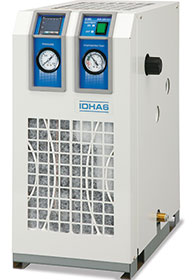
Refrigerated dryers are the most common measure to lower dew point. A refrigerated dryer will further cool the compressed air by removing heat at its inlet side and lowering its temperature dew point down to 3°C, then expelling the condensate through an automatic condensate drain. The dryer will then reheat the dried compressed air back to ambient temperature by recycling the previously removed heat using a heat exchange process. This reheating of the compressed air to ambient temperature will eliminate ‘sweating’ cold pipes when working in humid factory conditions.”
It is recommended that a coalescing filter be installed upstream from the refrigerated dryer to remove any compressor oil and other contaminants that may still be trapped in the compressed air to ensure the dryer’s proper functioning. Oil coating the cooling surfaces decreases efficiency while coalescing filters saturated with liquid water will aid its drying capacity. In circumstances where factory piping is exposed to ambient temperatures lower than the dew point achievable by refrigerated drying, alternate methods of drying must be considered.
Best practices
Membrane dryers use hollow fibres composed of a macro molecular membrane through which water vapour passes easily, but is difficult for air (oxygen and nitrogen) to pass through. When humid, compressed air is supplied to the inside of the hollow fibres, only the water vapour permeates the membrane and is drawn to the outside due to the pressure differential between the moisture inside and outside the hollow fibres. The compressed air becomes dry and continues to flow unimpeded out of the membrane dryer.
A portion of the dry air from the outlet side is passed through a very small opening to reduce the pressure and purge the outside of the hollow fibres. The moisture that permeated to the outside is discharged to atmosphere by the purge air which in turn creates a low partial pressure allowing the dehumidification process to continuously perform.
By altering the air flow rate and membrane configurations, pressure dew points from 15 to -60°C can be achieved. Membrane air dryers are a cost effective solution for point-of-use applications in pharmaceutical manufacturing, packaging, laboratory environments and other applications.
Desiccant dryers, on the other hand, pass air through beds of desiccant, an absorbent material such as silica gel or activated alumina, which adsorb water vapour to its surface to effectively lower dew points to temperatures well below that which a refrigerated dryer can achieve. Heatless regenerative models use a pair of desiccant beds which alternate in service while the one bed is operational, the off-line bed is regenerated via a pressure swing adsorption process. Pressure dew points from a standard -30°C to an optional -50°C and beyond can be achieved with a desiccant dryer.
Both membrane and desiccant dryers are adversely affected by the presence of oils or liquid water and must be protected with a quality coalescing filter.
What is the appropriate dew point?
Over specifying an application’s or a facility’s dew point can be very costly due to exorbitant energy bills just as the maintenance costs for water vapour damage to product lines can be for an under specified dew point.
According to Abbott, drying the entire factory’s compressed air supply to -30°C dew point is unnecessary and extremely wasteful. It is sensible practice to dry the compressed air to a dew point which is -10°C lower than the factory’s lowest ambient temperature then subdivide each compressed air supply by application using zone or point-of-use membrane or desiccant dryers to provide the appropriate level of dryness.
The costs of energy, downtime, replacing production components, end product defects or even loss of brand value are just a few factors to consider when determining an appropriate dew point.
| Tel: | +27 10 900 1233 |
| Email: | [email protected] |
| www: | www.smcza.co.za |
| Articles: | More information and articles about SMC Corporation South Africa |






© Technews Publishing (Pty) Ltd | All Rights Reserved
 printer friendly version