



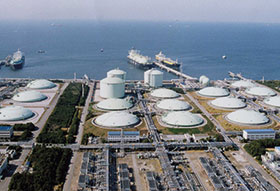
Over long distances, the safest and most economic method of transporting natural gas is in a liquid state. Plants dedicated to turning raw natural gas into liquefied natural gas (LNG) and later back into gas for distribution are either on-stream, under construction or planned all over the globe. The production, processing, storage, transportation and distribution of natural gas all require accurate, repeatable flow measurement.
The high-pressure, volatile nature of this valuable, but hazardous fluid makes it a challenge to measure in both its gaseous and liquefied state. While there are multiple gas and liquid flow measurement technologies, many of them rely on moving part designs (a potential safety hazard) or fail to measure accurately over a wide turndown range under upset conditions or require long straight runs of pipe upstream and downstream from the location of the meter that are difficult to achieve under the always crowded production and refining environment.
The challenge
Converting natural gas to its liquefied LNG state reduces its volume by 600 percent. This reduction in volume facilitates transport by ship, export and distribution. The natural gas is first cooled to -160°C), which condenses it into the liquefied state. Flow is then measured again several times during transportation, storage, regasification and distribution through pipelines to the end users.
The liquefaction process takes place in hazardous, space-constrained facilities. LNG processing, transportation, storage and distribution require a flowmeter that is rugged, dependable, simple to install and suitable for use in potentially explosive environments. Flowmeter technologies with moving parts or those requiring complex installation, or frequent recalibration and other maintenance represent potential safety issues, accuracy problems and added operating costs that burden production and refinery operations.
The solution
Featuring a unique self-conditioning flow technology, the versatile V-Cone flowmeter from McCrometer offers low installed cost and maintenance, and a highly reliable measurement solution for challenging hazardous applications in LNG processing, transportation, storage and distribution. The no moving parts, high-reliability design offers safe, stable measurement in explosive environments with the standard global agency approvals required for use worldwide.
The advanced V-Cone meters offer significant installed and operational cost savings in LNG facilities with complex or crowded equipment layouts, where the options for upstream and downstream piping are limited. The V-Cone flowmeter utilises a centrally located intrusion that redirects the flow to the outside of the pipe and conditions the flow by reshaping the velocity profile, all but eliminating the need for straight pipe runs.
The V-Cone requires straight pipe runs of only 0 to 3 pipe diameters upstream and 0 to 1 pipe diameters downstream. This smaller footprint, requiring up to 70% less straight pipe without being affected by flow disturbing equipment up or down stream, offers reduced installed and operational costs. The cost savings is especially common at both liquefaction and regasification facilities where large lines enter and exit the plant. Beyond the initial savings due to shorter pipe runs, there is an additional energy cost savings that accrues from maintaining the extreme cryogenic temperatures necessary over a much shorter distance.
The V-Cone is a differential pressure (dP) type flowmeter. The principle of operation is based on Bernoulli’s theory of conservation of energy. In a closed system, as the cross sectional area changes, so must velocity. By placing the cone in the pipe, the cross sectional area is reduced forcing velocity of the fluid to increase. As velocity increases, pressure drops and it is that pressure drop that can be measured and used to determine the fluid flow rate. This system can be used for liquids and gases, as well as steam in other applications.
The rugged, no moving parts meters measure abrasive, dirty, and particle-laden fluids over a wide range of Reynolds numbers without wear or clogging concerns, resulting in a standard 25 year operating life with virtually no need for maintenance. Reynolds numbers are a measure of whether flow is laminar or turbulent. With relatively low maintenance cost, which is an important concern in LNG processing and distribution, the V-Cone helps reduce total operating costs.
Conclusion
With its self-conditioning, no moving parts differential pressure (dP) sensing technology, McCrometer’s V-Cone flowmeters are now installed in a wide variety of LNG applications all over the world. Hundreds of them have been installed to measure gas as it flows into liquefaction trains and then from the trains into storage tanks. It has even been used in specialised cryogenic applications where flow was never before measured. The versatile meters offer low installed cost and maintenance measurement solution for challenging hazardous applications in LNG processing, transportation, storage and distribution.
For more information contact Stuart Brown, UIC Instrumentation, +27 (0)31 468 2561, stuartb@uic.co.za, www.uic.co.za
| Tel: | +27 31 468 2561 |
| Email: | guyw@uic.co.za |
| www: | |
| Articles: | More information and articles about UIC Control & Automation |






© Technews Publishing (Pty) Ltd | All Rights Reserved
 printer friendly version