April 2014Analytical Instrumentation & Environmental Monitoring
In general usage, LPG (liquefied petroleum gas) refers to propane, butane and their mixtures, which remain liquid at room temperature under relatively low pressure. It occurs as a by-product in crude oil refining and as an associated gas in the exploitation of crude oil and natural gas.
Liquefied gas, in contrast to crude oil, is not transported via pipelines but in large sea-going vessels, small barges, railway tank wagons and road tank vehicles to dealers and also directly to the liquefied gas tanks of the final consumers. The low pressure of propane and butane make this flexible transport of liquefied gas possible.
Application challenges
At normal temperatures and pressures LPG evaporates, it is therefore stored in pressurised steel tanks that are only filled between 80 and 85% of their capacity to allow for thermal expansion. The volume ratio of vaporised gas to liquefied gas varies depending on composition, pressure and temperature, but typically ranges around 250:1. LPG can be stored under high pressures in mounded bullets or in cryogenic tanks at negative temperatures. Thanks to the wide range of high-quality tank gauging as well as safety instrumentation, the expertise in project management, system integration, third-party supply, service and training, Endress+Hauser is able to act as one-stop solution provider to increase productivity and lower costs of complete tank farms and terminals.
The solution
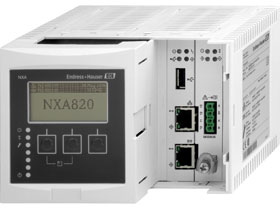
Endress+Hauser has implemented a complete inventory management solution for mounded bullet tanks combining both measuring accuracy and the highest safety standards. Customer value includes:
* The right instrumentation for any application.
* High accuracy and system reliability.
* Transparency in the processes leading to accurate product and sales planning.
* Optimised capacity utilisation of tanks and improved material availability.
* Lower inventory and operating costs by data integration into systems.
* Monitor critical inventory information remotely.
* Lowered environmental risk through preventing overfills using safety class instruments (up to SIL3 – Liquiphant FailSafe).
The Endress+Hauser Tank and Terminal Management solutions can be fully integrated into business networks for the highest degree of transparency in processes, which leads to higher customer satisfaction and an increase of revenue and profit.
Matching HVAC to the real demands of buildings and processes
Analytical Instrumentation & Environmental Monitoring
Industrial Climate Engineering director, Alin Gomes explains why effective HVAC goes beyond specifying equipment on capacity, covering load profiling, ventilation requirements, heat recovery and turnkey delivery for specialised manufacturing and processing environments.
Read more...How SCE approaches sensor selection for critical environments Specialised Climate Engineering
Analytical Instrumentation & Environmental Monitoring
Specifying the right sensor for a critical climate involves far more than matching a datasheet accuracy figure. As an authorised Vaisala HVAC partner, SCE explains how understanding the environment, the measurement purpose and sensor placement determines effective climate control.
Read more...Changing gas quality calls for smarter combustion control
Analytical Instrumentation & Environmental Monitoring
As South Africa prepares for a transition from declining Mozambican natural gas to a proposed methane-rich bridge, LNG, industrial users can no longer assume a constant Wobbe Index and calorific value. The compact RMG RGQ 5 provides fast, plant-level gas-quality data to support approved burner and engine settings.
Read more...Getting the chemistry right
Analytical Instrumentation & Environmental Monitoring
Grace’s European production site has relied on analogue compression load cells from Minebea Intec for decades, with the long-proven measurement concept now serving as the reference for new silo projects as the company expands its capacity.
Read more...Why measurement matters in smelting Endress+Hauser South Africa
Analytical Instrumentation & Environmental Monitoring
South African smelters returning to operation after energy constraints face new demands for tighter control, better visibility and environmental compliance. Endress+Hauser explains how modern measurement technology supports safer, more efficient furnace operation and local beneficiation.
Read more...Sun tracking with pinpoint precision Senseca
Analytical Instrumentation & Environmental Monitoring
Senseca has introduced the SEMS-2000 solar energy measurement system, a 2-axis solar tracker with pinpoint sun-pointing accuracy that automatically monitors direct, global and diffuse irradiance for unattended outdoor solar installations.
Read more...AMETEK expands 993X gas analyser series with explosion-proof enclosures
Analytical Instrumentation & Environmental Monitoring
AMETEK Process Instruments has added ATEX and IECEx Zone 1-certified explosion-proof enclosures to its 993X series of gas analysers, enabling reliable installation in Zone 1 hazardous locations where purge gas is unavailable.
Read more...Why medical device leak testing matters for South Africa's MedTech future ATEQ South Africa
Analytical Instrumentation & Environmental Monitoring
As South Africa works to grow local medical technology manufacturing, non-destructive leak and flow testing is becoming a strategic quality assurance tool, helping manufacturers verify device integrity, meet regulatory requirements and improve production efficiency.
Read more...Moving forward with reverse osmosis
Analytical Instrumentation & Environmental Monitoring
Rising water costs and pressure on infrastructure are changing the way industries view reverse osmosis. G-Chem Aquacare is developing tailored, containerised solutions that make the technology more accessible for South African industry.
While every effort has been made to ensure the accuracy of the information contained herein, the publisher and its agents cannot be held responsible for any errors contained, or any loss incurred as a result. Articles published do not necessarily reflect the views of the publishers. The editor reserves the right to alter or cut copy. Articles submitted are deemed to have been cleared for publication. Advertisements and company contact details are published as provided by the advertiser. Technews Publishing (Pty) Ltd cannot be held responsible for the accuracy or veracity of supplied material.










 printer friendly version