


Electrical Power & Protection


Lightning protection for photovoltaic systems

October 2013 Electrical Power & Protection

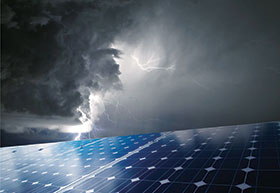
In recent years, photovoltaic (PV) systems have become a significant sector within the energy market. They increase energy security, enhance sustainability, reduces pollution and keep fossil fuel prices lower than they would be otherwise. However, since these plants are frequently subject to climatic influence, measures to protect the sensitive electronic systems components from failure due to lightning flashes and surges are essential.

Lightning surges in the PV system can damage PV modules and inverters, leading to both high repair costs and lost revenue for the operator. For a complex PV installation, such as a solar power plant, the aim is to protect the operations buildings and the PV array against damage by fire (direct lightning strike), as well as protecting the electrical and electronic systems (inverter, remote diagnostics system, generator main line) against the effects of lightning electromagnetic impulses (LEMP).

Air-termination and down conductor system

For the protection of the PV array against direct strikes, it is necessary to arrange the solar modules within the protection zone of an isolated air-termination system. According to the class of lightning protection, the height and the quality of the air-termination rods required is determined by means of the rolling sphere method. Furthermore, it has to be ensured that the separation distance is kept between the PV supporting frames and the air-termination rods. Also, the operation building must be equipped with external lightning protection. Down conductors must be connected to the earth-termination system by using terminal lugs. Due to the corrosion risk at the point where the terminal lugs come out of the soil or concrete, they have to be made out of corrosion-resistant material or be protected by applying sealing tape or a heat-shrink sleeve.

Earth-termination system

The earth-termination of the PV system is designed as a surface earth electrode, while the earth-termination system of the operation building should be designed as a foundation earth electrode. The metal supporting frames, onto which the PV modules are fixed, must be connected to the earth-termination system approximately every 10 metres. The earth-termination of the PV system, and the one of the operation building, must be connected via at least one conductor. The interconnection of the individual earth-termination systems reduces the total earthing resistance, while the intermeshing creates an equipotential surface that reduces the induced lightning effects on the electric cables between the PV array and operation building.

Surge protection measures in the PV array

In order to reduce the load on the isolation inside the solar modules, thermally monitored surge protective devices are installed in a junction box connected to the PV generator. On the DC side, a surge protection device is installed in each generator junction box to provide local protection for the PV modules and ensure that no spark-over caused by conducted or field-related interferences occurs.

Surge protection measures for IT systems

The operation building house the remote diagnostics used to check the status of the PV systems, permitting operators to recognise and remedy any malfunctions as early as possible. Measurements of wind velocity and module and ambient temperature are performed via external sensors and can be read directly from the data acquisition unit. The unit provides an Ethernet interface to which a PC or modems are connected for remote enquiry and maintenance.

In order to provide reliable trouble-free and continuous transmission of data to the measuring unit, it is necessary to lead the sensor cables entering the building via surge protective devices. When choosing the protective devices, it must be ensured that measurements cannot be impaired. Safety in the forwarding of the measured data via the telecommunication network per ISDN modem must be given as well in order to provide for continuous monitoring and performance optimisation of the installation.

For more information contact Alexis Barwise, Dehn Protection South Africa, +27 (0)74 505 0312, [email protected], www.dehn-africa.com


Share this article:
Share via emailShare via LinkedInPrint this page

Further reading:

South African businesses can alleviate energy price crisis
Electrical Power & Protection
While grid instability remains a concern, the immediate and most critical driver of South African commercial and industrial investment in renewable energy is the escalating cost of electricity.

Read more...
Real-time modelling is the key to a resilient, bi-directional energy grid
Schneider Electric South Africa Electrical Power & Protection
Utilities and municipalities are facing a challenge as the country’s legacy power grid, engineered for one-way energy delivery from centralised suppliers to end-users, must rapidly evolve to meet a new paradigm.

Read more...
Shielding data centre growth from the looming power crunch
Schneider Electric South Africa Electrical Power & Protection
Today’s digital economy is placing unprecedented strain on the power grid. The good news is that these challenges are not insurmountable. By adopting proactive strategies such as alternative power sources, infrastructure planning and software, operators can secure capacity, build resilient facilities and scale sustainably.

Read more...
Circuit breaker innovations
Schneider Electric South Africa Electrical Power & Protection
Recent advancements in circuit breaker technology have seen a major step forward in setting new standards for efficiency and sustainability in data centres, industrial and commercial infrastructure.

Read more...
Common battery tester errors and what they mean
Comtest Electrical Power & Protection
Battery testers help quickly assess battery health, diagnose issues, and determine whether a battery needs a charge or replacement. This guide covers some of the most common battery tester errors, what they mean, and what can cause them.

Read more...
Cathodic protection design considerations that influence ESG outcomes
Omniflex Remote Monitoring Specialists Electrical Power & Protection
Major infrastructure like wharves, bridges, pipelines and tanks are at constant risk of corrosion. David Celine, managing director of cathodic protection specialist Omniflex, explains how CP system design can support ESG commitments, while simultaneously lowering costs and improving maintenance capabilities.

Read more...
Africa’s digital future – building critical power infrastructure for data centre leadership
Electrical Power & Protection
Africa’s digital economy is growing rapidly, and countries like South Africa, Nigeria and Kenya are leading the way. However, a major challenge remains. Sustainable and reliable power systems must form the backbone of Africa’s digital growth to ensure lasting success.

Read more...
Recovering condensate and waste heat
Electrical Power & Protection
According to Associated Energy Services, strong partnerships with thermal energy users optimise opportunities to benefit from condensate return. waste heat recovery and the prevention of system contamination.

Read more...
Quantum engine powered by particle entanglement
Electrical Power & Protection
In a landmark achievement that signals a new era in energy research, a team of physicists in China has carried out the first successful test of a quantum engine powered by particle entanglement. This technological breakthrough represents a fundamental shift in our approach to energy production.

Read more...
Advancing sustainability in South Africa’s fruit industry
Schneider Electric South Africa Electrical Power & Protection
Schneider Electric, together with Technoserve Medium Voltage, has implemented its advanced SF6-free MV switchgear at Two-a-Day situated in Grabouw in the Overberg district.

Read more...


While every effort has been made to ensure the accuracy of the information contained herein, the publisher and its agents cannot be held responsible for any errors contained, or any loss incurred as a result. Articles published do not necessarily reflect the views of the publishers. The editor reserves the right to alter or cut copy. Articles submitted are deemed to have been cleared for publication. Advertisements and company contact details are published as provided by the advertiser. Technews Publishing (Pty) Ltd cannot be held responsible for the accuracy or veracity of supplied material.


© Technews Publishing (Pty) Ltd | All Rights Reserved

