



Automation technology from Beckhoff has proven itself in use worldwide in wind turbines up to a size of 5 MW. PC-based automation technology offers powerful controllers that unite all components of a wind turbine – such as operational management and control of pitch, generator, converter and brake, as well as condition monitoring and farm networking – all on a single platform. Eliminating special hardware lowers the costs of the basic electrical equipment and the costs of maintenance, while at the same time increasing the availability of the wind turbine.
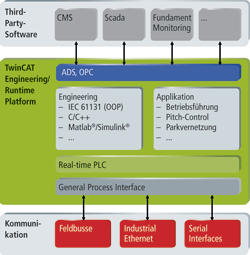
TwinCAT, the open, scalable automation software, forms the core of the Beckhoff PC-based control platform. TwinCAT offers the user a high degree of freedom in choice of programming language: in addition to the object orientated extensions of IEC 61131-3, C and C++ are now also available as programming languages for real-time applications. With the integration of Matlab/ Simulink, TwinCAT can also be used for plant simulation, for example for load calculation.
Open control technology offers investment security and reduces hardware and engineering costs
PC and EtherCAT-based control technology from Beckhoff is characterised by its variety of hardware and software interfaces. Openness is the basis of the system concept and aims at the integration of functions such as visualisation, safety and measuring technology, and of third-party software. In addition, the smooth interaction of the Beckhoff technology with industrial communication standards such as IEC 61400-25, Ethernet TCP/IP or OPC guarantees high investment security for the user.
The openness of the Beckhoff control architecture fits the requirement profile of the wind power industry perfectly: performance-related scalability, maximum flexibility in controller design and a high degree of integration. The functional range of the control platform, which, apart from sequence control, also encompasses visualisation, safety chain and condition monitoring, ensures the efficient interaction of all system components and optimises the performance of the wind turbine. Beyond that, dispensing with special hardware leads to a leaner control architecture and to lower engineering expenditure. Interfaces for all common fieldbus systems and the large signal variety of the Beckhoff I/O systems cover all types of signals and fieldbuses that are relevant to wind power.
High degree of integration optimises the controller and lowers the operating costs of wind turbines
Based on PC and EtherCAT technology, Beckhoff supplies a universal platform for all control requirements in wind turbines. All procedures are automated on the Industrial PC via a directly connected Beckhoff I/O system and the TwinCAT automation software: from the operational management and control of pitch, converter, gearbox and brakes to the visualisation and farm networking. EtherCAT offers full Ethernet compatibility and outstanding real-time characteristics. Beyond that, the fast communication system is characterised by flexible topology and simple handling. Lower-level fieldbuses such as CANopen, Profibus and Ethernet TCP/IP can be relocated to the field via fieldbus master or slave terminals for the control of subsystems. Software libraries and hardware components specially developed for the wind power industry round off the wide range of solutions from Beckhoff.
The Beckhoff standard controller for a wind turbine consists of an Embedded PC as the master computer, EtherCAT as the communication system, the bus or EtherCAT Terminals and the TwinCAT automation software. The converter, the I/O system in the nacelle and the pitch controller in the hub are connected to the master controller via EtherCAT or another fieldbus system. Safety technology and condition monitoring are integrated into the terminal strand via corresponding I/O modules, a separate CPU can thus be dispensed with. Through the use of EtherCAT as the universal fieldbus system, communication becomes much faster and simpler and the project engineering, programming and cabling of the wind turbine are simplified. The central Embedded PC acquires and processes all data, checks the feed-in and communicates with the central control room via Ethernet.
Ultra-fast wind farm networking
Wind farm networking with EtherCAT is not only faster compared to conventional IP solutions, but also offers cost benefits by dispensing with switches or hubs. With the EL3773 EtherCAT Power Measurement Terminal integrated in the automation system, momentary current and voltage values can be measured at up to 10 000 samples/s. Using the EtherCAT distributed clocks, the measured values of all wind turbines and the measurement at the point of common coupling can be synchronised to a timeframe smaller than 1 s. The physical layer can be used for both Ethernet TCP/IP and for EtherCAT. The existing Ethernet infrastructure (fibre-optic technology) can be used over distances of up to 20 km without loss of speed. TwinCAT supports the standardised IEC 61400-25 communication protocol for wind turbines, which simplifies the monitoring and control of heterogeneous wind farms, including the connection to the electricity supplier.
For more information contact Kenneth McPherson, Beckhoff Automation, +27 (0)11 795 2898, [email protected], www.beckhoff.co.za
| Tel: | +27 11 548 9960 |
| Email: | [email protected] |
| www: | www.profiafrica.co.za |
| Articles: | More information and articles about PI SA (PROFIBUS & PROFINET SA) |
| Tel: | +27 11 795 2898 |
| Email: | [email protected] |
| www: | www.beckhoff.com |
| Articles: | More information and articles about Beckhoff Automation |






© Technews Publishing (Pty) Ltd | All Rights Reserved
 printer friendly version