The control room used to run one plant, now it runs the world
September 2026
SCADA/HMI
We are living in an age of volatility. Energy market swings, trade frictions and tighter financial conditions are part of the global economic fabric, underpinning a more complex and unpredictable global system.
Operational architectures in this environment must assume continuous disruption. Networks need to be capable of reconfiguring themselves, not if disruption hits, but when.
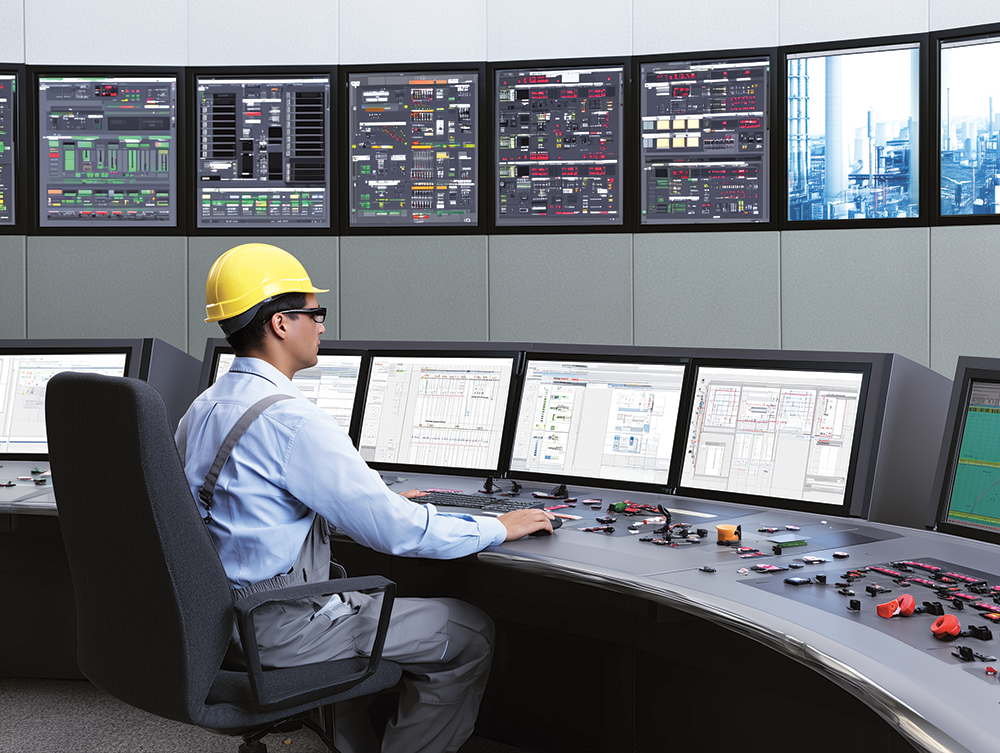
One moment a refinery is producing, and the next it is not. Somewhere in a control room on the other side of the world, an operator is staring at a screen trying to answer a question that efficiency models were never designed to answer: now what?
Today, success depends on more than efficiency. Manufacturing performance relies on how fast and flexibly capacity can be moved or absorbed. If the supply chain dries up, how fast can the plant pivot to another supplier? What does the forecast look like? Where can production be offloaded from one factory to another?
It is about understanding real-time supply and demand, forecasting dynamically, and translating that insight all the way through to the manufacturing floor. This shift, from local control to network-wide responsiveness, is redesigning what optimal industrial operations look like. Sitting at the centre of it is HMI and SCADA.
For most of their history, these systems had one purpose: they let operators see and control what was happening inside a facility. HMI is the interface operators use to monitor and control processes. SCADA aggregates and distributes real-time data from physical assets. For decades, both were confined to single sites.
This began to change as industrial infrastructure started to converge with the cloud-based architecture that had already transformed every other sector. Sensors became cheaper and networks became faster. The gap between operational technology and information technology began to close.
What has emerged is something quite different. The screen now shows many facilities. It can also show historical patterns, live forecasts, and engineering data alongside the operational picture. The system provides the context to understand what the data means and what to do next. Decisions can happen in minutes rather than days.
Consider the global dairy business Agropur. The 29 plant company with $9 billion in annual revenues, now visualises overall equipment effectiveness trends through geographically connected visualisation capabilities. Previously, all its plants operated independently without shared visibility which limited operational efficiency and problem-solving.
Today, through digitalising its legacy industrial model, it has standardised and integrated operational data across sites and centralised it into a single view. The result is better reporting and the ability to plan production in real time across the network.
HMI and SCADA are becoming the layer that connects data and software across industrial operations, providing the real-time operational layer to maintain output when individual plants fail.
For decades, industrial companies optimised for efficiency and just-in-time supply. Agility is now the primary survival requirement, and it starts with connected data and systems. For the operators watching these screens, the ability to see across the entire network and react in an informed and nimble way represents the future of resilience in uncertain times.
For more information contact AVEVA, +971 4 454 0777, [email protected], www.aveva.com
Further reading:
Software-defined automation is overcoming hardware interoperability limits
Schneider Electric South Africa
SCADA/HMI
Schneider Electric’s Kobus Vermeulen and Sydney Higgo explain how open communication standards and software-defined architectures are enabling industrial operators to integrate legacy equipment, new control systems, and cloud platforms without disrupting operations.
Read more...
Siemens modernises WinCC Unified engineering
SCADA/HMI
Siemens has launched SIMATIC AX WinCC Unified Elements, an IT-style engineering application for the WinCC Unified system that lets automation engineers build and deploy visualisation projects using code-based workflows, Git integration and AI-generated configuration
Read more...
Effective alarm management for safer, more productive operations
Adroit Technologies
SCADA/HMI
Adroit Technologies addresses alarm flooding and nuisance alarms with its Adroit Alarm Management solution.The platform combines performance dashboards, mobile escalation via Adroit AIR, and an integrated digital logbook to turn alarms into actionable operational intelligence.
Read more...
What you need is a nerve centre for your building
Schneider Electric South Africa
SCADA/HMI
Schneider Electric’s Anoop Hariparsad explains how a building management system acts as a single nerve centre, cutting energy use and improving safety and guest experience.
Read more...
How a digital foundation can overcome the LNG trilemma
Schneider Electric South Africa
IT in Manufacturing SCADA/HMI
The LNG sector is racing to add capacity, but without a digital backbone, growth creates complexity rather than capability. Christophe Begat of Schneider Electric explains how connecting data, systems and analytics across the LNG value chain can resolve the trilemma of secure supply, lower emissions and tighter costs.
Read more...
Full HD industrial AI panel PC
Vepac Electronics
SCADA/HMI
Powered by the NVIDIA Jetson Orin NX, the NIKY-2215-NX industrial AI panel PC provides up to 100 TOPS of AI performance through the module’s 1024-core NVIDIA Ampere architecture GPU.
Read more...
When SCADA meets the cloud
Omniflex Remote Monitoring Specialists
SCADA/HMI
Engineers are faced with the challenge of unifying legacy SCADA systems with modern, IoT-based data platforms. The trouble is, when hardware from multiple manufacturers and generations are all used in the same system, compatibility becomes an issue
Read more...
Adroit Technologies strengthens Sasol Synfuels operations with digitalisation
Adroit Technologies
SCADA/HMI
Adroit Technologies has reinforced its position as a trusted digitalisation partner to the petrochemical and mining sectors through its longstanding collaboration with Sasol Synfuels.
Read more...
Adroit Technologies champions sustainable, scalable industrialisation across Africa
Adroit Technologies
SCADA/HMI
Adroit Technologies has reaffirmed its commitment to accelerating Africa’s industrial growth through resilient, affordable and future-ready digital solutions for utilities, manufacturing and process industries.
Read more...
Modernising critical water systems without disruption
Rockwell Automation
SCADA/HMI
The region of Waterloo needed to upgrade its SCADA and PLC systems across 157 water facilities while ensuring continuous water availability for over 60 000 residents. Their success story, powered by Rockwell Automation technology, shows that modernisation doesn’t have to mean disruption.
Read more...










 printer friendly version