



As wind farms become more globalised and suitable sites are being taken up, turbines are being built further out to sea. The impact of this is that their foundations’ diameters and heights are increasing to stand up to, and harness the full force of stronger winds. Their weights and sizes are also therefore ever increasing, so the capacity of the equipment used for lifting, transport and installation must grow with them.
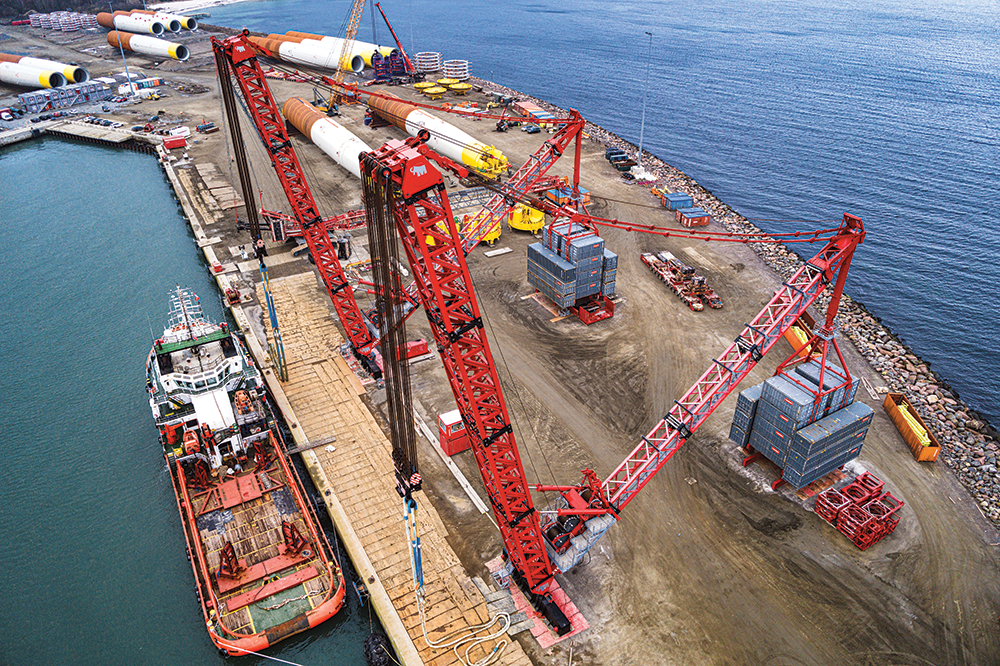
Mammoet’s XXL monopile transport system allows the world’s largest and heaviest monopiles to be marshalled, stored and transported safely, even as they grow at unprecedented rates. The new MTC 1600, on site for the first time, is a terminal crane with 1600 ton lift capacity. It works in tandem with another unit to lift XXL monopiles safely and efficiently, creating a production line environment.
Both innovations demonstrated their advantages when Mammoet supported Van Oord to marshal over 70 monopiles for Baltic Power offshore wind farm, which will deliver 4 TWh of electricity annually.
Innovative tools to support the future of offshore wind
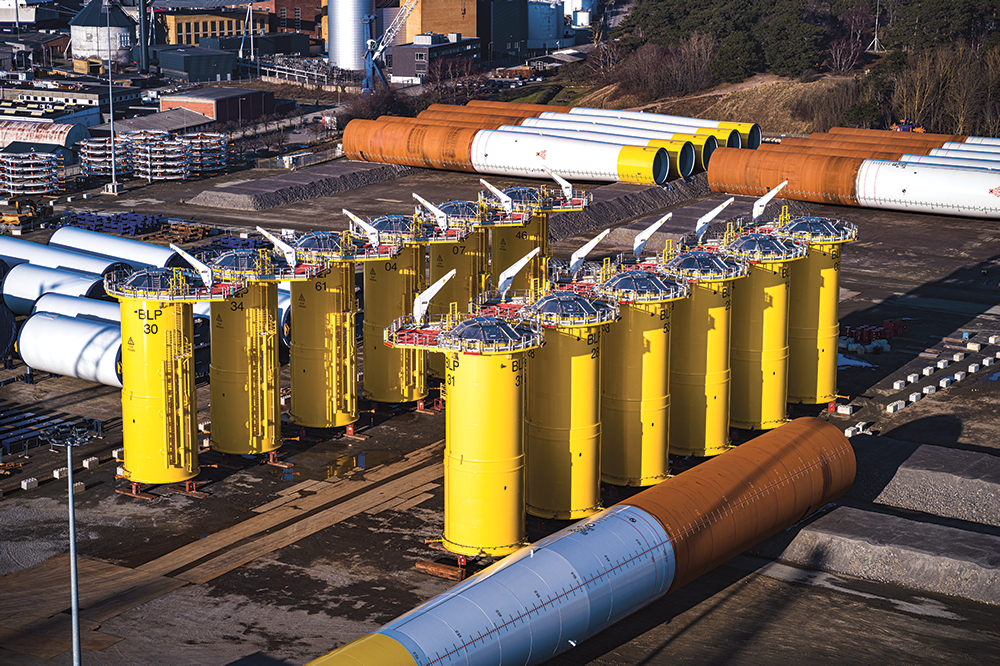
Mammoet assisted with the lifting and marshalling of 78 monopiles between factory and foundation. The monopiles weighed up to 1680 tons, with a maximum of 86,3 metres in length and a diameter of 9,1 metres.
The monopiles were shipped in batches of three, via barge, to the Port of Ronne in Denmark. They were initially unloaded using 78 axle lines of SPMT fitted with Mammoet’s XXL monopile transport system.
When the SPMT combination was in position, the system’s saddles unfolded hydraulically to cradle each monopile. Using the combined stroke of the SPMT and the system’s jacking spacers, the components were safely lifted off the grillages that supported them during sea transit.
They were then driven to a temporary storage location where they were placed on gravel bunds. The jacking spacers were extended fully to allow the monopiles to be lifted an extra 0,6 metre.
This extra stroke length allows the XXL monopiles to be placed into the bunds and retrieved from them, despite the greater lift distance needed to do so caused by the growing indents required to support larger monopiles.
The system’s foldable saddles also allow the height of the bunds to be lower and their lengths shorter, meaning far less gravel is needed, reducing the amount of civil preparation work necessary on site.
Before load-out, the monopiles were lifted off the storage bunds and taken to a plugging station where they could be plugged at both ends and tested to ensure they were airtight.
They were then driven to the quayside where the two MTC 1600 cranes effortlessly lifted them into the water, ready to be sailed out to Van Oord’s heavy lift installation vessel, Svanen, using a tug. The foundations travelled 23 km offshore the Polish settlements of Choczewo and Leba for installation. In this fashion, the MTC 1600 is able to turn any quay into an efficient heavy lift terminal for monopile load-ins and load-outs.
This work comes after Mammoet’s 2024 project to support Van Oord with the upgrade of the Svanen, fitting this vessel with a new A-Frame to install taller monopile foundations at sea for Baltic Power. The re-fit and this marshalling project are inextricably linked.
Jaap van der Riet, commercial manager at Mammoet, says this is a real strength of Mammoet. “If no solutions exist, we develop them, together with our clients, to meet their specific needs.”
Finding efficiencies at every stage
Load testing for the MTC 1600 cranes was carried out at the project site. The load-in RoRo method was also changed mid-project to streamline the marshalling process. The MTC 1600s proved so efficient at lifting the monopiles, they were used to unload them from the barges instead of SPMTs.
The added benefit was that it significantly reduced the time needed to fully ballast each barge, as the monopiles could be lifted directly rather than their weight being transported across the deck.
Thanks to a combination of the new XXL monopile handling equipment and these time-saving measures, Mammoet was able to save a lot of manual handling at critical phases and make the entire marshalling project safer and more efficient.
For more information contact Mammoet Global,






© Technews Publishing (Pty) Ltd | All Rights Reserved
 printer friendly version