



Jungheinrich is a global leader in intralogistics solutions based in Hamburg, Germany. With decades of experience in material handling and warehouse automation, the company helps businesses optimise space and improve efficiency.
As a global leader, Jungheinrich knows it must anticipate tomorrow’s needs. With e-commerce booming and customers expecting faster deliveries, the company recognised that warehouses need a smarter, fully automated way to process goods while making the most of limited space. This insight led to the development of an innovative solution that redefines automated storage, the PowerCube, an automated compact container storage system. “Our customers need a way to use limited space efficiently while meeting growing demands for faster order processing,” explains Carlos de Almeida.
Meet the PowerCube
The PowerCube was designed with one clear goal, to improve efficiency. By maximising storage density and accelerating order processing, it helps warehouses handle more goods in less space and time. At the heart of the system is Jungheinrich’s own Warehouse Control System, which controls automated shuttles via Ethernet communication to ensure they move quickly and safely within a high-density storage grid. These shuttles operate on the entire bottom level in two dimensions, leveraging the full vertical space above the system for maximum storage capacity.
The PowerCube delivers a number of benefits:
• Unique use of space: Up to four times higher storage density compared with conventional shelving.
• High system height: Vertical storage up to 12 metres.
• Scalable design: Flexible throughput, container capacity and shuttle count.
• Powerful performance: Each shuttle can carry two containers at once, up to 50 kg per container.
• Easy integration: Short assembly times and simple IT connections, with no need for floor milling.
“We wanted a system that combines speed, safety and scalability. PowerCube delivers all three,” says de Almeida.
Turning to HMS Networks for reliable connectivity
Keeping shuttles moving safely in two dimensions is no easy task, it demands reliable and deterministic wireless communication. Any delay or disruption stops a shuttle, blocks access to storage areas and can halt the entire line, leading to costly delays. Cables were not an option because the shuttles need complete freedom to move across the bottom level without restrictions.
Recognising the need for reliable connectivity, Jungheinrich turned to HMS Networks. As de Almeida puts it, “We’re experts in logistics, not networking, so we contacted HMS for help.”
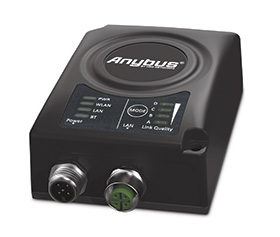
To ensure reliability, HMS recommended a robust wireless setup. Anybus Wireless Access Points are installed throughout for full signal coverage, with dual-band segmentation using 5 GHz for tablets and maintenance devices and 2,4 GHz for shuttle control and safety communication. On each shuttle, an Anybus Wireless Bridge II, with its integrated antenna and compact IP67 form factor, provides a space-saving installation. A point-to-multipoint architecture lets shuttles roam freely between access points, with continuous Ethernet connectivity anywhere in the system, while IP67-rated hardware withstands harsh environments, including cold storage where condensation is a risk.
“We really appreciated HMS’ support and guidance. The Bridges and Access Points are working well, but it wasn’t just about the products. Their Wireless & Infrastructure Implementation Assistance service made a big difference, helping us overcome the challenges of deploying wireless connectivity in a dense, metallic structure. Using their expertise and analysis tools, HMS designed the best layout for access points to ensure reliable performance in every installation. In some cases, we even asked HMS to join us at our customer’s warehouse to perform a site survey and validate signal coverage,” adds de Almeida.
First deployments in the field
The PowerCube is now entering real-world applications, proving its efficiency and reliability in multiple installations. “It’s great to see PowerCube out in the field solving issues. Fastbolt, for example, wanted faster order processing and better space utilisation. That’s exactly what the PowerCube is providing,” says de Almeida.
The future of automated storage
With the PowerCube, Jungheinrich is setting a new benchmark for automated storage systems, and with HMS providing the wireless backbone that keeps shuttles moving, this partnership is paving the way for smarter, more efficient warehouses worldwide.
The journey does not stop here.Jungheinrich plans to scale the PowerCube to larger deployment systems with increasing storage surface and numbers of shuttles, a move that will require advanced wireless design and continuous network monitoring. At the same time, meeting cybersecurity requirements and complying with regulations such as RED, CRA and NIS2, along with optimising safety architecture for the upcoming EU Machinery Regulations 2027, will be critical. “We’re really pleased with the collaboration with HMS. It’s helped us achieve the required robust connectivity, and as we expand and meet cybersecurity and safety requirements, our partnership with HMS will become even more valuable. This is only the start.” concludes de Almeida.
For more information contact HMS Industrial Networks,






© Technews Publishing (Pty) Ltd | All Rights Reserved
 printer friendly version