



Designing and building pharmaceutical processes or skids demands close coordination between mechanical, electrical, instrumentation and automation engineering teams. Fragmented design and vendor selection can introduce challenges in integration and validation. Aligning these disciplines through compatible hardware, automation and measurement technologies can reduce risks in development and accelerate time to market.
The process is both complex and costly. It requires precise, scalable control to maintain high productivity, meet regulatory hygiene standards, and ensure reliable validation through accurate data. For pharma OEMs to optimise all these areas, close coordination between design and installation engineering teams is critical.
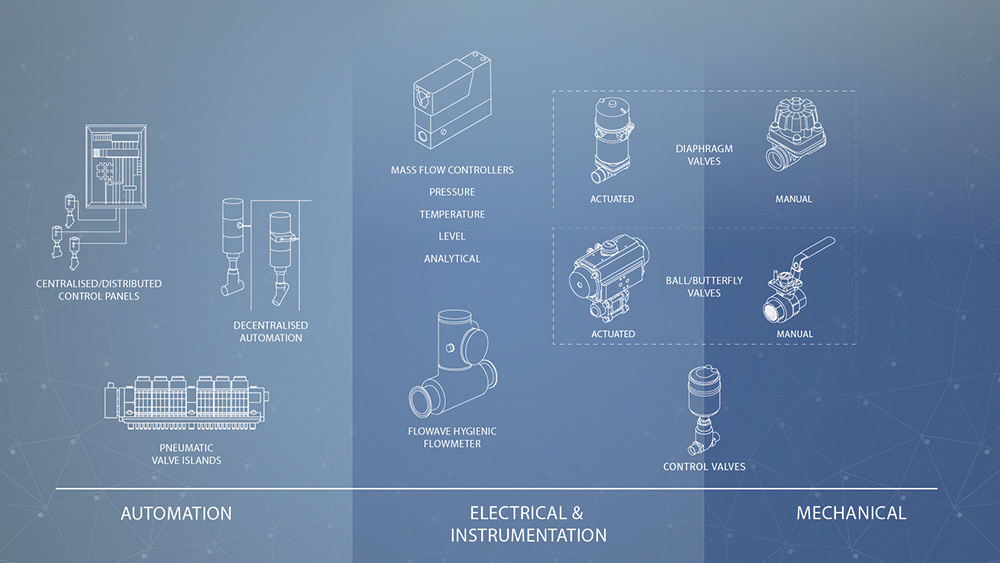
Designing and installing a new pharmaceutical process usually involves several specialist teams. Mechanical engineers handle pipework, vessels, and valves. Electrical and instrumentation engineers manage valve control and electrical installation. Automation engineers develop and implement the control concept.
Project coordination challenges
While each of the disciplines has distinct objectives and timelines, aligning the mechanical, electrical, instrumentation and automation teams is essential. However, project scale and its complexity make coordination of these teams a demanding task. The first development phase is often the most critical for coordination, as issues that arise early can have lasting effects and are harder to correct later. Selecting the right vendors is therefore essential, and long-term project success depends on compatibility across hardware, software, controls, and related services. As each team develops its part of the design and specifies components from approved vendors, the primary objective is to achieve precise process-level control. Process valves, flowmeters and control systems may each meet the required individual specifications, but differences in response times or control and communication interfaces can introduce small mismatches that decrease precision and repeatability of the overall process. This makes exacting compatibility of control hardware and automation architecture essential to optimise process quality.
Reliability and compliance
Even when the desired process quality is reached, achieving productivity means throughput matched with reliability. Here, again, challenges in compatibility can increase the potential for maintenance issues over time, and the most significant problem is downtime. When a maintenance challenge develops, the involvement of multiple vendors increases the time and complexity of diagnosis. Resolving any issues could also demand the coordination of service teams from two or more vendors working together.
Meeting regulatory hygiene standards, including the automated availability of full process data, is another area where separation of hardware and systems has the potential to introduce risk. Components may comply at an individual level, but integrating separate vendor components into the process system or skid is likely to make it more challenging to validate as a complete hygienic unit. Moreover, the independent selection of vendors can complicate data management, whether this results from the software, the communications protocols or the measurement sensors themselves.
Project partner
Unifying the mechanical, electrical, instrumentation and automation aspects of a process or skid project under a single supplier can remove risks, optimise the capability of the system overall, and enable more efficient development. In practice, this means working with a project partner that has in-depth expertise across fluid control and automation, combined with in-house expertise to develop a full system.
Bürkert’s Pharma Project Management team offers a central pool of expertise that can be positioned towards resolving a specific design challenge. The team allocates engineers to work with the original project team and provides assistance to all three areas of design, and a local project manager is assigned responsibility for coordinating all aspects. This provides project management support along with practical expertise and input towards design and documentation, including the development of step files, drawings, 3D models, simulation, and sizing tools for control valves.
Flexibility and time to market
Ensuring a flexible system design is also a frequent requirement for pharma process and skid development where processes increasingly require modular systems, adaptable recipes and scalable production. Managing a project with a holistic approach to the integration of valves, measurement devices and control systems makes it significantly easier to build in the required flexibility.
Fast time to market is essential for any pharmaceutical development project, and any design adaptions can be quickly realised via a single supplier with the right expertise. Not only does a single partner enhance coordination in project delivery across the mechanical, electrical, instrumentation and automation teams, but this approach also minimises the potential for compatibility challenges to arise later in the project.
Often, pharma process and skid development is as much about minimising risk as it is optimising performance. To deliver both aims, the project partner approach is nearly always the more secure choice.
For more information contact Bürkert Fluid Control Systems,






© Technews Publishing (Pty) Ltd | All Rights Reserved
 printer friendly version