


Motion Control & Drives


Lowering a steam generator into a nuclear power plant

March 2026 Motion Control & Drives

With different contractors working on the same site operating a wealth of machinery and equipment, effective planning and communication are critical to ensure a successful nuclear construction project. Operations must be meticulously planned and performed safely to ensure that the site delivers to program.
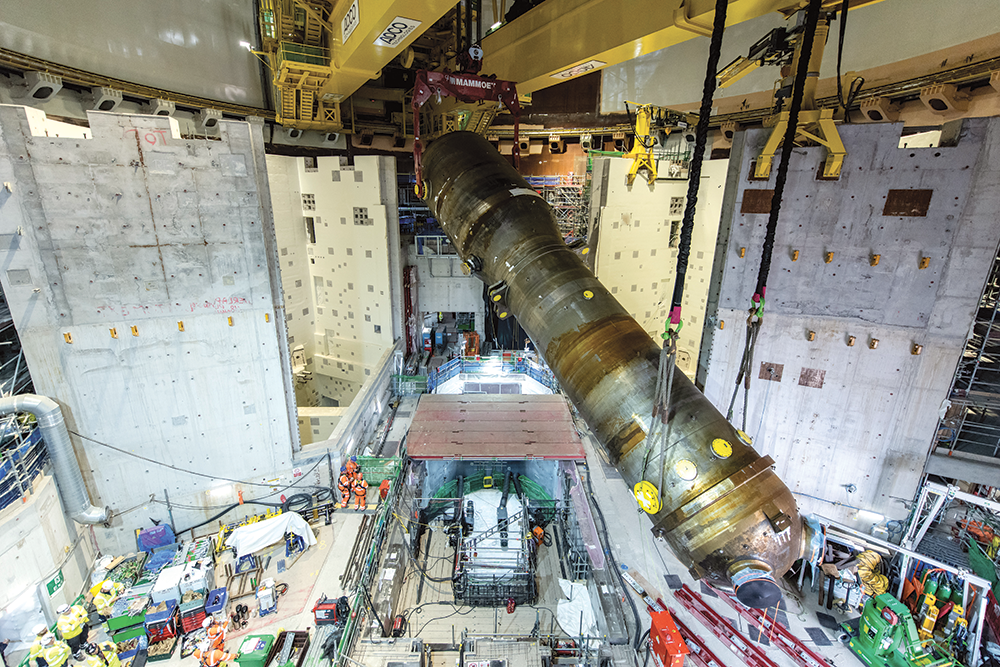
In addition, years of engineering are needed to develop a solution that can deliver high value loads for installation around pre-existing structures. Design choices mean that space on site is at a premium and a smartly engineered solution is required.

In Somerset, United Kingdom, the first of a generation of planned nuclear sites was under construction by EDF and its contract partners. Framatome, the manufacturer of its reactor pressure vessel and steam generators, approached Mammoet to handle their most sensitive components. These components, weighing up to 520 tons, are at the heart of the nuclear plant and will provide power to three million homes per unit.

Framatome required a technical solution that was not reliant on any pre-existing onsite lifting equipment. This was to ensure that the operation could be performed safely and to schedule around other work. Mammoet has considerable experience of custom engineering to support the construction, maintenance and decommissioning of nuclear power plants globally, and so its experts set to work.

On track to install the components

The biggest technical challenge for Mammoet’s team was how to deliver all components through a small opening in the reactor building. “The congestion around the unit, and the spatial limitations within which we were required to perform our activities gave Mammoet an interesting challenge” explains Darren Watson, sales director at Mammoet. “We engineered a solution, including a gantry system, which spanned from the identified pickup location and would bring the components to the required height for relocation into the building. This system also had to lift and manoeuvre these large sensitive components”.

To achieve this, Mammoet’s engineers designed and constructed the Outside Lifting System (OLS). Using a combination of winches and strand jacks, the OLS lifted the components directly from SPMT and, as part of a controlled operation, lowered them onto a skid system enabling their transition into the building.

Typically, skidding systems are laid in straight lines. However, due to the shape of the reactor building, a 30-degree curve was needed. This would allow the components to enter the structure at the correct angle for subsequent installation.

This system incorporated a turntable tailor-made to accommodate the transport saddles for the components, which allowed the units to be rotated as they travelled along the skid path.

Once transitioned inside of the building, the components were lifted and rotated from horizontal to vertical orientation before being lowered into their final installation position. For this operation, two Mammoet Temporary Lifting Devices (TLDs) were fitted to the existing polar crane.

The larger TLD, with a capacity of 600 tons, performed the main lifting operation using a containerised winch for the hoist. The second TLD, with a 320 ton capacity, used strand jacks to complete the reorientation of the loads.

The equipment, teams and experience to deliver

This grid powered solution also helped to reduce the carbon impact of the project, with a reduced level of noise, leading to a safer working environment.

“The ability of our engineers to develop bespoke solutions to perform these highly complex operations is one of many areas where we add value to nuclear power projects,” adds Watson.

“Our experienced teams, extensive toolbox and track record for operational excellence and safety is what sets Mammoet apart. Few companies can even dream of delivering the types of projects Mammoet can perform”.

For more information contact Mammoet Global, +31 622 63 5062, david.leon.shaw@mammoet.com, www.mammoet.com


Share this article:
Share via emailShare via LinkedInPrint this page

Further reading:

Supporting construction of next-gen floating offshore wind turbines
Motion Control & Drives
While windy locations naturally make ideal spots for offshore wind farms, they bring challenges when it comes to assembling wind turbines, particularly in ports. Mammoet was approached by Euroports to support with the marshalling and assembly of the components that make up the three turbines at Port-la-Nouvelle in France.

Read more...
Rollers excel where profits balance on a knife edge
igus Motion Control & Drives
Polymer component specialist manufacturer, igus has developed a range of lubrication-free long-life knife edge rollers designed to improve the transfer of products between conveyor belts in high-speed production environments.

Read more...
Bringing physical AI to the factory floor by deploying humanoids in industrial operations
Motion Control & Drives
Siemens and Humanoid have marked a landmark milestone in the journey to bring physical AI from vision to industrial reality. Humanoid’s humanoid robothas been successfully tested in operations at Siemens’ electronics factory in Germany, performing autonomous logistics tasks.

Read more...
Addressing cost, supply and disease pressures in Africa’s feed industry
Motion Control & Drives
Feed producers across Africa are operating in an increasingly complex and volatile environment. The pressures are forcing producers to rethink how they operate, balancing cost control, production efficiency and the need for greater flexibility in an unpredictable market.

Read more...
Rapid headframe replacement for Canada’s biggest potash mine
Motion Control & Drives
Mammoet has supported Ledcor with the construction of BHP’s new Jansen potash mine.

Read more...
Humanoid robots are moving faster
Motion Control & Drives
A humanoid robot has exceeded the world’s best human half marathon time, offering a glimpse into the industrial potential behind this spectacle.

Read more...
WearCheck strengthens onsite sampling capabilities
Wearcheck Motion Control & Drives
The precise accuracy of taking an oil sample from a machine component is one of the most critically important steps in the scientific analysis of oil as part of a condition monitoring programme.

Read more...
Enhancing carbon capture drilling efficiency with PowerFlex drives
Rockwell Automation Motion Control & Drives
To meet the growing demand for carbon capture and storage, Drillmec needed to make drilling ingress points for carbon capture faster, safer and more cost efficient.

Read more...
Investment in training is key for the lubrication industry
Motion Control & Drives
Lubrication management has grown more sophisticated in recent years, yet equipment failure rates linked to lubrication problems remain stubbornly high. The reason for this is that technology can only go so far without the people behind it being properly trained.

Read more...
Konecranes modernises paper roll warehouse with four automated cranes
Motion Control & Drives
Konecranes received a contract from Palm to modernise an automated paper roll warehouse at its Wörth facility in Germany. The project includes the delivery of four automated cranes equipped with vacuum lifters to replace existing units, along with extensive software upgrades and new crane runways.

Read more...


While every effort has been made to ensure the accuracy of the information contained herein, the publisher and its agents cannot be held responsible for any errors contained, or any loss incurred as a result. Articles published do not necessarily reflect the views of the publishers. The editor reserves the right to alter or cut copy. Articles submitted are deemed to have been cleared for publication. Advertisements and company contact details are published as provided by the advertiser. Technews Publishing (Pty) Ltd cannot be held responsible for the accuracy or veracity of supplied material.


© Technews Publishing (Pty) Ltd | All Rights Reserved

