



In workshops, plants and pits across southern Africa, the craft of machinery maintenance is changing faster than many teams can keep up with. Ever-tightening production targets, increasingly complex asset fleets and the rising cost of getting maintenance wrong all contribute to industrial inefficiency.
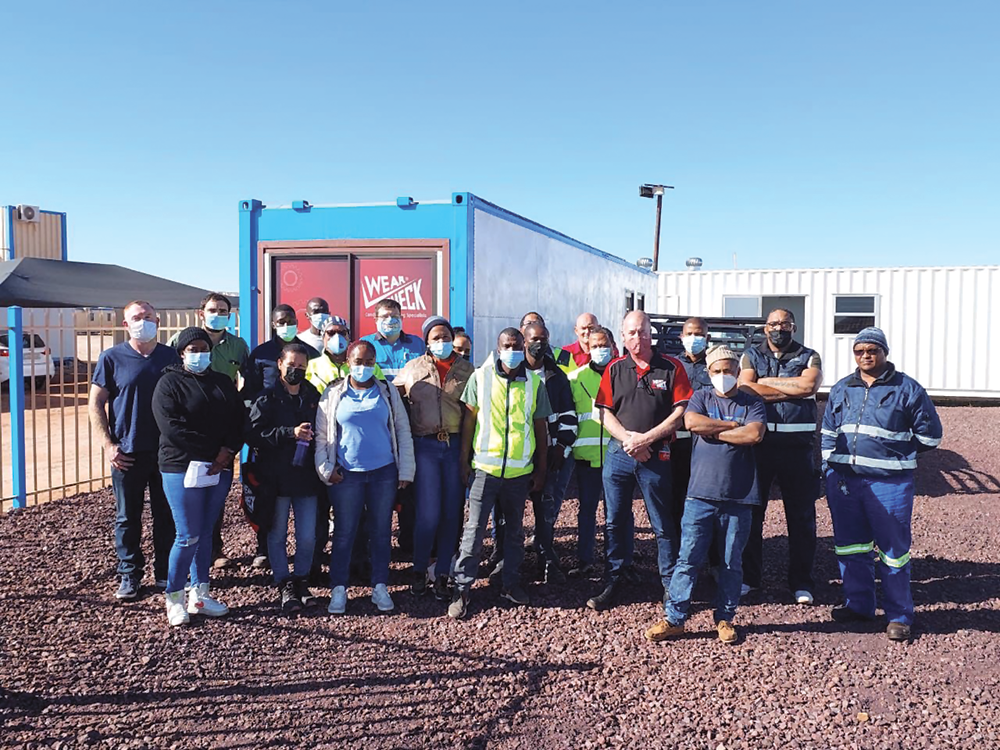 Staff from the Eurasian Resources Group based in the DRC who underwent training with WearCheck.
Often, the people charged with keeping mission-critical machinery running safely and efficiently have had limited access to structured, modern training. This results in skills gaps in maintenance disciplines, the very skills that determine whether a gearbox lasts another overhaul cycle, whether a transformer runs cool through summer, or whether a vehicle is parked idle to avoid component failure.
Condition monitoring specialist company, WearCheck is tackling this skills gap head on, offering a wide range of practical, hands-on courses that cover various topics related to condition monitoring and maintenance. Technical manager for WearCheck, Steven Lumley who oversees the company’s extensive training programme, explains that the courses are designed to be practical, current and immediately useful.
Heavy industry in the southern African region, including mining, manufacturing, power generation, transport and logistics, relies on rotating and electrical assets that fail in predictable ways.
Many crews excel at corrective tasks and heroic breakdown response, but are less confident about prevention. This includes condition-based lubrication, oil sampling and interpretation, precision alignment and balancing, basic vibration screening, thermographic inspection, and the ability to translate instrument readings into action. Add to that a generation shift with experienced artisans retiring and younger technicians stepping into responsibility too quickly, and the skills gap widens. When basic skills are uneven, plants lean more heavily on OEM callouts and run-to-failure habits, driving cost and risk.
WearCheck has trained thousands of technicians, artisans and engineers across Africa in the fundamentals that keep assets healthy. Courses are built around real plant scenarios, live demonstrations and hands-on exercises. Delegates graduate with real know-how they can apply on the next shift.
“Continual advancements in condition monitoring and reliability practice mean teams need structured, ongoing training. WearCheck’s programme design is anchored in practical, applied material that is constantly revised and updated to reflect the latest trends in technology,’ says technical manager, Steven Lumley.
To ensure that delegates gain maximum value from completing the training, many of the courses finish with a competency-based assessment, which must be completed before a certificate is issued. Many of WearCheck’s courses carry CPD points, giving both the learner and the employer external recognition.
WearCheck offers a choice of more than 15 courses covering a wide range of topics, from general oil analysis to transformer maintenance, thermography and many other reliability solutions services. Course presenters are WearCheck experts who are skilled in each field.
Oil analysis
WearCheck has run oil analysis courses for more than 20 years and has been accredited to run Mobius courses since 2015. The Mobius Institute is a global organisation that provides training and certification in reliability improvement, condition monitoring and precision maintenance. Oil analysis is the gateway condition monitoring discipline for many plants because it touches lubrication, contamination control and wear detection in one system. WearCheck’s courses start with the fundamentals: tribology basics, lubricant types and functions, and move through sampling techniques, contamination control, and the interpretation of lab reports.
Vibration analysis and precision maintenance
Mechanical reliability is won or lost at installation. Precision alignment, balancing and basic vibration know-how reduce destructive forces before they start. WearCheck delivers Mobius-aligned training from Category I to III, plus short, focused modules in precision shaft alignment and balancing.
Thermography
Heat is a universal language. Thermographic inspection helps maintenance teams find overloaded electrical connections, failing bearings, fluid blockages and insulation breakdown without dismantling equipment.
Transformer oil testing and electrical asset health
For plants with their own substations or distributed generation, transformer reliability is non-negotiable. WearCheck’s transformer oil training demystifies dissolved gas analysis (DGA), furan testing and moisture control.
The benefits
Across multiple industries, the pattern is consistent; when crews adopt a few good habits, equipment uptime improves and costs stabilise. Lumley outlines some typical milestones that customers attribute to training and follow-through:
• Cleaner oil, longer life: After sampling and contamination-control training, a mining customer tightened decanting practice and added simple breathers to critical gearboxes. Within months, particle counts dropped a grade and water ingress events all but disappeared. Drain intervals returned to planned targets and a persistent gearset replacement was deferred to the next major shutdown.
• Fewer premature bearing failures: A cement plant sent its fitters to precision alignment and balancing modules. The team changed its setup routine, checking base flatness, correcting soft foot, measuring thermal growth, aligning to published tolerances. Over the next quarters, unplanned bearing replacements on several fans and conveyors fell sharply, and vibration alarms reduced to manageable levels.
• Better use of lab data: A manufacturing plant wanted to move beyond ‘red/green’ oil reports. Maintenance personnel attended an interpretation course focused on trend analysis and common failure signatures. The plant now reviews exceptions weekly, opens targeted work orders, and feeds findings back to the lubrication team. Recurring wear metals on a set of gearboxes led to simple sealing and venting changes that eliminated dirt ingestion.
• Electrical risk reduced: A utilities customer introduced routine thermography after training its electrical team. Early inspections found multiple hot connections in a switchboard feeding a high-criticality line. Repairs were scheduled in a short, planned outage, and the risk of an extended trip during peak demand was averted.
• Transformers monitored, not guessed: A plant with ageing transformers built a dissolved gas analysis baseline and moisture control plan after training. One unit showed rising acetylene and ethylene, a sign of potential arcing, and was taken out for investigation before catastrophic failure. Another unit’s moisture trend was managed with online drying, avoiding a costly replacement.
These examples are the natural result when technicians are taught to see and measure the things that actually cause failures, and when supervisors build simple routines that make those measurements part of the working week.
The bottom line
There is nothing abstract about the skills gap in heavy industry. You can hear it in the rattle of a misaligned drive, see it in a milky sight glass and count it in lost production hours. Closing that gap does not require expensive new technology. It requires disciplined, current, practical training that gives technicians the confidence to do the simple things correctly and consistently.
WearCheck’s training offering is designed to do exactly that. It empowers crews to prevent avoidable failures, extend asset life and make better decisions sooner. Plants that commit to this journey report cleaner systems, fewer urgent callouts, steadier uptime and a maintenance culture that values evidence over guesswork.
In conclusion, Lumley reiterates the words of the engineering pioneer, Henry Ford: “The only thing worse than training your employees and having them leave, is not training them, and having them stay.”
To book a Mobius course, contact Louis Peacock,
| Tel: | +27 31 700 5460 |
| Email: | [email protected] |
| www: | www.wearcheck.co.za |
| Articles: | More information and articles about Wearcheck |






© Technews Publishing (Pty) Ltd | All Rights Reserved
 printer friendly version