



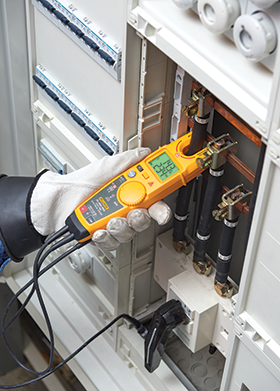
Voltage testers are valuable tools for professionals who work with electrical systems. They are used to verify the presence or absence of voltage in electrical circuits, ensuring safety and efficiency in various tasks. This application note will guide you on how to use a voltage tester effectively, and which Fluke voltage testers can assist in a variety of settings.
Voltage testers come in various forms, including non-contact voltage testers, contact voltage testers and multifunction testers. Fluke, a leading manufacturer of electronic test tools, offers a range of reliable and user-friendly voltage testers designed to meet different needs.
Types of voltage testers
• Fluke T6-1000 PRO Electrical Tester: Measures voltage up to 1000 volts AC and current up to 200 amps AC without contact. Displays voltage and current measurements simultaneously, providing visual cues for continuity in noisy environments.
• Fluke T5-1000 Voltage, Continuity, and Current Tester: Can measure current without breaking a circuit due to its OpenJaw design. Automatically selects AC or DC measurement up to 1000 volts.
• Fluke 1AC II Non-Contact Voltage Tester: Portable, non-contact voltage tester ideal for quick safety checks. Includes a continuous self-test feature and visual and audio cues during voltage detection. It can measure a range of currents from 90 to 1000 volts AC.
Using a voltage tester
These are some guidelines for using a voltage tester:
• Safety first: Always wear appropriate personal protective equipment (PPE) such as gloves and safety glasses. PPE needs will vary depending on the environment you test in, so refer to OSHA and NFPA guidelines to keep yourself safe when working with circuits.
• Ensure the voltage tester is in good working condition: This is done by performing a self-test if the device has this feature. If no self-test feature exists, make sure to visually inspect the device, and test leads and any accessories for signs of damage. If no damage is present, test the voltage tester on a known voltage source or proving unit to make sure it measures properly.
• Power off the circuit: Before using the tester, turn off the power to the circuit you are going to test at the main breaker panel.
• Test for voltage: For non-contact voltage testers, hold the tester close to the individual wire you want to test. The Fluke 1AC II will light up and beep if voltage is present. For contact voltage testers, touch the probes to the wires or terminals of the circuit. The Fluke T5-1000 and T6-1000 PRO will display the voltage reading on the screen.
• Interpret results: If no voltage is detected, it is safe to proceed with work on the circuit. However, if voltage is detected, further investigation is needed to ensure the circuit is safe to work on.
• Verify continuity: Set the tester to continuity mode. Touch the probes to the two points of the circuit. A continuous circuit will cause the tester to beep or display a continuity indicator.
• Record measurements: Note the voltage readings for documentation or further analysis. The Fluke T5-1000 and T6-1000 PRO feature a HOLD function to freeze the display if necessary.
Use cases for voltage testers
Fluke voltage testers can help test, troubleshoot and maintain circuits in a variety of settings. Here are a few typical applications showing which testers to use in each scenario:
• Verifying power supply: Use the Fluke 1AC II to quickly check if an outlet or power source is live before plugging in devices or performing maintenance.
• Troubleshooting circuit breakers: The Fluke T6-1000 PRO can measure voltage and current simultaneously, helping identify faulty breakers or overloaded circuits.
• Testing light fixtures: Ensure light fixtures are properly connected by using the Fluke T5-1000 or T6-1000 PRO to measure the voltage at the fixture’s terminals.
• Inspecting electrical panels: Use the Fluke T6-1000 PRO to safely measure voltage in electrical panels without making direct contact, reducing the risk of electric shocks.
• Checking outlet wiring: Verify that outlets are wired correctly by measuring voltage and continuity with the Fluke T5-1000.
• Maintaining industrial equipment: Regularly monitor the voltage and current of machinery with the Fluke T6-1000 PRO to ensure efficient operation and prevent downtime.
• Troubleshooting residential electrical issues: Homeowners and electricians can use the Fluke 1AC II or T5-1000 to check for live wires when installing or repairing electrical fixtures.
• Testing automotive electrical circuits: Use the Fluke T5-1000 to diagnose electrical issues in vehicles by measuring voltage in various automotive circuits.
• Maintaining HVAC systems: Ensure HVAC systems are receiving the correct voltage and functioning correctly with the Fluke T6-1000 PRO.
• Complete safety inspections: Conduct regular safety inspections in residential, commercial, and industrial settings using the Fluke 1AC II to detect any live wires or faulty installations.
Conclusion
Voltage testers are essential tools for ensuring electrical safety and efficiency when testing current sources. By understanding how to use these devices and recognising their applications, you can enhance your electrical testing and troubleshooting capabilities.
Fluke’s range of voltage testers, including the Fluke T6-1000 PRO, T5-1000 and 1AC II, provides reliable and accurate measurements for a variety of tasks. Whether you are verifying power supply, troubleshooting circuit breakers or conducting safety inspections, these tools help you perform your work safely and efficiently.
Product: www.tinyurl.com/47hphpf4
| Tel: | +27 10 595 1824 |
| Email: | [email protected] |
| www: | www.comtest.co.za |
| Articles: | More information and articles about Comtest |






© Technews Publishing (Pty) Ltd | All Rights Reserved
 printer friendly version