Direct-controlled seat valve
I&C February 2026
Pneumatics & Hydraulics
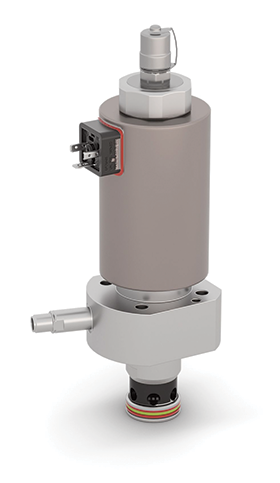
A new direct-controlled seat valve enables storage-free, load-tight holding functions in dynamic linear units without an additional control pressure supply, and offers significant advantages over classic, pilot-controlled solutions, particularly in stationary and servo hydraulics.
For many stationary applications in hydraulics, the demands on energy efficiency, process reliability and maintenance requirements are increasing. The new directly controlled seat valve from WEBER-HYDRAULIK, which can handle large volume flows with minimal pressure drop, creates new scope both in new development and in system modernisation. The valve combines several of these requirements in one powerful design.
Dynamics meets tightness
The focus is on the combination of high flow capacity (e.g., 100 l/min at only 1 bar pressure loss) and almost absolute seat tightness (maximum three drops per minute). This feature is essential, especially in safety-critical holding functions. Unlike conventional slide or proportional valves, the seat design prevents internal leakage and the load remains reliably in position without the need for control pressure.
Switching speed below 200 ms without control pressure
Switching times of ≤ 70 ms when opening and ≤ 180 ms when closing can be achieved. In many conventional control circuits, a separate control pressure is necessary, either from accumulators or additional pump units. The directly controlled valve, on the other hand, does not require control pressure. This simplifies the design, reduces the number of components and lowers maintenance costs.
Advantages in mechanical and plant engineering
The valve really comes into its own in machine and plant engineering, where modular, prefabricated plug-and-play units are becoming increasingly important. It can be flowed through on both sides and is therefore suitable for both simple switching functions and reversible motion sequences. In large servo-hydraulic axes such as in presses, test benches or automation solutions, the combination of dynamics and tightness allows cylinder positions to be maintained reliably, even when the pump is switched off.
Another key advantage is the flow-optimised design of the valve, which enables particularly low pressure losses while maintaining high volume flows. This allows servo-hydraulic systems to be designed even more efficiently. The directly controlled seat valve opens up new options for energy-efficient, dynamic and virtually leak-free hydraulic solutions. For designers who want to dispense with control pressure and at the same time require maximum load reliability, it represents a future-proof alternative to conventional hydraulic valve technology.
“The directly controlled seat valve opens up new options for energy-efficient, dynamic and virtually leak-free hydraulic solutions. For designers who want to dispense with control pressure while still requiring maximum load reliability, it represents a sustainable alternative to conventional hydraulic valve technology,” explains Dominik Vogt, head of the valve technology division.
For more information contact WEBER-HYDRAULIK, +49 7135 71 10907, kerstin.adam@weber-hydraulik.com, www.weber-hydraulik.com
Further reading:
Precision and durability in metal manufacturing and injection moulding
Parker Hannifin - Sales Company South Africa
Pneumatics & Hydraulics
From 800 bar hydraulic circuits in metal presses to low-pressure cooling systems in injection moulding machines, Parker Hannifin’s fluid connector systems are engineered for the contrasting demands of high-pressure sealing, thermal resistance and rapid serviceability.
Read more...
BMG expands fluid technology portfolio with Boston by Danfoss industrial hose
Bearing Man Group t/a BMG
Pneumatics & Hydraulics
BMG has added the Boston by Danfoss Industrial Hose range to its fluid technology portfolio, giving customers a single source for both hydraulic and industrial hose requirements across Africa.
Read more...
Pneumatic solutions for versatility, operational safety and efficiency
Pneumatics & Hydraulics
As an authorised partner of Festo, BMG combines access to globally recognised pneumatic technologies with local application expertise and technical support.
Read more...
Turning compressed air into a strategic energy advantage
Pneumatics & Hydraulics
Compressed air accounts for up to 80% of a system’s lifecycle costs, yet often remains overlooked in energy strategies. CompAir’s Energy Check provides a data-driven analysis of the complete compressed air network to identify energy savings of 20 to 30% or more.
Read more...
Air compressor secures premium meat company’s legacy
Pneumatics & Hydraulics
A tailored ELGi compressed air solution from Integrated Air Solutions is helping Tulisa Meat Market protect six decades of quality and consistency in its premium meat production.
Read more...
How laser cladding delivers 33% more life and maximum ROI in hydraulic cylinders
Pneumatics & Hydraulics
By utilising advanced laser cladding, Honingcraft can help clients achieve a 33% longer life from their components, ensuring they secure the maximum return on their investment.
Read more...
Identifying signs of hydraulic cylinder wear and tear
CT Hydraulics (Nqoba)
Pneumatics & Hydraulics
Recognising the early warning signs of hydraulic cylinder degradation is crucial for preventing costly downtime, ensuring operator safety and maximising the lifespan of your hydraulic systems.
Read more...
Integrated Air Solutions opens Pinetown branch
Pneumatics & Hydraulics
Integrated Air Solutions has opened a branch in Pinetown, bringing world-class diesel and electric air compressor services closer to customers in KwaZulu-Natal.
Read more...
Cartridge-style flowmeter
Axiom Hydraulics
Pneumatics & Hydraulics
Sun’s new cartridge-style flowmeter QMEH delivers precise, real-time flow measurements for demanding hydraulic applications. Using a custom-built, state-of-the-art sensor, the QMEH accurately detects flow and converts the electrical signal into a proportional flow rate.
Read more...
Robust sensors for pneumatic applications
ifm - South Africa
Pneumatics & Hydraulics
The pressure sensors from ifm have a G1/8 process connection, combined with a welded thin-film measuring cell. While offering an unbeatable price/performance ratio, this technology provides for high measuring accuracy in a very compact and robust housing.
Read more...










 printer friendly version