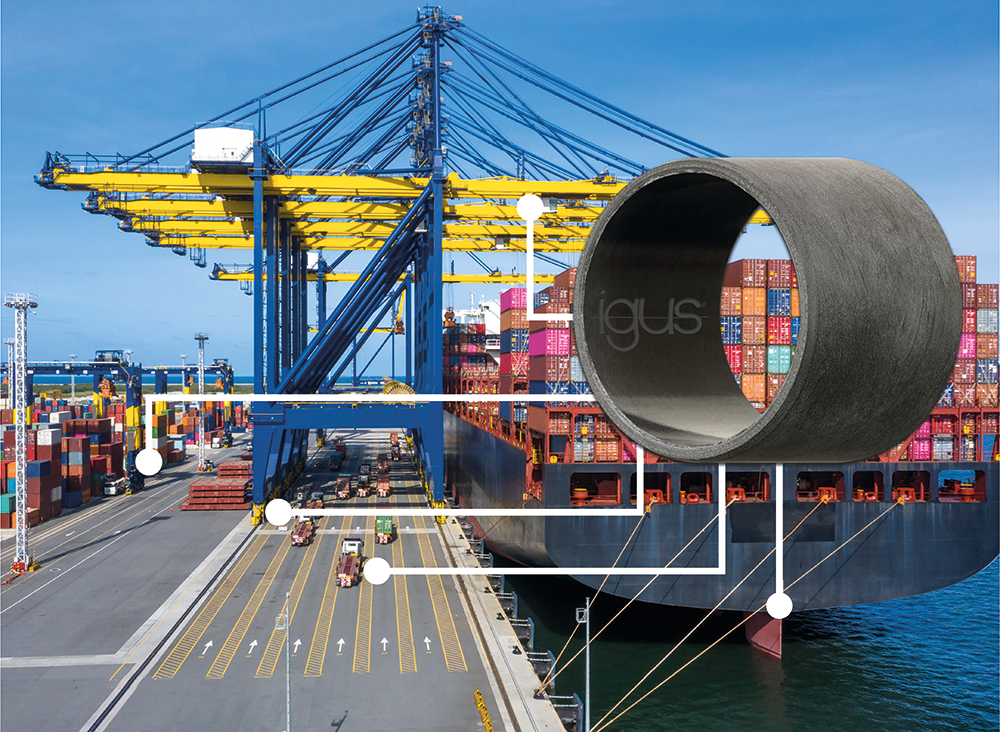
Polymer technology is increasingly being used in heavy lifting equipment and other industrial machinery, where it is replacing steel bearings for strength and durability in a growing range of demanding applications. World leading polymer bearing manufacturer, igus, produces a wide range of polymer bearings that do not require external lubrication and are resistant to corrosion. This makes them ideal for environments where dirt, moisture or abrasive particles can quickly destroy traditional bearings. Manufactured from advanced tribologically-optimised polymers they deliver minimal wear and a long service life, even under high loads in applications like lifting.
“In South Africa, we found that one of the key advantages of polymer bearings in heavy lifting equipment is their ability to operate reliably in ‘dirty’ conditions, such as timber processing, construction and mining. Sawdust, sand or grit that might cause steel bearings to seize or wear prematurely have little effect on polymer surfaces. This ensures consistent reduced downtime and significantly lower maintenance costs,” says igus product manager, Juan-Eric Davidtz.
He adds that the versatility of polymer bearings extends across industries. They combine strength with lightweight design, resist chemicals, dampen vibration and can be tailored for specific load or temperature ranges. Importantly, they last longer than steel bearings in many real-world applications where lubrication is inconsistent or where contaminants are present.
• Lifting applications where polymer bearings replace steel for longer life include:
• Scissor lifts: Pivot points and joints that handle high loads and repeated cycles.
• Forklifts: Steering, mast and lift linkages, especially in dusty or wet conditions.
• Boom lifts and cherry pickers: Articulating joints that carry heavy platforms safely.
• Crane booms and hoists: Corrosion-resistant, low-maintenance pivot points.
• Dock levellers: Hinges and pivots exposed to continuous movement and debris.
• Hydraulic lift tables: Bushings and pins that endure high compression forces.
• Mobile platform lifts: Bearings that ensure smooth motion in all positions.
• Warehouse stackers: Heavy-duty pivot points in compact, high-use environments.
• Material handling trolleys: Lift mechanisms that resist wear from repetitive loads.
• Telehandlers and telescopic lifts: Joints and pivots with long-lasting, lubrication-free operation.
“The adoption of polymer bearings in lifting equipment is all about educating engineers and service technicians who are used to using steel bearings and lubrications and are not yet aware of the higher performance abilities of our modern-day polymers. These are often much more durable and efficient, and in some cases, a simple switch to polymer bearings can save companies hundreds of thousands of rands in maintenance savings. Wherever we work with companies to find solutions for their lifting equipment challenges, we have our customer’s designers and operators comment that the machines operate more reliably and require less maintenance in tough industrial environments,” concludes Vavidtz.
Smarter motor technology for high-performance industrial automation Adroit Technologies
Motion Control & Drives
Adroit Technologies is bringing Mitsubishi Electric’s EM-A series permanent magnet motors to Africa, offering servo-like speed and position control at a lower cost by combining patented sensorless control with the FR-E800 inverter to eliminate encoders while achieving IE5 efficiency.
Read more...A smarter approach to simplifying motion architecture
Motion Control & Drives
n motion system design, the wiring and drive placement between motor and drive are often decided by default, yet they shape a machine’s cost, footprint and adaptability. Kollmorgen sets out how single-cable and decentralised architectures simplify the cabinet.
Read more...Robotic case packer achieves 99% uptime Rockwell Automation
Motion Control & Drives
DCC Automation designed a new robotic case packer for a nutrition supplement manufacturer using delta robots and a unified Rockwell Automation control platform, cutting changeover time from 45 minutes to 5 minutes, and achieving 99 to 99,5% uptime against the previous 10% per-shift downtime.
Read more...igus puts 3D-printed wear materials to the test igus
Motion Control & Drives
A new igus white paper compares its tribological iglidur 3D-printing materials directly with conventional POM, reporting lower wear, more stable friction and up to ten times longer service life in gear testing for customised, low-volume and replacement components.
Read more...SEW-EURODRIVE’s expanded local engineering capability SEW-EURODRIVE
Editor's Choice Motion Control & Drives
At Electra Mining Africa, SEW-EURODRIVE demonstrated how its expanded local engineering capability, digital technologies and lifecycle support strategy help customers improve reliability, energy efficiency and total cost of ownership across the full life of their drive assets.
Read more...Latest Danfoss automation drive Bearing Man Group t/a BMG
Motion Control & Drives
BMG has launched the Danfoss iC7-Automation enclosed variable speed drive range in South Africa, backed by significant local stockholding of 400 V models up to 710 kW, approved warranty workshops, and DrivePro digital asset management support.
Read more...Severe-duty workhorses powering mining
Motion Control & Drives
Mining machines such as rock crushers, pumps and conveyors need motors that combine high torque with robust enclosures, seals and cooling. WEG Africa explains how severe-duty motors deliver more than a decade of reliable performance in harsh conditions while meeting modern energy-efficiency standards.
Read more...Looking beyond the spec sheet when choosing motion architecture
Motion Control & Drives
When machine builders focus only on torque, speed and price, engineering time, integration effort and long-term maintainability get overlooked. Kollmorgen explains how thinking at the system level, not the component level, leads to better motion architecture choices.
Read more...Economy drive system closes the drive gap in the entry-level segment Beckhoff Automation
Editor's Choice Motion Control & Drives
Beckhoff has launched an economy drive system pairing its new AX1000 servo drive and AM1000 servomotor with the AF1000 dual-axis variable frequency drive on a shared EtherCAT platform, targeting series machines and price-sensitive markets without sacrificing TwinCAT integration or functional safety.
While every effort has been made to ensure the accuracy of the information contained herein, the publisher and its agents cannot be held responsible for any errors contained, or any loss incurred as a result. Articles published do not necessarily reflect the views of the publishers. The editor reserves the right to alter or cut copy. Articles submitted are deemed to have been cleared for publication. Advertisements and company contact details are published as provided by the advertiser. Technews Publishing (Pty) Ltd cannot be held responsible for the accuracy or veracity of supplied material.










 printer friendly version