



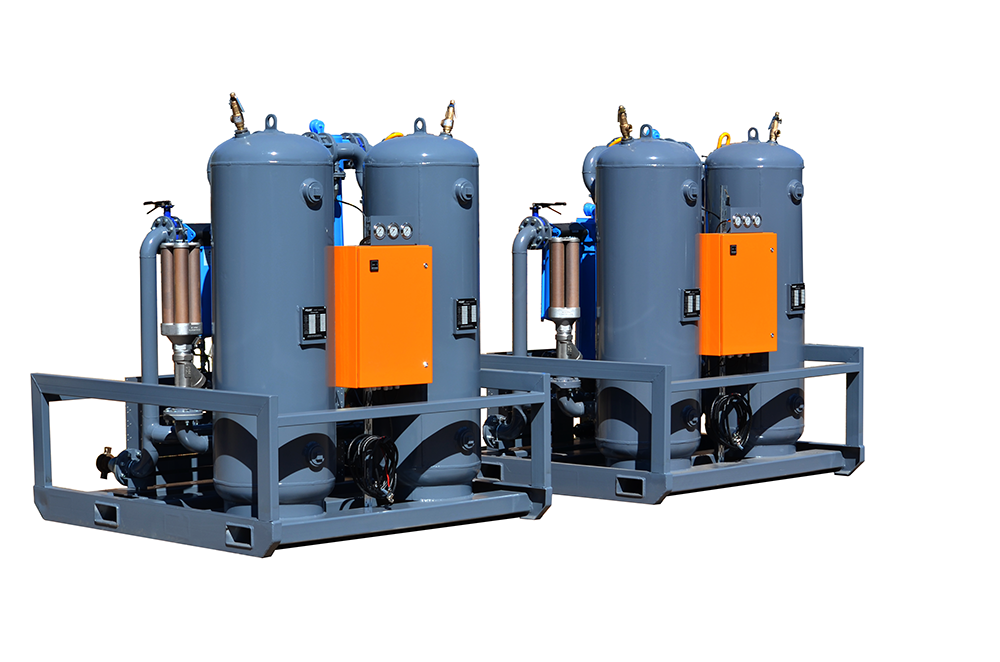
Compressed air is an expensive source of motive power, so it makes good sense to supply clean, dry compressed air to your distribution system. This ensures that pneumatics, control instrumentation and bulk pneumatic transport systems operate faultlessly 24/7/365. Your compressed air needs treatment prior to introduction to the air system, and your choice of compressed air treatment is driven by the air quality demands of your plant.
Low dewpoint dryers
If ultra-dry compressed air is required with very low dewpoints in the minus 40°C range, then the choice is really about which type of pressure swing desiccant air dryer you will install.
If the flow requirements for low dewpoint compressed air are relatively small compared with the total air flow, a decentralised desiccant air dryer can be installed at the point of use. This will reduce capital costs and the wastage of purge air imposed by heatless air dryers.
Volumes less than 50 m3/min can be handled by pressure swing heatless air dryers. These may be equipped with dew point controls to reduce compressed air purge wastage by extending cycle times. Above these volumes, heat regenerative dryers can be considered. They are more expensive than the heatless varieties, but offer operational cost savings by reducing the air purge wastage. The feed air to this dryer style should be from oil-free compressors.
The Sahara range of desiccant heatless dryers is locally built to survive the harshest conditions. The dryers are constructed on a heavy-duty skid fitted with forklift slots to fit into standard
Any desiccant air dryer is susceptible to compressor oil contamination. Oils are detrimental to the adsorption chemical’s ability to remove water vapour from the compressed air stream. This can lead to poor dew points and wet compressed air. Compressor oils therefore need to be eliminated from the incoming air stream.
Dewpoint controllers and alarms can be fitted to any desiccant air dryer to either extend cycle times, or to act as an alarm system in the event of a compressed air quality problem.
Refrigeration dryers
For dew points above 3°C the natural choice is a refrigeration air dryer. The capital cost is lower than its desiccant cousin. Reliable and cost-effective, refrigeration dryers are easy to install and maintain. But, if aggressive airborne contaminants are in the atmosphere, the copper and aluminium in the refrigerant dryers will be exposed to the ambient air. In our dryers, the internals that are in contact with compressed air are manufactured from stainless steel.
Dryer selection for ambient conditions
Always remember to re-rate the dryer’s capacity for your local ambient air temperature. Failure to do this will lead to a multitude of problems caused by excessive heat loads, adversely affecting the refrigeration circuit within the dryer. This can lead to HP gas trips and/or fridge pack failures. Lubricated compressed air may be handled by these dryers with no real issues. Desiccant air dryers are also adversely affected by temperature and pressure.
Inlet pressures will also affect the sizing of any dryer, so don’t forget to consult the potential supplier before you purchase the unit. If the re-rate factors for ambient air, inlet air temperature and air pressure are not shown in the sales brochure, we suggest you look for an alternative supply chain.
Compressed air treatment
The use of pad separators helps remove bulk water and oil contamination prior to inline coalescing filters. These pad separators have less contamination load, and therefore elements will last longer. After filtration, it is also essential to ‘polish’ the air downstream of the dryer prior to delivering the compressed air to your system. Filtration media can also be detrimentally affected by high inlet air temperatures and low inlet pressures. The lower the inlet temperature the better, ideally less than 40°C. Study the sales literature in depth or consult the proposed supply chain to ensure reasonable service intervals. It is possible to get oil vapour contamination down to 0,001 mg/m3, or even lower, if activated carbon filters or towers are installed.
Inline filtration is never cheap, and it is prudent to oversize the casings relative to the inlet air flow rate. This will assist with reducing pressure drops across the filter bank, giving the elements longer service life intervals between change-outs.
Automatic drainage
The drainage of condensate from air filters and refrigeration dryers is vital. Reliable autocondensate drains are critical. Elements ‘drowning’ in condensate in the base of the casing will not function and may well collapse. The choices range from low-cost, simple, timer solenoid drains to sophisticated level-controlled units that will send an alarm if they fail to eject the condensates.
Condensate management
While considering the choice of air filters and dryers, do not neglect the oily water waste condensate treatment system to ensure that waste compressor oils are separated from the water condensates, retained and properly disposed of when the adsorption cartridge is saturated.
The clear clean water condensate, the largest component, is allowed to run to waste, while the oils are retained for proper waste disposal. A litre of waste compressor oil can, and will, contaminate a square kilometre of wetland area.
Having bought the equipment, you should take a long hard look at where and how the equipment will be installed. You can contact Artic Dryers to have the publication ‘Notes on Compressor House Design’ sent to you, it’s a thought-provoking read.
Compressed air quality testing
Artic is able to monitor particle, dewpoint and residual oil levels from one mobile or static auditing data logger, and to monitor a variety of gases via the unit. Dewpoint monitoring provides an early warning of a dryer treatment system hiccup. This is a better solution than relying on an operator.
For more information contact Artic Driers International,
| Tel: | +27 11 420 0274 |
| Email: | [email protected] |
| www: | www.articdriers.co.za |
| Articles: | More information and articles about Artic Driers International |






© Technews Publishing (Pty) Ltd | All Rights Reserved
 printer friendly version