



What are ISO standards and why do they matter to us?
The International Organisation for Standardisation (ISO) develops and publishes standards that provide a consistent framework for products and services globally. When we manufacture a hydraulic cylinder or a component of it to an ISO standard, we’re meeting a specific, internationally recognised benchmark for quality, safety and performance. Using ISO standards helps industry speak a universal language of quality. For our customers, this means:
• Trust and reliability: It gives you confidence that the products you source from us are dependable and will perform exactly as expected.
• Global compatibility: It ensures our components are compatible with systems worldwide, which opens up new markets and opportunities for you.
• Risk reduction: It significantly reduces the likelihood of product failures, costly recalls and warranty claims.
Key ISO standards in hydraulic cylinder manufacturing
While there are many ISO standards, a few are particularly relevant to hydraulic components. The most important ones are:
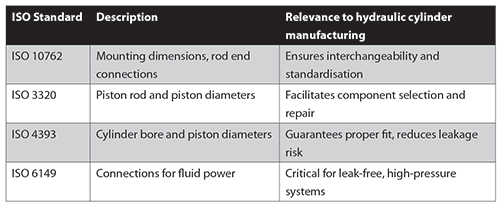
• ISO 10762: Mounting dimensions and rod end connections. This standard is fundamental as it defines the mounting dimensions and rod end connections for single-rod hydraulic cylinders. It ensures that a cylinder manufactured by us can be easily interchanged with a cylinder from another company, as long as both comply with ISO 10762. It covers bore diameters from
• ISO 3320: Piston rod and piston diameters. This standard specifies the preferred diameters for piston rods and pistons. By following this, we ensure that our components fit a wide range of standard cylinders, making it easier for you to select replacement parts or design new systems.
• ISO 4393: Cylinder bore and piston diameters. Similar to ISO 3320, this standard focuses on the diameters of the cylinder bore and piston. Compliance ensures a proper fit and optimal performance, minimising leaks and extending the life of the cylinder.
• ISO 6149: Connections for fluid power and general use. This standard specifies the dimensions, design and performance requirements for ports and stud ends for use in hydraulic and pneumatic systems. It is crucial for ensuring leak-free connections, which is a major concern in high-pressure applications.
How to use ISO standards to your advantage
Knowing about these standards is one thing, leveraging them to build a better business for you is another. The following table provides a quick reference for some of the critical ISO standards and their relevance to the components we supply (see table).
Beyond the standards
For professionals in the hydraulics field, making the right decisions about where to source components can directly impact the success of a project. Using a trusted supplier that understands and applies ISO standards consistently is a strategic move. It saves you time, reduces risk and ensures you’re always delivering a top-tier product.
While ISO standards provide a solid foundation, true quality goes beyond just the specifications. It’s about the materials we use, the precision of our machining, and the quality control throughout the entire hydraulic cylinder manufacturing process. Honingcraft provides a comprehensive range of components, from honed tubing to chrome bars, all manufactured with precision and a deep understanding of industry requirements. Understanding and applying ISO standards is a critical step towards producing superior hydraulic cylinders, but true success comes from partnering with a company that shares your commitment to quality and precision.
For more information contact Honingcraft,






© Technews Publishing (Pty) Ltd | All Rights Reserved
 printer friendly version