



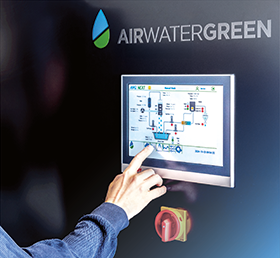
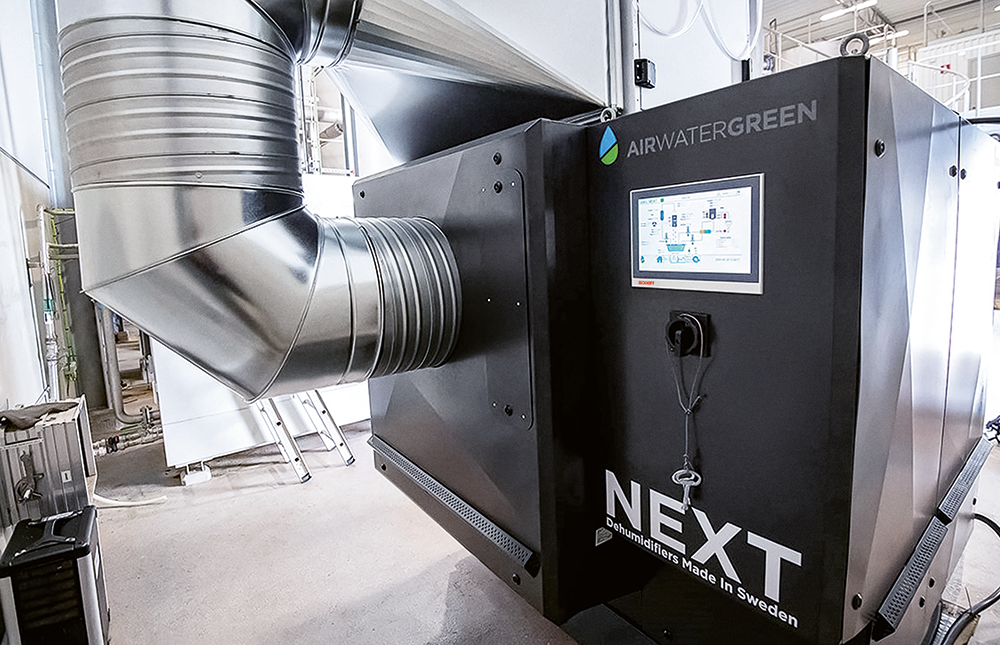
With NEXT, the Swedish company Airwatergreen AB is breaking new ground in the dehumidification of air in industrial buildings and warehouses. The patented CVP technology reduces energy requirements and ensures an indoor climate that prevents corrosion and mould growth. PC-based control from Beckhoff regulates this innovative process,and due to its open nature, enables networking and remote maintenance of the systems, including energy tariff-optimised and cost-saving operation.
Airwatergreen specialises in indoor climate solutions that reduce energy consumption by between 30 and 70% compared to conventional technologies. Their CVP technology works with a liquid drying agent and uses the principle of absorbing water vapour from the air. The temperature and concentration of the solution, i.e., its vapor pressure, determine its ability to extract water vapour from the air or to add it in. The concentration can be regulated, so that when the device releases the air it has previously drawn in, it has a relative humidity of between 30 and 90%. “Our technology generates the optimum air quality in terms of humidity directly in the production hall or warehouse, eliminating the need for complicated evacuation systems,” explains Bo Tiderman, CEO of Airwatergreen.
Indoor climate is relevant to the process
NEXT meets the specific humidity control requirements of many industries, including food production and storage, logistics, water and wastewater management, and the preservation of historically significant buildings. In all of these industries there is a need to regulate moisture levels to prevent damage to structures, materials or equipment.
As the NEXT devices only need to discharge the water collected during dehumidification, installation is much simpler than with conventional air conditioning systems. In addition, the control system implemented with TwinCAT 3 avoids operation at times of day when electricity prices are high, without compromising on cooling or dehumidification performance. “This sustainable, energy-optimised operation is something that many interest groups are calling for across a range of industries,” says Tiderman.
Fanless embedded PC as control centre
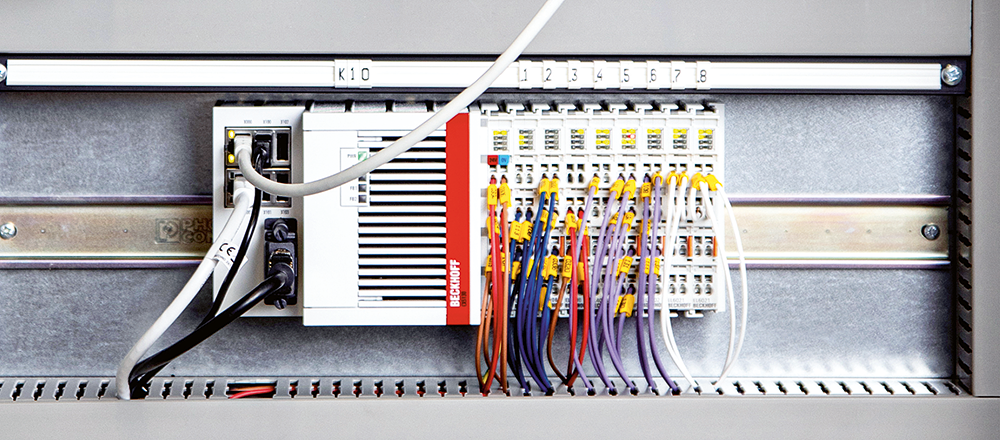
After evaluating various alternatives, Airwatergreen opted for a CX5130 embedded PC as the controller, because its multi-core Intel Atom processor with a clock frequency of 1,75 GHz, provides sufficient computing power to evaluate the data and control the vapour pressure, the circulation pump and the fan motor. “The compact, fanless design and low power consumption of the embedded PC, as well as TwinCAT 3 as a flexible engineering platform, made PC-based control the ideal choice for us,” says David Johansson, development engineer at Airwatergreen. For operation, Airwatergreen uses a compact CP29xx multi-touch built-in control panel with visualisation implemented by means of a TwinCAT 3 HMI which supports comprehensive remote monitoring. “If, for example, there is an unexpected deviation in humidity, an alarm is triggered immediately so that the operator can take action right away,” says Johansson.
One or more NEXT units are installed and networked with each other, depending on the size of the building and the different indoor climate requirements. Sensors in the rooms and parts of the building provide the necessary data to control dehumidification. The wide range of connection options via the EtherCAT terminals and gateway functions facilitate networking with other building automation components and the integration of sensor technology at I/O level.
High market expectations
Airwatergreen has installed around 20 NEXT systems since the market launch. “The potential is considerable due to the wide range of applications,” says Tiderman confidently. He expects sales to increase to several hundred devices per year in the foreseeable future. As the machines are suitable for different indoor climate control systems with temperatures from 0 to 40°C, they can be used in a wide range of industries. According to Tiderman, the ROI of the dehumidifiers is usually two to three years, regardless of whether existing humidification systems are being replaced or NEXT is being integrated into new construction projects as part of the ventilation infrastructure.
| Tel: | +27 11 795 2898 |
| Email: | info@beckhoff.co.za |
| www: | www.beckhoff.com |
| Articles: | More information and articles about Beckhoff Automation |






© Technews Publishing (Pty) Ltd | All Rights Reserved
 printer friendly version