



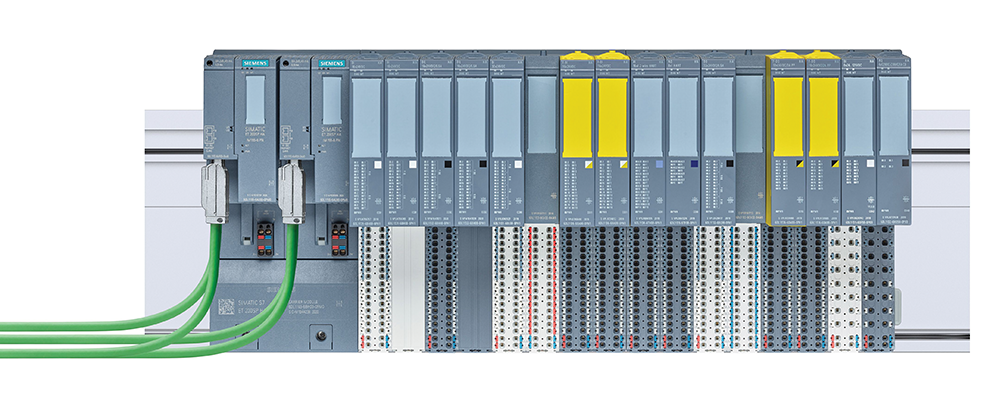
Industrial automation is evolving at an unprecedented pace, driven by the pursuit of operational efficiency, reduced downtime and the integration of digital technologies. At the forefront of this transformation is the Siemens SIMATIC ET 200SP HA Distributed I/O system, which challenges conventional approaches to process control infrastructure. This is a flexible and scalable distributed I/O system for modern signal transfer from the field to the control level. It redefines control cabinet concepts, reduces costs, enhances productivity and lays the groundwork for digitalisation.
From centralised to distributed intelligence
Traditional industrial control systems have long relied on centralised architectures where massive control cabinets house countless I/O modules and extensive wiring with the need for multiple protective devices. These challenges increase not only capital expenditure, but also operational complexity. Siemens recognised the need for a smarter approach and developed the SIMATIC ET 200SP HA, a system that eliminates many of these inefficiencies while boosting reliability.
The SIMATIC ET 200SP HA represents a fundamental change in approach bringing intelligence closer to the process while dramatically reducing infrastructure complexity. Its distributed architecture redefines how industrial systems can be designed, installed and maintained. By eliminating the constraints of centralised control rooms, engineers gain unprecedented freedom to optimise their automation strategies based on process requirements rather than hardware limitations.
Less space, more performance
The most striking characteristic of the SIMATIC ET 200SP HA is compactness. This miniaturisation is achieved without sacrificing functionality. With up to 32 channels on a module measuring just 22,5 mm in width, the system achieves channel densities once unimaginable. It supports up to 56 I/O modules per rail, enabling significant density within a small footprint. This translates directly to fewer cabinets, reduced wiring complexity, simplified installation and enhanced reliability through fewer interconnections, resulting in lower costs.
Eliminating redundant components
One of the SIMATIC ET 200SP HA’s notable features is its ability to replace traditional fuses and circuit breakers. Monitored short-circuit protection is integrated into the transmitter supply, making individual fuses unnecessary. Modules are protected with cost-effective fuses activated through integrated pushbuttons. The result is a simplified architecture with fewer components, reduced maintenance and lower costs.
Built-in intelligence also speeds up fault diagnosis. Channel-specific diagnostic information enables technicians to identify and resolve issues quickly, cutting downtime significantly.
Maximum availability for critical operations
In industries where uptime is mission-critical, availability cannot be compromised. The SIMATIC ET 200SP HA has been designed with high availability as a core principle. Interface modules are offered for both simple and redundant connections to automation systems. Stations can be extended or modules replaced without interrupting operation, a key advantage for continuous processes. For plants requiring redundancy at the module level, Siemens integrates redundancy directly into the terminal blocks. This approach avoids the need for external components or complex additional wiring, making redundancy both easier and more cost-effective to implement.
Built for harsh environments
Industrial settings demand robust solutions. The SIMATIC ET 200SP HA meets these demands with specifications that exceed typical requirements. It operates reliably from -40 to 70°C and at altitudes up to 4000 metres, making it suitable for diverse climates.
Conformal coating on all components adds protection against contaminants, moisture and corrosive substances, extending lifespan and reducing maintenance. Enhanced electromagnetic compatibility (EMC) resistance according to NAMUR NE21 standards ensures reliability in electrically noisy environments.
Certification for Ex Zone 2 makes it suitable for potentially explosive atmospheres. This ruggedness ensures the system is dependable in mission-critical applications.
Accelerating project execution
Plant modernisation and expansion are often slowed by installation and commissioning complexity. Siemens addresses this with design features that standardise and simplify project execution. The SIMATIC ET 200SP HA incorporates push-in technology that enables tool-free wiring, reducing installation time and minimising connection errors. This is especially beneficial for projects with tight commissioning schedules or frequent configuration changes.
Standardised terminal block design across all 24 V signal types further simplifies installation and maintenance. Technicians need to learn only one terminal configuration, reducing training needs and potential errors.
The separation of I/O modules and terminal blocks allows pre-wiring before module installation, supporting flexible scheduling and parallel work streams. Electrical contractors can complete wiring while automation engineers finalise configurations, significantly reducing project timelines.
Integrated safety and protection features
Safety is paramount in industrial automation and the SIMATIC ET 200SP HA addresses these concerns through integrated protection mechanisms. The system includes monitored short circuit protection within its transmitter supply, eliminating the need for individual field device fuses. This integration not only reduces component count, but also provides channel-specific diagnostic information that accelerates troubleshooting procedures.
High availability and redundancy capabilities
Modern industrial processes cannot tolerate extended downtime making high availability a critical system requirement. The SIMATIC ET 200SP HA addresses this need through multiple redundancy options and hot-swappable components. Interface modules are available for both simple and redundant connections to automation systems, allowing engineers to tailor reliability levels to specific process requirements.
By supporting hot-swappable I/O modules, the system enables maintenance and upgrades without process interruption. This capability proves particularly valuable in continuous process industries where unplanned shutdowns result in significant economic losses.
For applications requiring the highest reliability, the system offers terminal blocks with integrated I/O redundancy that operate without external components or additional wiring. This integrated approach simplifies redundant system design, while maintaining the compact footprint that characterises the entire product line.
Future-ready connectivity and digital integration
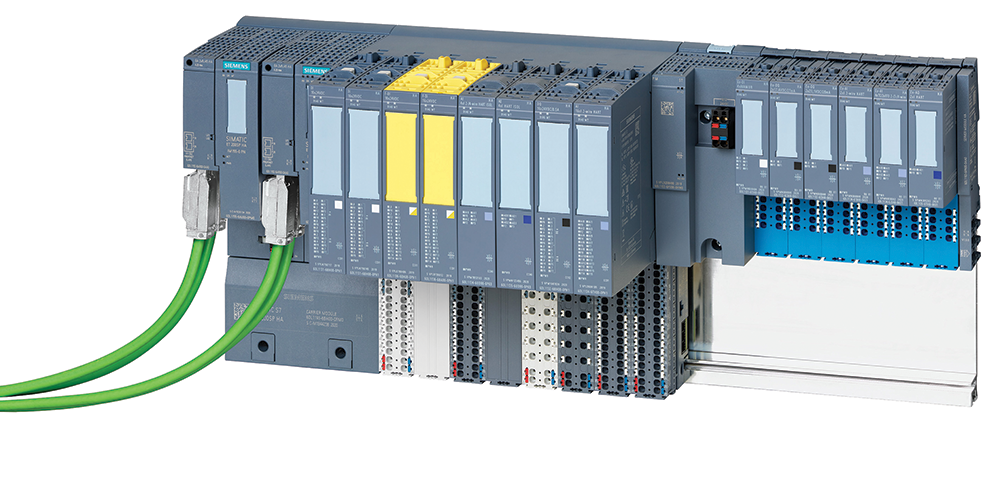
The SIMATIC ET 200SP HA incorporates modern communication standards through its PROFINET connectivity. This support enables seamless integration with modern automation architectures, while providing the bandwidth necessary for advanced diagnostic and monitoring capabilities. It supports predictive maintenance strategies, where continuous monitoring of system parameters enables proactive intervention before failures occur.
The system’s diagnostic capabilities extend beyond simple fault detection to provide detailed operational insights that support optimisation efforts. The system-integrated Powerbus further enhances connectivity options while reducing wiring complexity. This integrated approach aligns with Industry 4.0 principles by providing the communication infrastructure necessary for smart manufacturing initiatives.
Economic impact and return on investment
The economic benefits of the SIMATIC ET 200SP HA extend far beyond initial hardware costs. The system’s compact design enables massive savings in control cabinet requirements and improved space utilisation in control rooms. These space savings translate directly to reduced facility costs, particularly valuable in urban industrial locations where real estate commands premium pricing. The elimination of trunk cables through decentralised installation approaches provides additional cost savings while improving system reliability. Reduced wiring complexity translates to lower installation costs and fewer potential failure points throughout the system lifecycle. Maintenance cost reductions result from simplified diagnostic procedures, standardised components and integrated protection features. The system’s channel-specific diagnostic capabilities enable targeted maintenance interventions, reducing both labour costs and spare parts inventory requirements.
A future-ready platform
As industries start implementing digital transformation, flexible and scalable infrastructure becomes increasingly important. By combining robust hardware with intelligent diagnostics and seamless connectivity, Siemens has created a platform that not only solves today’s challenges, but also anticipates tomorrow’s needs. Whether the goal is to reduce capital expenditure, improve plant availability or prepare for Industry 4.0 integration, the SIMATIC ET 200SP HA delivers a flexible, scalable and future-proof solution.
For more information contact Siemens South Africa, cbcqueries.za@siemens.com, www.siemens.co.za






© Technews Publishing (Pty) Ltd | All Rights Reserved
 printer friendly version