



Quantum computers still face a major hurdle on their pathway to practical use cases–their limited ability to correct the arising computational errors. To develop truly reliable quantum computers, researchers must be able to simulate quantum computations using conventional computers to verify their correctness – a vital yet extraordinarily difficult task. In a world first, researchers from Chalmers University of Technology in Sweden have now unveiled a method for simulating specific types of error-corrected quantum computations – a significant leap forward in the quest for robust quantum technologies.
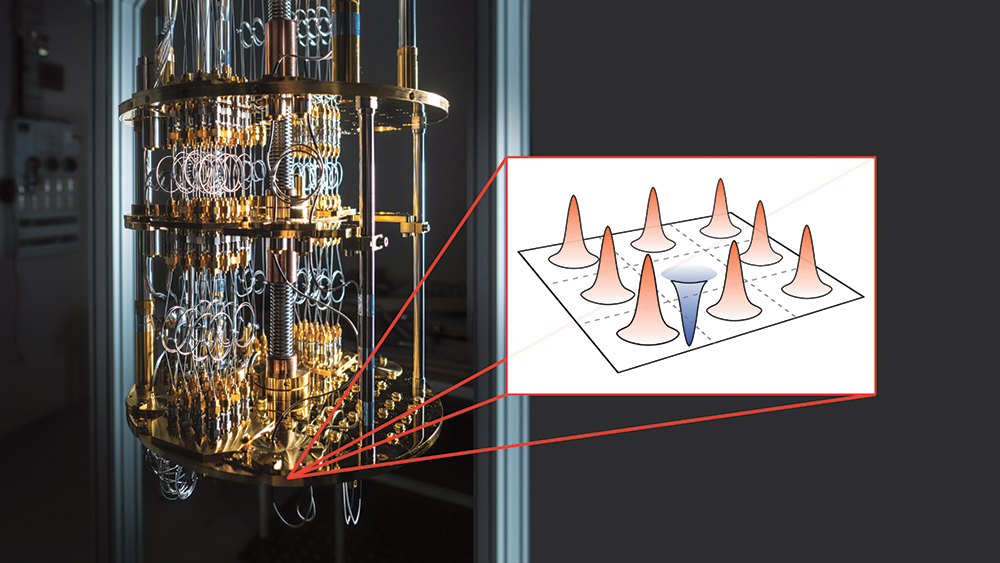 Illustration: Chalmers University of Technology: Cameron Calcluth.
Quantum computers have the potential to solve complex problems that no supercomputer today can handle. In the foreseeable future, quantum technology’s computing power is expected to revolutionise fundamental ways of solving problems in medicine, energy, encryption, AI and logistics. Despite these promises, the technology faces a major challenge, correcting the errors arising in a quantum computation. While conventional computers also experience errors, these can be quickly and reliably corrected using well-established techniques. In contrast, quantum computers are subject to far more errors, which are harder to detect and correct.
To verify the accuracy of a quantum computation, researchers simulate the calculations using conventional computers. One important type of quantum computation that researchers are interested in simulating is one that can withstand disturbances and effectively correct errors. However, the immense complexity of quantum computations makes such simulations extremely demanding – so much so that in some cases even the world’s best conventional supercomputer would take the age of the universe to reproduce the result.
Researchers from Chalmers University of Technology are the first in the world to present a method for accurately simulating a certain type of quantum computation that is particularly suitable for error correction, but which thus far has been very difficult to simulate. “We have discovered a way to simulate a specific type of quantum computation where previous methods have not been effective. This means that we can now simulate quantum computations with an error correction code used for fault tolerance, which is crucial for being able to build better and more robust quantum computers in the future,” says Cameron Calcluth, PhD in Applied Quantum Physics at Chalmers.
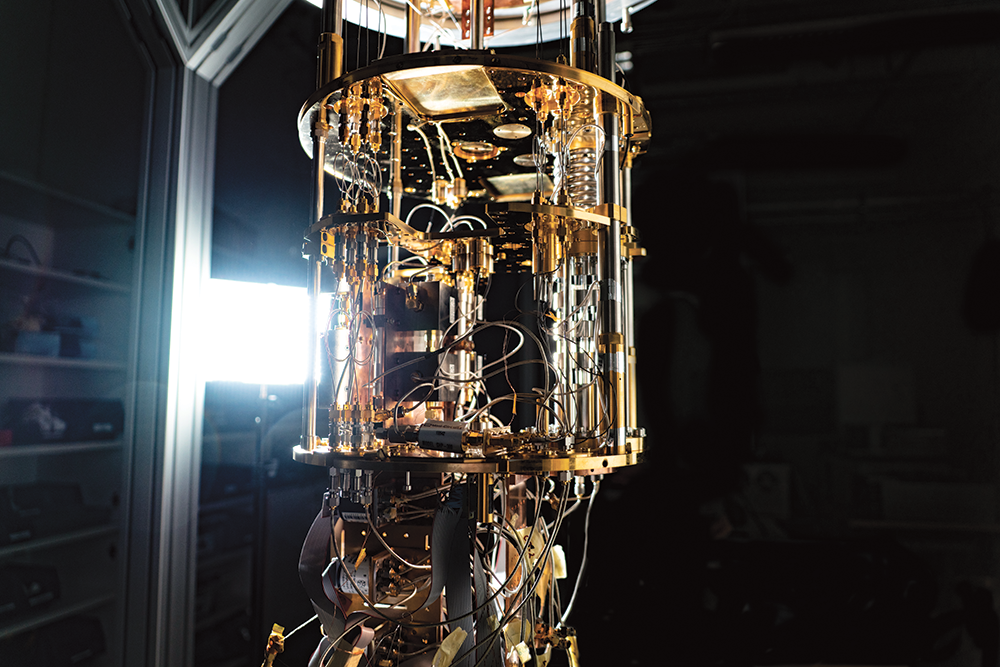 Photograph: Chalmers University of Technology
Error-correcting quantum computations
The limited ability of quantum computers to correct errors stems from their fundamental building blocks – qubits – which have the potential for immense computational power but are also highly sensitive. The computational power of quantum computers relies on the quantum mechanical phenomenon of superposition, meaning qubits can simultaneously hold the values 1 and 0, as well as all intermediate states, in any combination. The computational capacity increases exponentially with each additional qubit, but the trade-off is their extreme susceptibility to disturbances.
“The slightest noise from the surroundings in the form of vibrations, electromagnetic radiation or a change in temperature can cause the qubits to miscalculate or even lose their quantum state and their coherence, thereby also losing their capacity to continue calculating,” says Calcluth.
To address this issue, error correction codes are used to distribute information across multiple subsystems allowing errors to be detected and corrected without destroying the quantum information. One way is to encode the quantum information of a qubit into the multiple – possibly infinite – energy levels of a vibrating quantum mechanical system. This is called a bosonic code. However, simulating quantum computations with bosonic codes is particularly challenging because of the multiple energy levels and researchers have been unable to reliably simulate them using conventional computers – until now.
New mathematical tool key in the researchers’ solution
The method developed by the researchers consists of an algorithm capable of simulating quantum computations that use a type of bosonic code known as the Gottesman-Kitaev-Preskill (GKP) code. This code is commonly used in leading implementations of quantum computers.
“The way it stores quantum information makes it easier for quantum computers to correct errors, which in turn makes them less sensitive to noise and disturbances. Due to their deeply quantum mechanical nature, GKP codes have been extremely difficult to simulate using conventional computers. But now we have finally found a unique way to do this much more effectively than with previous methods,” says Giulia Ferrini, associate professor of Applied Quantum Physics at Chalmers.
Thanks to the new method, researchers can now more reliably test and validate a quantum computer’s calculations. “This opens up entirely new ways of simulating quantum computations that we have previously been unable to test, but are crucial for building stable and scalable quantum computers,” concludes Ferrini.






© Technews Publishing (Pty) Ltd | All Rights Reserved
 printer friendly version