



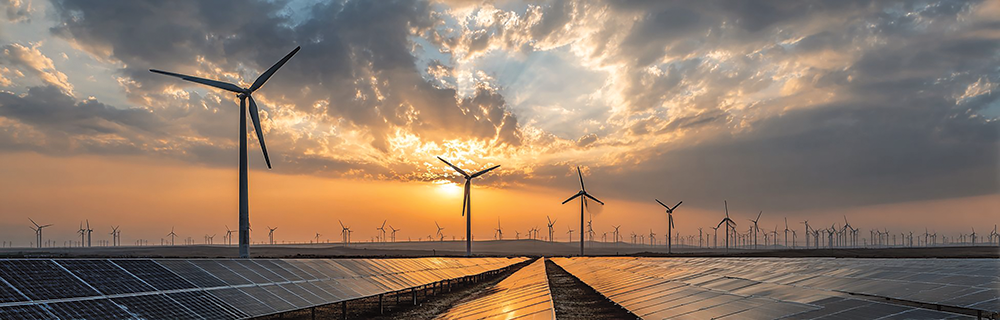
2024 was certainly a year for the books, particularly on the African continent, which has seen some noteworthy growth in its efforts to realise secure and sustainable energy provision. It is a continent that continues to show great potential, which is why investment in infrastructure and technology to enhance grid efficiency, energy storage and resilience should become a major agenda point.
According to PwC’s recent report, Africa Energy Review Overview, public-private partnerships are essential for driving energy-sector reforms and infrastructure development. Here, examples from South Africa and Nigeria show how collaboration between the public and private sectors can enhance energy security, attract investment and support the transition to a competitive and sustainable energy markets. PwC also says that Africa is making significant strides in renewable energy, with countries like Kenya, Egypt, and Morocco leading in solar, wind and geothermal projects.

On a visit to South Africa, Jean-Pascal Tricoire, global chairman of Schneider Electric, emphasised the company’s continued commitment to South Africa and Africa, highlighting key developments. “South Africa is making significant strides in reaching important sustainable energy milestones,” he said.
South Africa’s share of renewables is projected to reach 17% by 2032, driven by the Renewable Energy Independent Power Producer Procurement Programme (REIPPPP) and regulatory reforms that allow greater private sector participation. “South Africa’s energy crisis pushed over five gigawatts of renewables into the grid in just a few short years. When it’s necessary, it becomes possible,” he notes.
Overall, it is projected that as much as 76% of Africa’s electricity could come from renewables by 2040 if existing and planned power plants are built and used to their full capacity. This would be made up of 82% hydropower, 11% solar and 7% wind.
Prioritising efficiency, electrification and decarbonisation
Tricoire stressed that Africa’s energy transition must focus not just on increasing the supply of green energy, but also on transforming demand. “The world will become electric because technologies like electric cars, data centres and digital infrastructure are inherently driven by electricity. The first priority is to save energy through digitalisation and efficiency, the second is to electrify and the third is to decarbonise the energy supply,” he explained.
He further added that up to two thirds of carbon emissions can be mitigated by using existing technologies. For example, optimising energy efficiency in urban infrastructure such as water networks, transport systems and buildings could yield significant reductions in energy consumption. “We are experiencing a historic development in the field of energy,” he added, noting the convergence of IoT, AI and big data to drive digitalisation, which is now accessible and scalable at a lower cost.
Public-private partnership
For South Africa and the broader African continent, the energy transition is not just about adopting renewables, but also about optimising current systems to be more efficient and sustainable.
“Africa’s energy future hinges on collaboration between the public and private sectors,” noted Annabel Bishop, chief economist of Investec, echoing Tricoire’s sentiments on the need for integrated solutions. “By embracing digital technologies and fostering private sector involvement, South Africa can achieve its ambitious goals of economic growth and sustainability.”
Leading by example
Across Africa, the drive towards cleaner energy is gaining momentum. Tricoire emphasised that the continent is undergoing an important shift towards sustainable energy. A key example is Kenya; the country’s energy mix consists primarily of renewable sources like geothermal, hydro, wind and solar, accounting for 85% to 90% of the country’s energy generation. “Kenya is on a path to a fully green grid by 2030,” he said.
The journey ahead for South Africa and the rest African continent involves leveraging existing technologies, fostering innovation and nurturing partnerships between government and industry. As Tricoire aptly put it: “We have to be champions of efficiency and sustainability by being smart and green.”
| Tel: | +27 11 254 6400 |
| Email: | [email protected] |
| www: | www.se.com/za/en/ |
| Articles: | More information and articles about Schneider Electric South Africa |






© Technews Publishing (Pty) Ltd | All Rights Reserved
 printer friendly version