




Siemens Digital Industries Software has announced that Arc Boat Company (Arc), a startup on a mission to electrify the marine industry, has adopted the Siemens Xcelerator portfolio of industry software to design and manufacture their high-performance, fully electric boats.
Founded in 2021, Arc is a venture-backed startup based in Los Angeles, California. The company designs and manufactures everything for its electric boats in-house, including battery packs, powertrain systems, thermal control systems and software. Arc One, the company’s first product, sold out its initial production run; and the next generation, Arc Sport, a 370 kW all-electric wake boat, is taking the wake boat industry by storm.
The Arc team had experience using Siemens software at other companies, so Siemens Xcelerator was a natural choice to be the company’s technology platform. As Ryan Cook, co-founder and chief technology officer at Arc explains, “We thought if Siemens Xcelerator is going to be our long-term software, we might as well just start with it so we don’t have to migrate later.”
The ability to build complex parameterised models in Siemens’ NX software from the Siemens Xcelerator portfolio enables Arc to develop adaptable parametric 3D models that support its rapid iteration design, build, test and redesign process. “There’s a lot of parameters involved in hull design – including deadrise, beam at chine and keel angle – so we used NX to parameterise them all. With our fully parametric hull model, we would build one boat, gauge performance, collect data and tweak one or two parameters, and then build a second boat based on what we learned,” says Cook. “Fast forward to today and we’re even more sophisticated because we know the performance characteristics we want out of the vehicle. With a given centre of gravity and the type of shape we want to go with, we can do it in one shot with NX.”
Arc uses Siemens’ Simcenter software to simulate its products – a particular challenge when looking to disrupt an industry that continues to rely on gas-powered propulsion systems and long-established marine engineering principles. Arc’s focus on all-electric propulsion brings new design, engineering and manufacturing challenges, which is why the company depends on Siemens’ simulation technologies.
Arc also uses Simcenter software to optimise the centre of gravity, which is challenging due to the heavy battery pack, and to optimise across the composite hull, deck and hard top to remove weight. This lightweighting is critical to achieving the required performance. Simcenter software also enables the team to carry out smaller-scale structural, vibration and thermal analysis work across the entire boat.
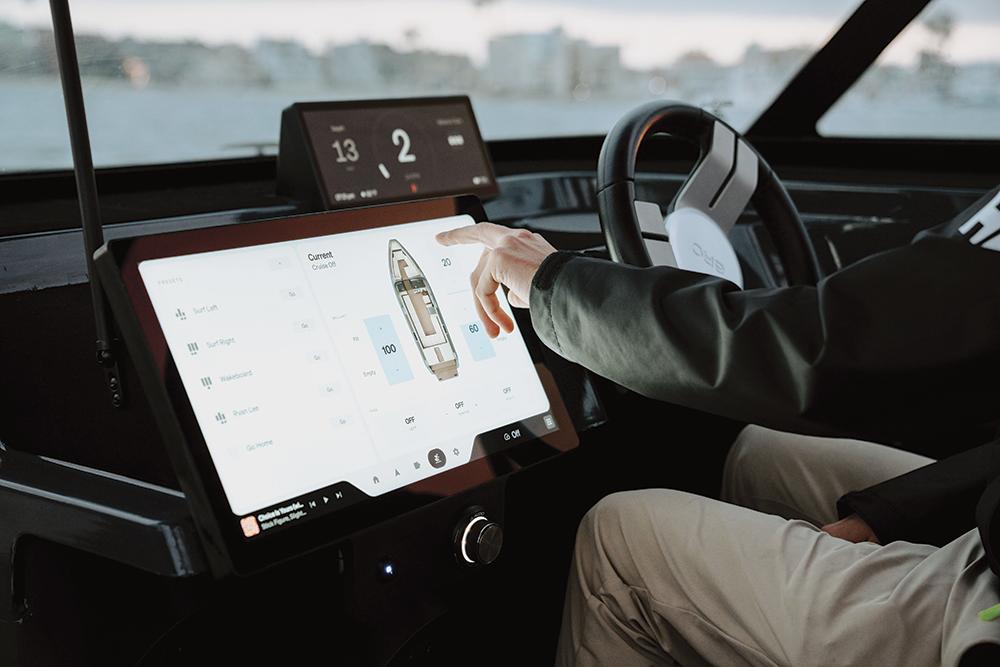
To optimise its product and production data management, Arc added Teamcenter software for product lifecycle management (PLM) during development of its second product, the Arc Sport, as the complexity of both its product and supply chain increased. Today, the company is expanding its operations in the recreational and wake boating industries and has announced its first steps into the commercial marine industry and expanded line of recreational boats including the Arc Coast, a ‘centre console’ all-electric boat that targets fishing and other water activities.
Arc is opening a research and development facility at the port of Los Angeles and has begun to build out the charging infrastructure needed to support the ports of Los Angeles and Long Beach’s goal to move to zero emission equipment by 2030. It is also collaborating with Portland shipyard, Diversified Marine, to retrofit an eight-meter tugboat for high-performance, zero-emission operations.
Arc continues to innovate in the marine industry without using fossil fuel power propulsion methods that don’t fit with today’s requirements for cleaner, more sustainable activities, Siemens Xcelerator is at the heart of its product development process. “We’re moving very quickly and it’s a lot of fun to try and apply some fundamental engineering principles to the marine industry and see if we can come up with something better. Siemens Xcelerator helps us to get there quicker and develop new category-defining products that delight our customers and create the electrification revolution we want to see in the marine industry,” concluded Cook.






© Technews Publishing (Pty) Ltd | All Rights Reserved
 printer friendly version