



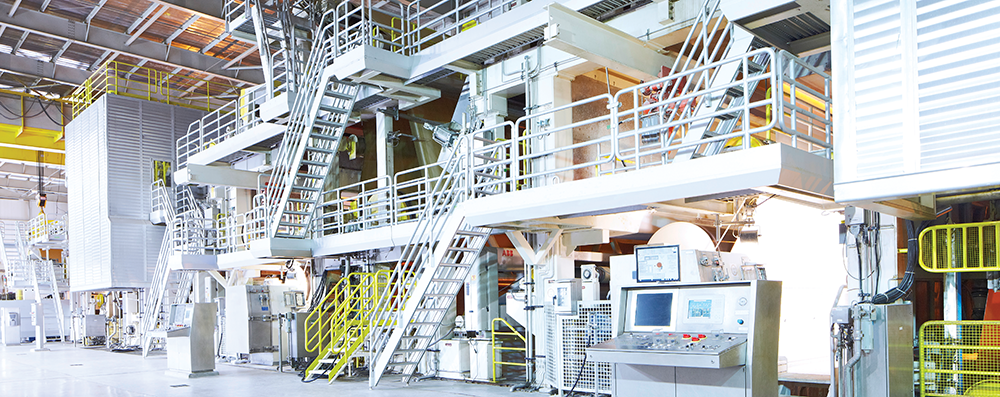
The pulp and paper industry in South Africa is undergoing a significant transformation from traditional manual processes to embracing automation technologies. Automation in pulp and paper mills aims to improve various production stages, from raw material preparation to final product creation. We have seen a shift in the paper industry where there has been reduced demand for newsprint and graphic paper. However, this has been replaced by demand for renewable packaging and tissue and kraft paper. The level of automation in the pulp and paper industry is quite mature compared to other key industries. The next level is exploring digitalisation solutions to extract more value by improving manufacturing efficiency.
Paper manufacturing is one of the most complex industrial processes. Ensuring visibility of product properties is crucial to minimise rejects and improve repeatability and runnability. By continuously making counteractive changes to dynamic process movements and disturbances, quality control systems (QCS) reduce variability with swift responses to setpoint changes, avoiding production losses, lowering emissions and improving product consistency. Rather than simply reducing variability, modern QCSs enable automatic controls to optimise production processes and energy consumption, reducing waste and costs.
The pulp and paper industry in South Africa is actively looking to transition to renewable energy sources. We have seen strategic investments being made into integrating renewable energy sources for existing manufacturing processes with a focus on energy, water, chemical and carbon management.
ABB offers a comprehensive and integrated automation portfolio of products and solutions to support the pulp and paper industry throughout the entire manufacturing process. These include power distribution and electrification, paper machine drives, distributed control systems (DCS), paper machine QCS, manufacturing execution systems (MES) and ABB Ability Collaborative Operations to leverage IIoT and deliver digital solutions.
Paper mills that use ABB products and solutions can reduce rejects by keeping the product properties within a target range throughout the papermaking process. This is accomplished through the ABB Ability QMS, which provides measurement and control to reduce variability and therefore production waste. When paired with ABB Ability Expert Optimiser for Pulp, operators can further optimise process efficiency and raw material consumption.
Adaptive Advanced Process Control (APC) and Model Predictive Control (MPC) adjust many variables to achieve the desired output and ideal target range at the wet end of the machine. Staying within this range keeps costs down in terms of energy and fibres, and even water and chemicals. APC achieves savings by reducing energy and fibre costs, also resulting in improved end paper sheet properties while obtaining low raw material usage.
Latest advances include ABB’s tailored MES for pulp and paper, a system that connects and automates processes while providing visibility from shopfloor to enterprise. The idea here is to move one’s operations from conventional connectivity towards fully autonomous operations which can be recognised as smart manufacturing. ABB’s process automation portfolio includes updated QCS products to achieve higher resolution for various critical measurements that have direct impact on product quality.
The ABB Ability Energy Management Solution (EMS) is an integrated solution incorporating forecasting and optimisation to address the various process demands. It maximises sustainability performance and energy cost savings by an iterative process of auditing, monitoring, forecasting and optimising energy consumption and supply for the entire manufacturing facility. EMS is helping process industries and manufacturing organisations make data-driven decisions about environmental, financial and operational cost/benefit trade-offs while working toward achieving carbon neutrality.
Where the pulp and paper industry in South Africa was once facing the challenge of limited availability of expert resources, ABB leverages the digitally connected world to alleviate this challenge with its ABB Ability Collaborative Operations solution to provide customers access to a global resource pool of subject matter experts who can support operations remotely 24/7.
To address the shortage of expertise, ABB has introduced Visual Remote Support using augmented reality. Having this solution in place opens customers to a global pool of engineering resources that can not only assist customers on an emergency basis but also assist in commissioning critical projects remotely.
In terms of artificial intelligence (AI) and digitalisation, ABB Ability Genix combines industrial analytics and AI in an enterprise-grade digital platform. Genix unlocks the value of contextualised data by means of IIoT to improve industrial productivity and operational excellence. Industrial AI and analytics, combined with IIoT, bring together AI algorithms, machine learning models and advanced analytics tools to extract actionable insights from massive amounts of industrial data to optimise production and manufacturing processes.
| Tel: | +27 10 202 5000 |
| Email: | [email protected] |
| www: | www.abb.com/za |
| Articles: | More information and articles about ABB South Africa |






© Technews Publishing (Pty) Ltd | All Rights Reserved
 printer friendly version