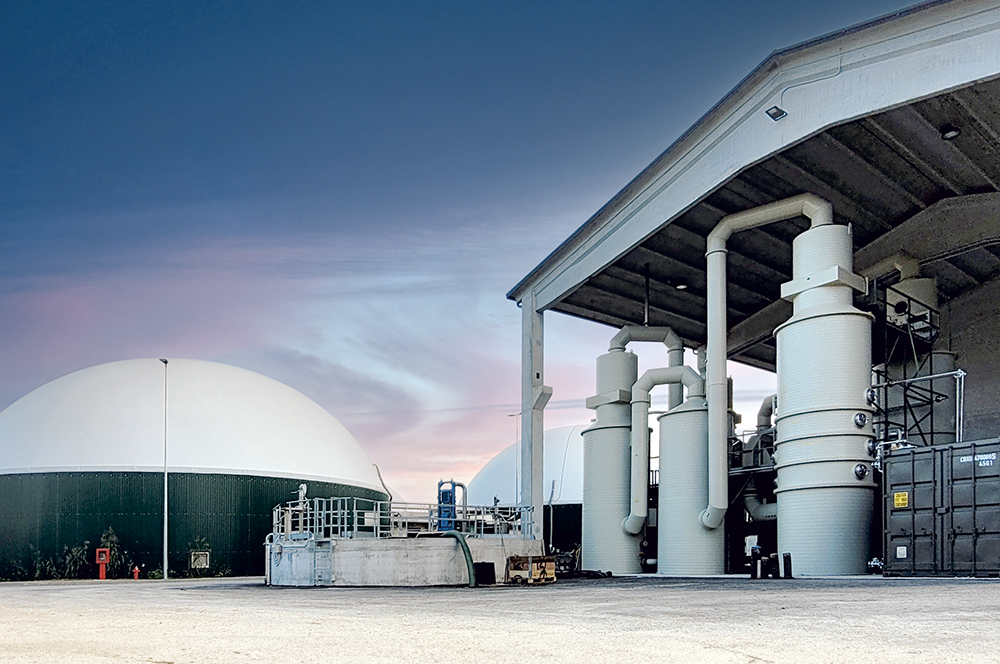
On a farm in the USA ammonia is extracted from slurry in a large fermenter and processed into ammonium sulphate. NSI Byosis has transformed this complex process into a modular system concept that can be flexibly adapted to different operating scales and organic raw materials. This modular approach requires an automation solution with flexible scalability in both hardware and software, which this Dutch company has found in PC-based control from Beckhoff.
Biogas is produced by bacteria during the fermentation of organic waste, sewage sludge and slurry. One resulting byproduct is ammonia which is toxic to the bacteria and must be removed from the reactors. “We extract the ammonia from the slurry stream and convert it into ammonium sulphate which can then be spread on fields as fertiliser,” explains Dylan Veelers, project engineer at NSI Byosis. The ByoFlex systems from NSI Byosis, located in the Dutch town of Raalte, are commonly used alongside biogas plants, waste and sewage treatment plants, and are also installed in industrial environments.
A large Byosis system was recently installed for an agricultural business in the USA. The dimensions reflect the impressive size of the operation and quantity of slurry. Each line of the modular system comprises a 3 x 12 m frame with three polypropylene towers. “With a capacity of up to 40 m3 per hour, more than 70% of the ammonia is extracted and converted into valuable fertiliser,” explains Veelers.
TwinCAT replaces graphical engineering tool
Veelers joined Byosis in 2021. “At that point, the company was looking for a new control platform to replace the previous graphical programming system,” recalls Reinoud van Bennekum, sales engineer at Beckhoff Netherlands. “The initial tests with a C6017 ultra-compact Industrial PC demonstrated that we could make significant progress in standardising automation technology with PC-based control, especially with TwinCAT as a development environment,” notes Veelers. Programming with TwinCAT is much more straightforward, far more intuitive and open to boot. Since EtherCAT had already been used in previous projects, fully switching to PC-based control from Beckhoff was simply the next logical step.
Byosis has been automating the ByoFlex systems with a C6025 ultra-compact Industrial PC ever since. The company uses its three configurable Ethernet ports to read out flowmeters and pH transmitters via EtherNet/IP. “The advantage for our customers is that we support any Ethernet-based communication,” says van Bennekum. Byosis adds an additional Ethernet interface via a CU8880 USB-to-LAN adapter.
The browser-based system visualisation is implemented with TwinCAT HMI and runs on a CP2921 multi-touch control panel. This means technicians can access the systems remotely from any location as required. The system used for commissioning, diagnostics and service can be supplemented with Teamviewer, OpenVPN or Anydesk to suit the customer’s preferences. A PC-based platform makes all of this very easy to implement according to Veelers, who is impressed by more than just the technology, “The support and service provided by the Beckhoff experts are also quick and efficient.”
The system determines the topology
Byosis structures the control architecture with an 8-port CU1128 junction, in line with the modular design of the systems. Comprehensive EtherCAT diagnostics ensure a transparent network by displaying the entire hardware configuration at the push of a button. “Another great feature is hot connect,” adds Veelers. With a decentralised 2-port EP1122 EtherCAT junction, individual EtherCAT segments can be easily disconnected on site to address and resolve system faults. The other parts of the system can thus continue to extract ammonia allowing the bacteria in the reactors to produce biogas without disruption.
The wide range of I/O modules from Beckhoff is used to connect the various sensors for measuring pressure, temperature, pH level and flow. In addition to EtherCAT Terminals in the control cabinet, EtherCAT Box modules with an IP67 protection rating are also used for IO-Link communication, for example. As the process is energy-intensive, the systems’ energy consumption is determined using SCT series current transformers and EL3443 power measurement terminals. This allows users to check whether the actual consumption matches the target.
One industrial PC for all system sizes
By switching to PC-based control, Byosis has specified a control configuration for all system sizes and developed a single piping and instrumentation diagram (P&ID), ranging from the entry-level demo model at 5 m3 through to the scalable standard systems at 10, 20, or 40 m3.“ With EtherCAT as the fastest fieldbus system and PC-based control, we can keep pace with developments at Byosis at all times,” concludes Van Bennekum.
| Tel: | +27 11 795 2898 |
| Email: | info@beckhoff.co.za |
| www: | www.beckhoff.com |
| Articles: | More information and articles about Beckhoff Automation |






© Technews Publishing (Pty) Ltd | All Rights Reserved
 printer friendly version