February 2025Analytical Instrumentation & Environmental Monitoring
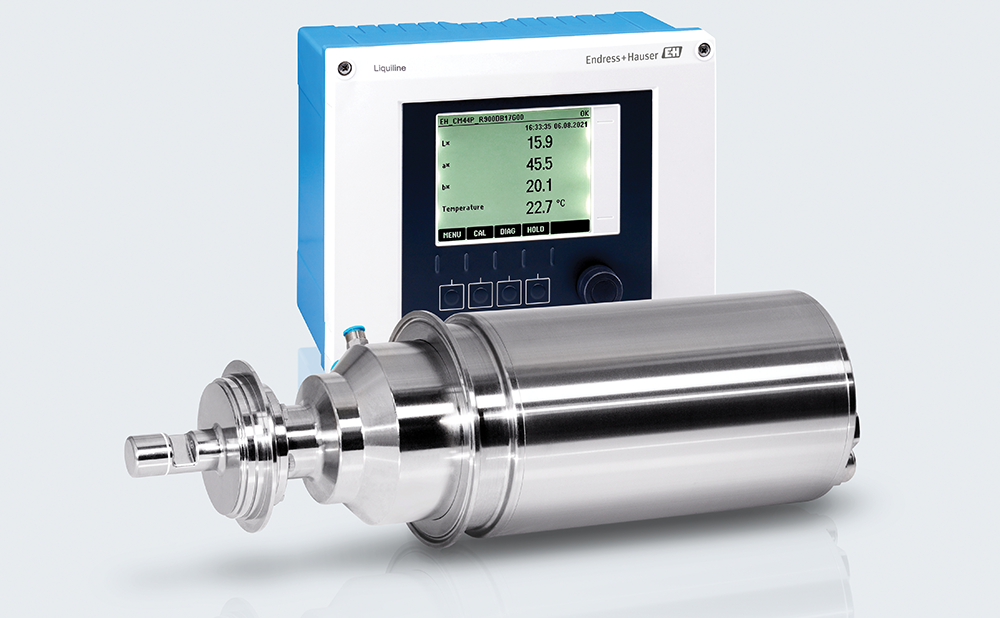
Colour measurements are necessary in many processes to avoid product losses and ensure safe production and batching. They are used in the food and beverage industry, the chemicals industry and in life sciences. For checks and quality assurance, samples are often taken from the manufacturing process and brought to the laboratory, where they are analysed before the batches can be approved. Continuous monitoring in real-time can happen if measurements are carried out directly in the process. This is made possible by the Memosens Wave CKI50 process spectrometer from Endress+Hauser − a compact, robust and process-friendly device.
With the Memosens Wave CKI50 process spectrometer, the quality, batching and phase checks can now be performed by a single instrument for the entire visible colour spectrum from 380 to 830nm. The colour is output as an L*a*b* value. The CIE-L*a*b* colour space is a universal and versatile colour scale defined by a DIN standard.
The spectrometer’s colour measurements, which offer superior repeatability and long-term reliability, are as precise as those in the laboratory, but take place directly in the process. Incorrect colour values and irregularities in the colour can therefore be displayed immediately in the process control system. The process can then be fine-tuned directly when a defined limit value is reached.
Thanks to the innovative spectrometer design, equipped with the proven digital Memosens technology, combined with a Liquiline transmitter, it is very easy and quick to integrate the Memosens Wave CKI50 into the process. Simply connect and the measurement is ready to go. Operation is just as user friendly. It requires no calibration whatsoever and personnel have no need for any further specialist knowledge or expertise in data modelling or process development.
In combination with the Liquiline transmitter, you also have all common communication protocols available and can enjoy the benefits of Endress+Hauser’s Liquiline platform. For example, you can quickly connect further Memosens sensors as required because the transmitter detects the sensors automatically.
In addition, ATEX and hygiene approvals make the Memosens Wave CKI50 fit for safe operation in potentially explosive and hygienic environments. The maximum protection class of IP69 and resistance to vibrations and high temperatures enable use even in harsh environments.
Consumers expect a product to have a consistent colour as a recognisable factor, and the specific colour is a sign of the quality they expect. Any variation in the colour automatically leads to a change in the product, usually perceived as a deterioration. Colour consistency is ensured with the Memosens Wave CK150 process spectrometer.
The hidden role of motion systems in electronic pipetting
Analytical Instrumentation & Environmental Monitoring
Portescap explains how motor selection defines the precision and accuracy of electronic pipettes, comparing brushed DC motors and stepper linear actuators across force, speed, positional fidelity and system complexity for laboratory liquid handling applications.
Read more...Matching HVAC to the real demands of buildings and processes
Analytical Instrumentation & Environmental Monitoring
Industrial Climate Engineering director, Alin Gomes explains why effective HVAC goes beyond specifying equipment on capacity, covering load profiling, ventilation requirements, heat recovery and turnkey delivery for specialised manufacturing and processing environments.
Read more...How SCE approaches sensor selection for critical environments Specialised Climate Engineering
Analytical Instrumentation & Environmental Monitoring
Specifying the right sensor for a critical climate involves far more than matching a datasheet accuracy figure. As an authorised Vaisala HVAC partner, SCE explains how understanding the environment, the measurement purpose and sensor placement determines effective climate control.
Read more...Changing gas quality calls for smarter combustion control
Analytical Instrumentation & Environmental Monitoring
As South Africa prepares for a transition from declining Mozambican natural gas to a proposed methane-rich bridge, LNG, industrial users can no longer assume a constant Wobbe Index and calorific value. The compact RMG RGQ 5 provides fast, plant-level gas-quality data to support approved burner and engine settings.
Read more...Getting the chemistry right
Analytical Instrumentation & Environmental Monitoring
Grace’s European production site has relied on analogue compression load cells from Minebea Intec for decades, with the long-proven measurement concept now serving as the reference for new silo projects as the company expands its capacity.
Read more...Why measurement matters in smelting Endress+Hauser South Africa
Analytical Instrumentation & Environmental Monitoring
South African smelters returning to operation after energy constraints face new demands for tighter control, better visibility and environmental compliance. Endress+Hauser explains how modern measurement technology supports safer, more efficient furnace operation and local beneficiation.
Read more...Sun tracking with pinpoint precision Senseca
Analytical Instrumentation & Environmental Monitoring
Senseca has introduced the SEMS-2000 solar energy measurement system, a 2-axis solar tracker with pinpoint sun-pointing accuracy that automatically monitors direct, global and diffuse irradiance for unattended outdoor solar installations.
Read more...AMETEK expands 993X gas analyser series with explosion-proof enclosures
Analytical Instrumentation & Environmental Monitoring
AMETEK Process Instruments has added ATEX and IECEx Zone 1-certified explosion-proof enclosures to its 993X series of gas analysers, enabling reliable installation in Zone 1 hazardous locations where purge gas is unavailable.
Read more...Why medical device leak testing matters for South Africa's MedTech future ATEQ South Africa
Analytical Instrumentation & Environmental Monitoring
As South Africa works to grow local medical technology manufacturing, non-destructive leak and flow testing is becoming a strategic quality assurance tool, helping manufacturers verify device integrity, meet regulatory requirements and improve production efficiency.
While every effort has been made to ensure the accuracy of the information contained herein, the publisher and its agents cannot be held responsible for any errors contained, or any loss incurred as a result. Articles published do not necessarily reflect the views of the publishers. The editor reserves the right to alter or cut copy. Articles submitted are deemed to have been cleared for publication. Advertisements and company contact details are published as provided by the advertiser. Technews Publishing (Pty) Ltd cannot be held responsible for the accuracy or veracity of supplied material.










 printer friendly version