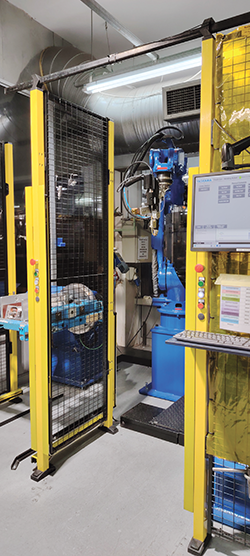
Yaskawa Southern Africa has partnered with Aerosud Aviation, a leading aerospace manufacturer, to implement a cutting-edge robotic TIG welding solution tailored to the exacting demands of aerospace production. The collaboration, highlighting both companies’ commitment to innovation, precision and efficiency, is poised to strengthen Aerosud’s production capabilities and ensure compliance with stringent original equipment manufacturer (OEM) standards.
The project, spearheaded by Yaskawa’s national project manager, Devon Prinsloo, and Aerosud’s welding engineer, Nico du Toit, demonstrates the potential of automation and robotics to transform aerospace manufacturing.
Meeting aerospace challenges with advanced automation
Aerosud’s need to scale up the production of aluminium track cans for Airbus A320 aircraft was a key driver for the project. “Airbus is ramping up production on its Single Aisle aircraft, requiring us, as a single-source supplier, to increase throughput,” explains Du Toit. “This welding robot solution allows us to repeatedly produce uniform welds on 1,4 to 1,6 mm aluminium while meeting OEM specifications with the highest efficiency.”
The TIG welding process, chosen for its superior quality and precision, delivers clean, consistent welds with minimal distortion, and is essential for aerospace components. The solution integrates Yaskawa’s high-precision robotic arms, Fronius TIG welding systems and a SERVO-ROBOT Micro-Trac camera system, ensuring accurate seam tracking and filler wire positioning. “The camera scans the weld seam before welding, enabling precise alignment,” says Prinsloo. “This approach not only ensures repeatability, but also reduces waste by minimising errors. Automation in TIG welding enhances safety, precision and efficiency, all of which are critical in aerospace manufacturing.”
Seamless integration and tangible benefits
Yaskawa’s expertise in robotics and software was instrumental in overcoming the complexities of aerospace welding. Using MotoSim simulation software, the welding process was meticulously planned, reducing programming errors and setup time. Additionally, Yaskawa’s custom solutions addressed challenges such as variable component geometries, and maintaining consistency across diverse materials.
The impact on Aerosud’s operations has been significant. “This technology improves workflow efficiency by reducing rework and increasing yield,” notes Du Toit. “Automation allows us to maintain consistent quality, while scaling up production. This positions Aerosud as a competitive, innovative supplier in the global aerospace market.”
A commitment to innovation
The success of this project underscores Yaskawa’s mission to push the boundaries of automation technology. “This collaboration reflects our dedication to developing solutions that address the most complex manufacturing demands,” says Prinsloo. “Aerospace manufacturing requires precision and reliability, and Yaskawa is proud to contribute to Aerosud’s growth and innovation.”
Looking ahead, the partnership between Yaskawa and Aerosud is set to explore new advancements, including adaptive welding technologies. By leveraging their combined expertise, the two companies are paving the way for further innovation in aerospace robotics and manufacturing.
A smarter approach to simplifying motion architecture
Motion Control & Drives
n motion system design, the wiring and drive placement between motor and drive are often decided by default, yet they shape a machine’s cost, footprint and adaptability. Kollmorgen sets out how single-cable and decentralised architectures simplify the cabinet.
Read more...Robotic case packer achieves 99% uptime Rockwell Automation
Motion Control & Drives
DCC Automation designed a new robotic case packer for a nutrition supplement manufacturer using delta robots and a unified Rockwell Automation control platform, cutting changeover time from 45 minutes to 5 minutes, and achieving 99 to 99,5% uptime against the previous 10% per-shift downtime.
Read more...igus puts 3D-printed wear materials to the test igus
Motion Control & Drives
A new igus white paper compares its tribological iglidur 3D-printing materials directly with conventional POM, reporting lower wear, more stable friction and up to ten times longer service life in gear testing for customised, low-volume and replacement components.
Read more...SEW-EURODRIVE’s expanded local engineering capability SEW-EURODRIVE
Editor's Choice Motion Control & Drives
At Electra Mining Africa, SEW-EURODRIVE demonstrated how its expanded local engineering capability, digital technologies and lifecycle support strategy help customers improve reliability, energy efficiency and total cost of ownership across the full life of their drive assets.
Read more...Latest Danfoss automation drive Bearing Man Group t/a BMG
Motion Control & Drives
BMG has launched the Danfoss iC7-Automation enclosed variable speed drive range in South Africa, backed by significant local stockholding of 400 V models up to 710 kW, approved warranty workshops, and DrivePro digital asset management support.
Read more...Severe-duty workhorses powering mining
Motion Control & Drives
Mining machines such as rock crushers, pumps and conveyors need motors that combine high torque with robust enclosures, seals and cooling. WEG Africa explains how severe-duty motors deliver more than a decade of reliable performance in harsh conditions while meeting modern energy-efficiency standards.
Read more...Looking beyond the spec sheet when choosing motion architecture
Motion Control & Drives
When machine builders focus only on torque, speed and price, engineering time, integration effort and long-term maintainability get overlooked. Kollmorgen explains how thinking at the system level, not the component level, leads to better motion architecture choices.
Read more...Economy drive system closes the drive gap in the entry-level segment Beckhoff Automation
Editor's Choice Motion Control & Drives
Beckhoff has launched an economy drive system pairing its new AX1000 servo drive and AM1000 servomotor with the AF1000 dual-axis variable frequency drive on a shared EtherCAT platform, targeting series machines and price-sensitive markets without sacrificing TwinCAT integration or functional safety.
Read more...Mammoet supports critical heavy lift and marine activities for topsides
Motion Control & Drives
Mammoet provided specialised heavy lift and marine logistics support for the Munin topsides on Aker BP’s Yggdrasil North Sea development, including a complex transshipment operation and a tidal-window load-out classified as a Class 1 operation.
While every effort has been made to ensure the accuracy of the information contained herein, the publisher and its agents cannot be held responsible for any errors contained, or any loss incurred as a result. Articles published do not necessarily reflect the views of the publishers. The editor reserves the right to alter or cut copy. Articles submitted are deemed to have been cleared for publication. Advertisements and company contact details are published as provided by the advertiser. Technews Publishing (Pty) Ltd cannot be held responsible for the accuracy or veracity of supplied material.










 printer friendly version