


IT in Manufacturing


Higher level cybersecurity certification for Schneider Electric

November 2024 IT in Manufacturing

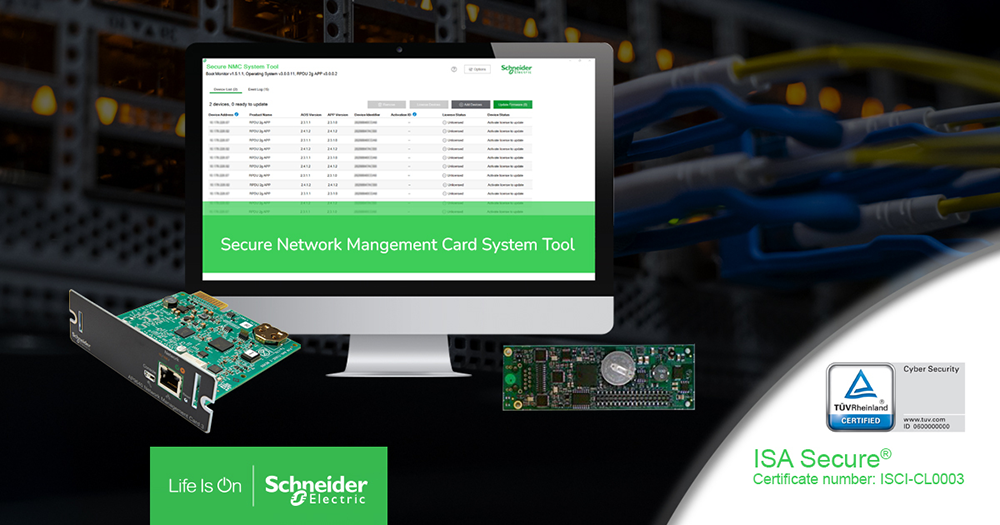
Schneider Electric’s EcoStruxure IT Network Management Card 3 (NMC3) platform has obtained a new and higher level of cybersecurity certification, making it the first data centre infrastructure management (DCIM) network card to achieve IEC 62443-4-2 Security Level 2 (SL2) designation from the International Electrotechnical Commission (IEC).

TÜV Rheinland, one of the world’s largest and leading testing providers, has independently certified the NMC3 platform, ensuring vendor products designed for data centre and distributed IT environments meet a set of well-defined security requirements, and undergo thorough testing and assessment.

This new and higher level of cybersecurity certification underscores Schneider Electric’s commitment to leading the industry in secure operations and better protection against cyberthreats. SL2 certification provides more stringent requirements and increased security resiliency than SL1, which was obtained last year.

In addition to the new standard, TÜV Rheinland has certified Schneider Electric and the cybersecurity processes used to develop its products, including the NMC3, as ISASecure Secure Development Lifecycle Assurance (SDLA) compliant. The NMC3 is embedded in the majority of Schneider Electric’s EcoStruxure IT DCIM products, and provides a robust, remotely accessible management application over the network for critical power and cooling infrastructure.

“According to the 2024 Allianz Risk Barometer, cyber incidents are ranked as the number one business concern. At an average reported cost of more than $4 million an incident, we understand why cybersecurity tops the priority list for CIOs,” said Kevin Brown, SVP for EcoStruxure IT, Data Centre Business, Schneider Electric. “With the IEC 62443-4-2 SL2 and ISASecure SDLA cybersecurity certifications, Schneider Electric is leading the industry with this dual certification, helping to reduce risks to critical infrastructure.”

Simplifying the process of installing firmware

Companies are challenged to keep up with firmware updates. Many enterprise customers manage their critical power and cooling infrastructure with their own in-house management tools, third-party network management tools, or building management systems. These systems do not know when the firmware at connected endpoints – particularly in distributed and edge environments − requires an update.

The EcoStruxure IT Secure NMC System offers improved embedded firmware management, thanks to a new dedicated tool. The Secure NMC System Tool transforms the cumbersome process of researching and installing the latest firmware on all devices, making the process up to 90% faster. Users no longer need to search for firmware on an ad hoc basis, check to see if that firmware is the latest one for the device, and read the release notes to understand what is included in the new version before they download it and update their device. Instead, the Secure NMC System Tool notifies customers that new firmware is available and directs them to install the new version.

The benefits of the Secure NMC System include:

• Eliminates fear of becoming outdated: Simplifies firmware management, making it up to 90% faster and reducing risk

• Achieves consistent compliance: Customers have a systematic, standardised approach to cybersecurity updates for their critical power and cooling infrastructure

• Reduces exposure to potential attack: IEC 62443-4-2 SL2 and ISASecure SDLA cybersecurity certifications, combined with the Secure NMC System Tool, ensure connected devices are protected with the latest security updates.

“EcoStruxure IT is providing customers with a powerful approach − the flexibility to manage their IT infrastructure as they choose, and to do it simply while also managing their cybersecurity compliance. Being secure doesn’t mean it has to be difficult,” Brown said. “We are the first in the industry providing this solution as we continue our commitment to enable resilient, secure and sustainable IT infrastructure.”


Credit(s)


Share this article:
Share via emailShare via LinkedInPrint this page

Further reading:

Turning system integrators into trusted technology partners
Schneider Electric South Africa IT in Manufacturing System Integration & Control Systems Design
Schneider Electric’s Alliance Partner Programme is repositioning system integrators from hardware suppliers into lifecycle-value partners. Oriel Soupen explains the competency framework, certification model and real-world results that are already helping African system integrators win higher-value, longer-term engagements.

Read more...
Schneider Electric introduces next-generation BlokSeT switchboard
Schneider Electric South Africa Electrical Power & Protection
Schneider Electric has launched its next-generation BlokSeT low-voltage switchboard in West Africa, offering high reliability, predictive maintenance capability and digital integration for critical infrastructure and industrial applications.

Read more...
Why renewable projects need integrated protection and control
IT in Manufacturing
Fragmented secondary plant integration in renewable energy projects causes costly delays during commissioning. ACTOM Protection and Control’s Secondary Plant Integration solution consolidates all secondary systems under a single engineering framework, reducing risk and accelerating grid

Read more...
When digital twins move from concept to critical tool
IT in Manufacturing System Integration & Control Systems Design Maintenance, Test & Measurement, Calibration
Digital twins are moving out of the lab and onto the mine, the factory floor and the transport network where they predict failures before they happen. Amritesh Anand looks at where they earn their keep, the data and integration work behind them, and the security questions every organisation should ask before switching one on.

Read more...
How a digital foundation can overcome the LNG trilemma
Schneider Electric South Africa IT in Manufacturing SCADA/HMI
The LNG sector is racing to add capacity, but without a digital backbone, growth creates complexity rather than capability. Christophe Begat of Schneider Electric explains how connecting data, systems and analytics across the LNG value chain can resolve the trilemma of secure supply, lower emissions and tighter costs.

Read more...
You can’t digitise a blackout
Schneider Electric South Africa Electrical Power & Protection
Across East Africa, smart meters and AI promise cleaner, more reliable power, but digital tools cannot optimise a grid too weak to carry the load. Schneider Electric’s Symphrose Ochieng sets out why operators should strengthen physical infrastructure first, then add digital capability in phases.

Read more...
Decarbonisation is reshaping mining strategy in Africa
Schneider Electric South Africa IT in Manufacturing Electrical Power & Protection
Mining companies across Africa are embedding decarbonisation into operational strategy, driven by investor, regulatory and customer pressure to reduce emissions while improving resilience.

Read more...
Siemens and HighByte partner to scale industrial AI
Siemens South Africa IT in Manufacturing Fieldbus & Industrial Networking
Siemens is expanding its Industrial Edge ecosystem through a partnership with HighByte, enabling customers to connect, contextualise and transform data from operational technology and information technology sources to build AI models and applications at scale.

Read more...
Africa on the edge of a digital future
Schneider Electric South Africa IT in Manufacturing
Edge computing promises lower latency, stronger reliability and real-time responsiveness across Africa, yet its rollout keeps colliding with one stubborn obstacle, power. Steven Santini explores how renewable microgrids, smart energy management and the right partnerships could turn the continent’s energy gap into its biggest edge opportunity.

Read more...
How the DCS can step off the hardware obsolescence treadmill
Schneider Electric South Africa PLCs, DCSs & Controllers
Ageing servers and unsupported operating systems are quietly eroding the stability of process plants that rely on distributed control systems. Kobus Vermeulen of Schneider Electric explains how virtualising the DCS environment can break the hardware obsolescence cycle without disrupting operations.

Read more...


While every effort has been made to ensure the accuracy of the information contained herein, the publisher and its agents cannot be held responsible for any errors contained, or any loss incurred as a result. Articles published do not necessarily reflect the views of the publishers. The editor reserves the right to alter or cut copy. Articles submitted are deemed to have been cleared for publication. Advertisements and company contact details are published as provided by the advertiser. Technews Publishing (Pty) Ltd cannot be held responsible for the accuracy or veracity of supplied material.


© Technews Publishing (Pty) Ltd | All Rights Reserved

