The hydrogen industry is young, and the technology is still developing. One growing area is the efficient and safe operation of electrolysers and fuel cells. Due to the explosive character of hydrogen, this is a very important task. In addition to measuring the gas concentration and the flow of fluids, the monitoring of the electrical characteristics of an electrolyser, rectifier or fuel cell has become common. This is easier and safer than measuring gas and fluids only.
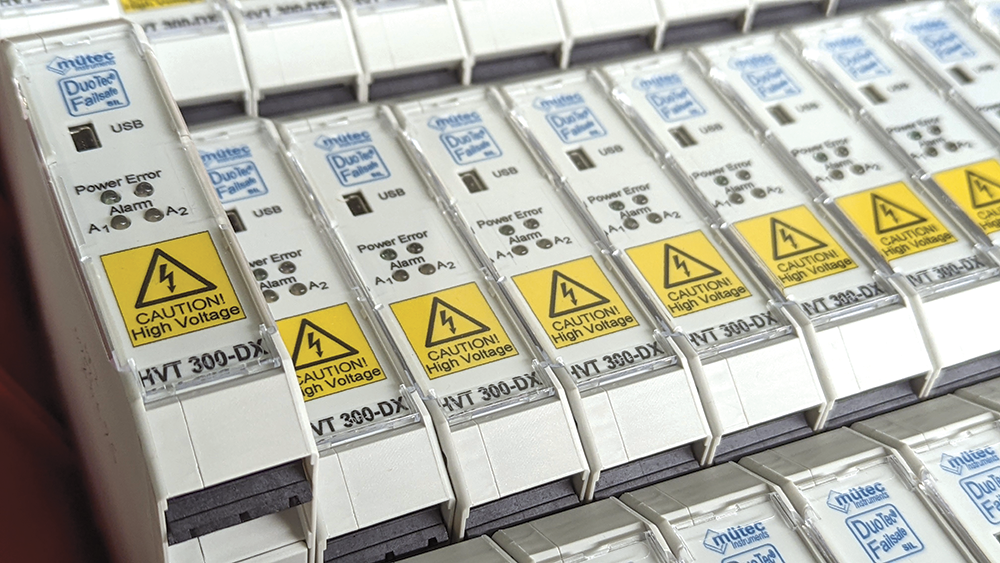
A major player in this area is the German manufacturer, Muetec Instruments. This is the only company offering SIL2-certified transmitters for electrical monitoring up to 1500 V, allowing safety loops for electrolysers and fuel cells to be built that are redundant and failure proof. These transmitters protect operators from electrocution, and safeguard the equipment from damage by voltage peaks. To achieve this, Muetec’s SIL2 transmitters generate safe alarms and shutoffs based on the measured voltage or current. They are easy to program, and only need to be checked and recalibrated after ten years.
Monitoring of earth faults
A common application when monitoring electrolysers is the detection of earth faults. Nearly all electrolysers, and many fuel cells, are insulated from ground. With fluids running through the system, there is always the risk that an electrical potential builds up on a stack. Touching the device can be dangerous, and operators need to be alerted before they are at risk. If a stack gets electrically out of balance, this is also an indication that there is a leakage of fluid in the system.
To realise a safe earth, fault monitoring of one high voltage transmitter (HVT) is done per stack by measuring the outside electrodes against earth in the middle of the stack.
Single cell voltage monitoring
The most complete system to monitor an electrolyser is the single-cell voltage monitor. This is also the most expensive, and some manufacturers, especially of PEM electrolysers, use it during the prototype phase only. Each cell is individually connected with the central measurement device, and the voltage values of all cells are recorded in real time. For a large electrolyser this means that thousands of measurement values are stored per second to analyse and detect inefficiencies, possible defects and cell deterioration. By comparing the voltage measurement of each cell and analysing how it develops over time, it is possible to detect membrane pinholes and other defects, and plan preventive maintenance.
Critical success factors for this form of measurement are the speed of data processing based on the use of fast glass fibre connections, high processing power, and the visualisation and analysis of the data set.
Safe monitoring of the rectifier
Electrolysers are supplied with the necessary energy from a rectifier. A second rectifier, the polarising rectifier, is used to ramp up the system. Several manufacturers, including companies like Siemens Energy, constantly measure the current on their rectifiers with Muetec’s safe HVT transmitters. Current measurement is important as it can ensure that a minimum current is always running through the system. This prevents hydrogen ions from recombining in the electrolyser to form atoms, creating a risk of explosion.
Safe total voltage measurement
Both rectifier and electrolyser manufacturers regularly integrate safe total voltage transmitters into their setup. They measure the electrical characteristic at the handover point between rectifier and electrolyser, therefore between the work of two different suppliers. Usually, they generate a pre-alarm at 60 V, which is when touching the system becomes dangerous. The main alarm is normally set above the maximum voltage of the system, around 800 to 1200 V for a large AEL/AEM electrolyser, or less for a PEM or SOEC. The analogue output is used for a standardised measurement of the voltage, and MODBUS RTU for connection to the PLC.
Monitoring of fuel cells
What works well for electrolysers is also becoming common in fuel cells − the electrical monitoring of their total voltage. Multiple setups are available, depending on the technology used in the fuel cell, for example protecting the DC link and inverters against overvoltage or overload. Muetec’s high-voltage transmitters are also used to prevent a critical reverse-supply by feeding back some energy into the fuel cell in case of an error on the downstream side. These safety loops are becoming more and more common for large stationary fuel cells and for fuel cells on ships.
No accidents, and an efficient operation
The use of SIL2 transmitters for safe voltage and current monitoring brings multiple benefits. Making a design safe is now much easier for engineers, accidents are prevented, and data for efficient operation of the system is collected. Safe electrolysers, rectifiers and fuel cells are becoming common.
Africa’s net-zero ambition must become operational Schneider Electric South Africa
Electrical Power & Protection
Schneider Electric’s Rohit Chashta argues that the biggest gap in Africa’s green transition is not ambition but execution, and outlines how advisory services, bankable project roadmaps, digital visibility and SF6-free switchgear can turn sustainability commitments into measurable progress.
Read more...High-efficiency half-brick DC-DC converters Vepac Electronics
Electrical Power & Protection
The Supreme series half-brick DC-DC converters from Vepac Electronics use synchronous rectification for high conversion efficiency, in a six-sided metal case built to withstand harsh industrial and transportation environments.
Read more...Zinc-based batteries power a more sustainable energy future
Electrical Power & Protection
Zinc-based batteries are gaining ground as a safe, recyclable and cost-effective energy storage option, from consumer electronics to grid-scale systems. The International Zinc Association’s Simon Norton explains why zinc is well placed to support the clean energy transition.
Read more...Energas introduces lower-cost German gas genset for South African market
Electrical Power & Protection
Energas Technologies will supply R Schmitt Enertec’s new Energy Line genset to the South African market, offering German-engineered gas-to-power generation of 400 to 500 kW at a lower entry cost through focused standardisation and a simpler standalone architecture.
Read more...ACTOM plays key role in large transmission substation project in Swellendam ACTOM Electrical Machines
Electrical Power & Protection
ACTOM has been appointed to engineer, procure, construct and commission the 1000 MVA main transmission substation for the Overberg Wind Farm in Swellendam, one of the largest substations of its kind in South Africa.
Read more...Reliable power conversion from high-voltage DC buses Conical Technologies
Electrical Power & Protection
The MEAN WELL DDRH-240 from Conical Technologies is a high-reliability DIN-rail DC-DC converter with a wide 250 to 1500 V DC input range, deriving stable low-voltage power directly from high-voltage DC buses in renewable energy, storage, charging, railway and industrial installations.
Read more...AES maintains a strong value and safety stance on boiler retrofits
Electrical Power & Protection
AES Commercial Director Dennis Williams explains when a boiler retrofit makes more sense than replacement, outlines the range of efficiency and emissions upgrades available, and draws the line at safety: a boiler not legally signed off is shut down, no exceptions.
Read more...The grid needs to become more intelligent Schneider Electric South Africa
Electrical Power & Protection
South Africa’s power grid is becoming bidirectional and far more dynamic as distributed energy resources proliferate. Schneider Electric’s Nishandra Bajinath explains why digitalisation, DERMS and aggregation are essential to keep this increasingly complex grid stable and efficient.
Read more...ACTOM’s integrated electrical solutions reduce project risk and accelerate delivery
Electrical Power & Protection
ACTOM has secured multiple orders across four divisions for the Naos-1 hybrid solar and battery project in the Free State, demonstrating its integrated model for supplying the full electrical chain from high-voltage equipment to distribution transformers.
Read more...Smarter energy management starts with intelligent electrification ABB South Africa ABB Electrification Products
Electrical Power & Protection
ABB Electrification specialists Adeline Maleka and Nokulunga Dube explain how the convergence of electrification, digitalisation and automation is helping South African industries gain real-time visibility, reduce energy waste and build operational resilience.
While every effort has been made to ensure the accuracy of the information contained herein, the publisher and its agents cannot be held responsible for any errors contained, or any loss incurred as a result. Articles published do not necessarily reflect the views of the publishers. The editor reserves the right to alter or cut copy. Articles submitted are deemed to have been cleared for publication. Advertisements and company contact details are published as provided by the advertiser. Technews Publishing (Pty) Ltd cannot be held responsible for the accuracy or veracity of supplied material.










 printer friendly version