



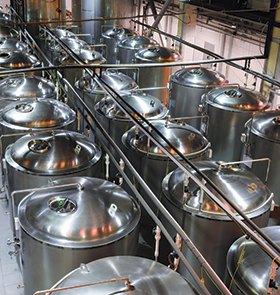
Storage tanks and containers can be found in a wide variety of locations and environments, from indoor or outdoor installations, to above or below ground deployments. Contents can vary greatly across applications. Properly monitoring and managing levels inside these receptacles can help owners and asset managers improve efficiencies and increase productivity and profitability.
The combination of wireless connectivity with wirelessly enabled sensors is proving to be an effective and increasingly popular method for tank level monitoring. These solutions can overcome many common challenges related to container location, contents and quantity and can provide users with access to timely, accurate tank level information with significant benefits for resource allocation and cost reduction.
Simple solutions, problematic results
There are several methods and tools that can be used to measure levels inside a container. Simple solutions such as visual inspections and measuring sticks are very easy to implement and require little or no investment for equipment.
These methods are also imprecise, easily susceptible to error, and labour intensive. The number of tanks requiring inspection, the distance to the tanks, and the level of difficulty and risk in accessing the tanks and their contents are all significant challenges that add time and expense to the process. Added to these expenses are wear and tear on vehicles, travel expenses, lost productivity and the risk of injury or accident in gathering the data.
More accurate measurements
More accurate tools for measuring content levels, such as magnetostrictive floats and submersible pressure transducers allow managers to make more informed decisions about their business. These devices are not dependent upon human labour to measure levels, which can simplify processes, minimise the risk of error and eliminate many of the safety concerns associated with acquiring the data. However, these tools determine levels by making contact with the contents of the container. This may not be acceptable in some applications where contact with measurement tools or other equipment can contaminate the contents.
Ultrasonic sensors are cost-effective solutions that are easy to implement, and particularly well suited for use in these applications. These sensors use sound waves to detect objects, so they do not need to come into contact with the materials they are measuring. Because they do not rely on light energy for detection, they are largely unaffected by conditions that typically challenge photoelectric sensors. They are immune to target colour, reflectivity or transparency, are unaffected by light conditions, and perform well in wet environments. Ultrasonic sensors capable of a proportional analogue output enable greater measurement accuracy and are a preferred choice for these applications.
Another level sensor that is commonly used for distance measurement is the radar sensor. These are suitable for harsh environmental conditions and are application-optimised with a range of opening angles for the numerous applications and variety of ranges. These robust devices, with protection class IP67/69K, are highly shock resistant. They are therefore suitable for applications in which optical or ultrasonic sensors are often ruled out due to their limited range or interference factors, such as dust, wind or light.
Collecting the data with a wired solution
These more accurate measurement tools typically support advanced methods of data collection. By integrating these tools into a network connected to the internet, asset managers can access current tank level data from a convenient location. Data is easily accessible and as accurate as the most recent measurement. Network connectivity essentially eliminates the need to deploy staff to a site to measure, record and log tank level data.
While wired infrastructure connects asset managers with their stored assets, the challenges associated with implementing, expanding or altering wired networks in these applications can be prohibitive. Purchasing the hundreds or thousands of metres of twisted pair wiring, conduit and accessories required to connect each device can be very expensive. Running the wire to all the containers in the network is a time-consuming and labour-intensive process that can be further complicated by the time and expense of tearing out and replacing concrete, asphalt or other obstacles in order to trench the wire.
Altering wired networks incurs new expenses and requires time and labour to implement. If for any reason tanks ever need to be moved, the wires connecting the containers to the network will also need to be moved, and if the new tanks need to be added to the network beyond the capacity initially designed into the system, new wires will need to be run.
In many instances, integrating tank level measurement equipment into a wired network is not cost-effective, practical or even possible.
Wireless tank level monitoring can be a cost-effective solution and provide real-time data and the versatility to help businesses keep pace with changes in the industry.
A cost-effective solution that saves time and money
Connecting measurement tools in a wireless network is far more cost-effective than in wired networks. By eliminating the need for wires, companies eliminate the expenses and hassles associated with installing, altering or expanding wired infrastructure. These include hardware and labour costs, and lost time and productivity.
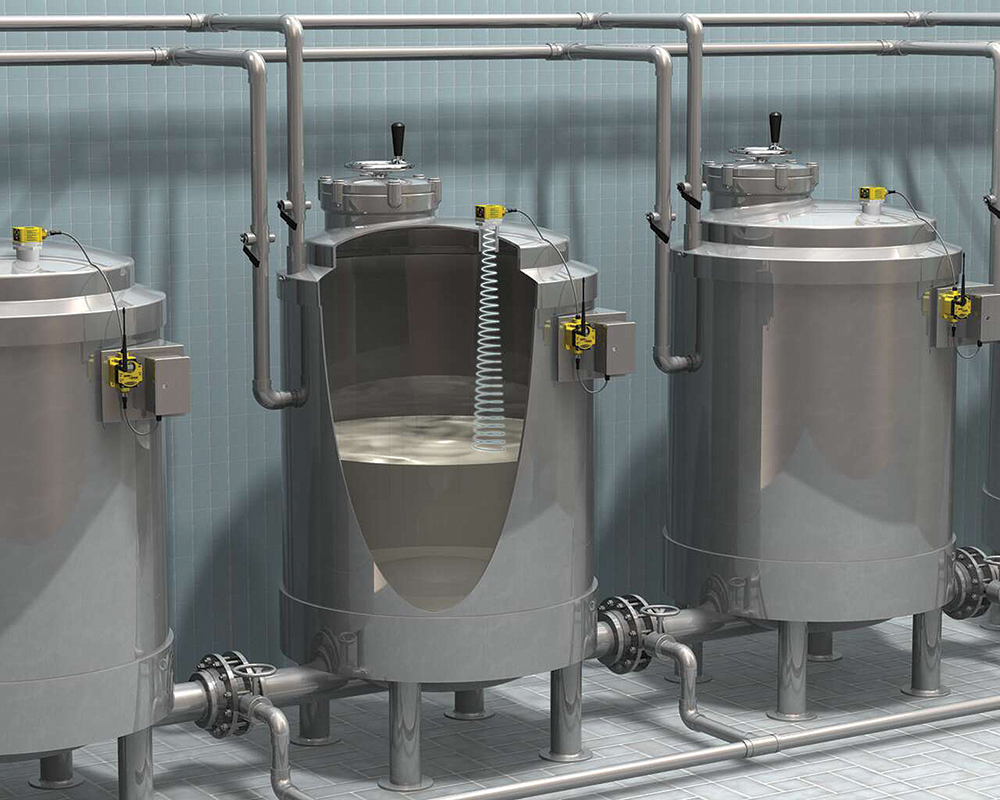
Additionally, whereas a wired system can require substantial changes to infrastructure, the changes required in a wireless system are minimal. Wireless systems are also far easier to implement than wired systems. In a basic setup, a wireless node is connected to a measuring device like an ultrasonic or radar sensor, and installed on the container. Each node in the network is bound to a wireless gateway or controller with an integrated gateway.
Next, a site survey is conducted to verify the connection between the deployed nodes and the gateway. The system is then configured, and inspection parameters and alarm thresholds set. Lastly, an Ethernet or cellular connection is established, enabling remote access to the data collected from the tanks. A system like this can monitor many containers and can be set up in a fraction of the time and at a fraction of the cost of a wired network.
Real-time data and alerts for quick troubleshooting and data-driven decisions
By connecting the network to the internet, asset managers or plant managers have easy access to timely, accurate information. This provides significant benefits for efficiency and productivity. Rather than sending staff to a site based on forecasted expectations of container levels or by following an arbitrary schedule, managers can strategically plan visits, routes and resources based on actual need. This makes it easy to keep tanks filled and processes running without overstocking a site.
In collection applications, this information can be used to prevent overfills and to ensure that staff and equipment are not sent to a site to empty, move or remove underfilled containers. Remote monitoring can minimise the potential for problem situations to arise. Sudden changes in use, equipment failure and other unexpected events can cause dramatic changes in content levels. A dry tank can have negative consequences for equipment, and processes may be brought to an unexpected halt. An overfill situation can be wasteful, damage equipment and lead to environmental consequences.
A wireless system can easily be set up to alert key personnel via text or email if tank levels are outside of the established parameters. Workers are then able to respond to a problem situation before it has the potential to become critical.
Versatility to expand to changing business needs
Business needs can change over time, and companies may need to add or move containers at a site to keep up with new demands. Wireless networks are versatile, highly scalable and can be easily adapted to meet changing needs.
Containers can be moved as much or as little as needed without altering the system or disconnecting the node and measuring device; they can be monitored even while in transit. New nodes and sensors taking measurements from new containers can be integrated into a network, or an entirely new network can be deployed to accommodate a new group of tanks, all with relative ease and without incurring substantial costs or requiring large commitments of time and labour.
Summary
Implementing a tank monitoring system that utilises ultrasonic or radar sensors in a wireless network has many advantages. Wireless systems can be set up quickly, cost-effectively and without large commitments of human labour or changes to infrastructure. They can monitor many containers and can adapt to meet changing needs and scale to accommodate new containers. Automated alerts can be set up to notify staff of potential issues, minimising the opportunities for emergency situations to develop. The data generated by these systems is more accurate and can be accessed from anywhere and at any time. This allows managers to make more informed decisions about their assets, how they are used, when they should be serviced, and what staff and resources are needed to service them.
| Tel: | +27 11 453 2468 |
| Email: | [email protected] |
| www: | www.turckbanner.co.za |
| Articles: | More information and articles about Turck Banner Southern Africa |






© Technews Publishing (Pty) Ltd | All Rights Reserved
 printer friendly version