How to avoid common failures in plain bearings
January 2024
Motion Control & Drives
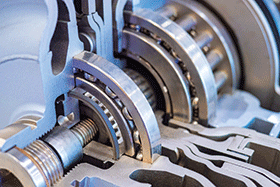
Plain bearings are often used in intensive applications because of their ability to operate for a long time under heavy loads and their low maintenance needs, even in harsh operating conditions. Despite this, their resilience does not mean that they are immune to failure. Common causes of plain bearings failures include metal fatigue, misalignment, localised rapid wear, and trapped dirt forming grooves in the bearing components. However, there are ways to prevent even these common failings from happening.
Colin Ford, MD of Lubrication Engineers South Africa explains that correct lubrication is one of the most important ways to mitigate plain bearing failures. “Even though plain bearings don’t necessarily have complex lubrication requirements, the use of quality lubricants can prevent many of the common causes of bearing failures,” he says.
Poor lubrication, including insufficient lubrication, or using the incorrect lubricant, can appear in a plain bearing as rapid wear, often in one spot, until the surface completely breaks down. “An experienced lubrication consultant can help identify the correct lubrication solution for an application and plain bearing component to prevent this,” says Ford.
The large bearing area on plain bearings means that they are able to carry heavy loads. Ford adds that the right size bearing also needs to be selected for each application and that they should have the proper clearances, supported by good lubrication. When these factors are in place, plain bearings can be better than antifriction bearings for carrying heavy loads or shock loads.
To get the most out of plain bearings, bearing surfaces should be completely separated by a film of lubricant. Most plain bearings will rapidly get ruined if this film wears out. When the bearing is moving and correctly lubricated, friction decreases to almost the low point of antifriction bearings.
Misalignment is another cause of failure in plain bearings, as it can cause disfigurement. Although it can sometimes be difficult to identify as the source of the fault, misalignment between a journal and shaft is usually easy to see. When studied closely, the wear pattern will reveal a skewed or unbalanced pattern. Sometimes a thrust load is also indicated. “This can be mitigated by using the correct lubrication to support any oscillation, without it turning into long-term misalignment,” says Ford.
Foreign material and dirt can also cause bearing failure when particles create grooves in the softer bearing alloy. “The tracks are plainly visible, either as large, long straight grooves or as smaller particle tracks that wander. Small, hard particles will cause multiple small, straight scratches, often resulting in excessive wear. If the foreign material is large or hard, it may become embedded. Lubrication is an excellent solution for preventing this problem because by nature it traps and removes dirt from the bearing system,” explains Ford.
LE includes proprietary Almasol and Monolec additives in its products. These are particularly helpful in lubricating plain bearings, because they significantly reduce operating temperatures in the bearings. This makes them effective in reducing wear during the critical startup and shutdown periods of operation.
Further reading:
Smarter motor technology for high-performance industrial automation
Adroit Technologies
Motion Control & Drives
Adroit Technologies is bringing Mitsubishi Electric’s EM-A series permanent magnet motors to Africa, offering servo-like speed and position control at a lower cost by combining patented sensorless control with the FR-E800 inverter to eliminate encoders while achieving IE5 efficiency.
Read more...
A smarter approach to simplifying motion architecture
Motion Control & Drives
n motion system design, the wiring and drive placement between motor and drive are often decided by default, yet they shape a machine’s cost, footprint and adaptability. Kollmorgen sets out how single-cable and decentralised architectures simplify the cabinet.
Read more...
Robotic case packer achieves 99% uptime
Rockwell Automation
Motion Control & Drives
DCC Automation designed a new robotic case packer for a nutrition supplement manufacturer using delta robots and a unified Rockwell Automation control platform, cutting changeover time from 45 minutes to 5 minutes, and achieving 99 to 99,5% uptime against the previous 10% per-shift downtime.
Read more...
igus puts 3D-printed wear materials to the test
igus
Motion Control & Drives
A new igus white paper compares its tribological iglidur 3D-printing materials directly with conventional POM, reporting lower wear, more stable friction and up to ten times longer service life in gear testing for customised, low-volume and replacement components.
Read more...
SEW-EURODRIVE’s expanded local engineering capability
SEW-EURODRIVE
Editor's Choice Motion Control & Drives
At Electra Mining Africa, SEW-EURODRIVE demonstrated how its expanded local engineering capability, digital technologies and lifecycle support strategy help customers improve reliability, energy efficiency and total cost of ownership across the full life of their drive assets.
Read more...
Latest Danfoss automation drive
Bearing Man Group t/a BMG
Motion Control & Drives
BMG has launched the Danfoss iC7-Automation enclosed variable speed drive range in South Africa, backed by significant local stockholding of 400 V models up to 710 kW, approved warranty workshops, and DrivePro digital asset management support.
Read more...
Severe-duty workhorses powering mining
Motion Control & Drives
Mining machines such as rock crushers, pumps and conveyors need motors that combine high torque with robust enclosures, seals and cooling. WEG Africa explains how severe-duty motors deliver more than a decade of reliable performance in harsh conditions while meeting modern energy-efficiency standards.
Read more...
Looking beyond the spec sheet when choosing motion architecture
Motion Control & Drives
When machine builders focus only on torque, speed and price, engineering time, integration effort and long-term maintainability get overlooked. Kollmorgen explains how thinking at the system level, not the component level, leads to better motion architecture choices.
Read more...
Economy drive system closes the drive gap in the entry-level segment
Beckhoff Automation
Editor's Choice Motion Control & Drives
Beckhoff has launched an economy drive system pairing its new AX1000 servo drive and AM1000 servomotor with the AF1000 dual-axis variable frequency drive on a shared EtherCAT platform, targeting series machines and price-sensitive markets without sacrificing TwinCAT integration or functional safety.
Read more...
SEW-EURODRIVE showcases modernisation and lifecycle support at Electra Mining Africa 2026
SEW-EURODRIVE
Motion Control & Drives
At Electra Mining Africa 2026, SEW-EURODRIVE showed how it has expanded beyond equipment supply into integrated engineering solutions, plant modernisation and long-term lifecycle support for mining and industrial operators across Africa.
Read more...










 printer friendly version