Siemens Digital Industries Software’s SynthAI service is delivering the power of machine learning (ML) and artificial intelligence (AI) to solve the challenge of training machine vision systems.
“We were looking for a quick and easy solution that will enable us to detect wire terminals in a robotic electric cabinet assembly station. With SynthAI, our control engineers were able to achieve great results within just a few hours,” said Omer Einav, CEO of Siemens’ client, Polygon Technologies. “The tedious task of annotating a large set of training images to train the model was shortened significantly. The results show great promise for many additional use-cases we plan to handle with SynthAI.”
Machine learning is used for a variety of vision-based automation use-cases such as robotic bin picking, sorting, palletising, quality inspection and more. While usage of machine learning for vision-based automation is growing, many industries face challenges and struggle to implement it within their computer vision applications. This is due to the need to collect many images of the parts in question and the challenges associated with accurately annotating the different products within those images – particularly before production or manufacturing begins.
To solve this challenge, synthetic data is used to speed up the data collection and training process. However, utilising synthetic data for vision use-cases requires expertise in synthetic image generation and can be complex, time consuming and expensive. This is where Siemens’ SynthAI changes the game.
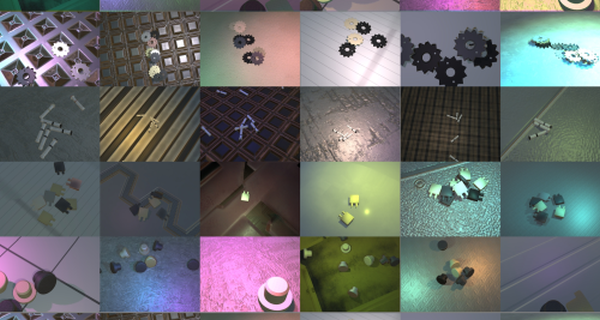
Rather than waiting for pre-production parts to be ready or using complex processes to generate synthetic data, machine vision specialists only need to provide 3D CAD data of the parts. SynthAI will then automatically generate thousands of randomised annotated synthetic images within minutes, without the specialist knowledge typically required.
SynthAI will also automatically train a machine learning model that could be used to detect a product in real life. Once the training is done, the trained model can be downloaded, tested and deployed offline, using no more than a little Python coding. If organisations prefer to handle training of their own systems, complete synthetic image datasets together with the annotations are also available.
ESG as a growth lever RS South Africa
IT in Manufacturing
Leading organisations are treating ESG not as a compliance obligation but as a practical tool for operational efficiency, supply chain resilience and business performance, with data and collaboration central to unlocking its value.
Read more...Preparing Africa’s data centres for the demands of autonomous AI Schneider Electric South Africa
IT in Manufacturing
Africa’s data centre infrastructure must evolve significantly to support agentic AI workloads, with GPU-intensive computing, advanced cooling and reliable power demanding a fundamentally different approach to facility design and investment.
Read more...Virtualising the control room to reshape building management systems Schneider Electric South Africa
IT in Manufacturing
Schneider Electric explains how virtualising building management systems frees facilities teams from ageing hardware, delivers stronger cybersecurity and enables portfolio-wide control from a single interface.
Read more...AI infrastructure solutions for data campus Schneider Electric South Africa
IT in Manufacturing
Schneider Electric and Motivair deliver more than $290 million in power and cooling infrastructure for TeraWulf’s AI-ready Lake Mariner data campus.
Read more...Africa’s data centre evolution: AI, edge computing and new energy demands
IT in Manufacturing
With less than half a gigawatt of active white space capacity serving over a billion people, Africa’s data centre sector faces a stark gap that AI’s surging power and cooling demands are set to widen. Vertiv and Open Africa Data Centres unpack how modularity, edge computing and smarter energy strategies could change the equation.
Read more...Luna Rossa partners with Siemens for 38th America’s Cup Siemens South Africa
IT in Manufacturing
Siemens details how Luna Rossa is using digital engineering and simulation tools, from CAD to structural optimisation, to design a faster yacht for the 38th America’s Cup.
Read more...AI is raising South Africa’s cybersecurity stakes
IT in Manufacturing
As AI accelerates both the sophistication and scale of cyber threats, South African organisations face significant gaps in cloud security, data governance and identity management that need to be addressed before AI capabilities are further embedded into business operations.
While every effort has been made to ensure the accuracy of the information contained herein, the publisher and its agents cannot be held responsible for any errors contained, or any loss incurred as a result. Articles published do not necessarily reflect the views of the publishers. The editor reserves the right to alter or cut copy. Articles submitted are deemed to have been cleared for publication. Advertisements and company contact details are published as provided by the advertiser. Technews Publishing (Pty) Ltd cannot be held responsible for the accuracy or veracity of supplied material.










 printer friendly version