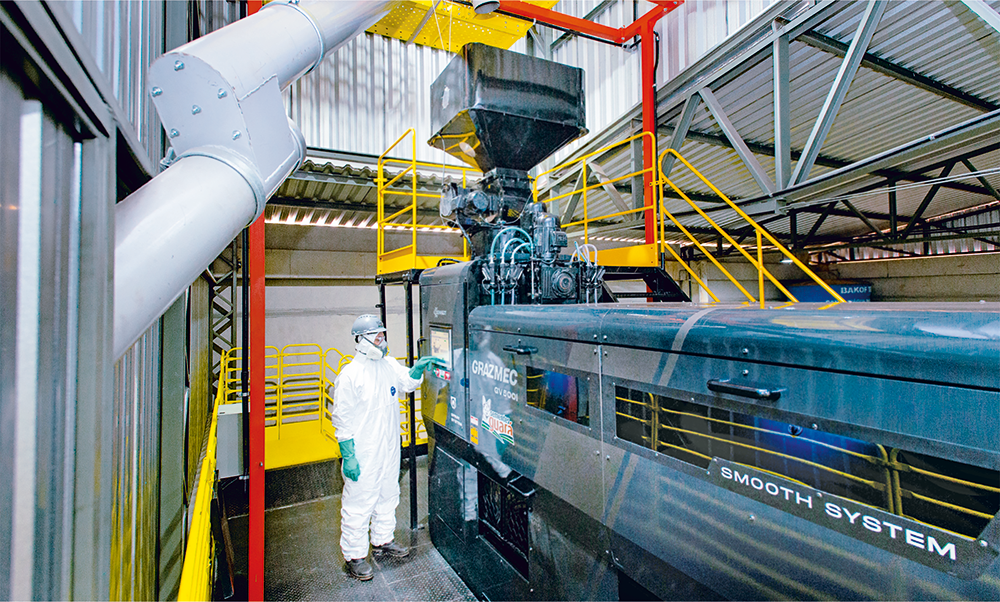
Founded in 1986 and headquartered in Não-Me-Toque in the Brazilian state of Rio Grande do Sul, Grazmec consistently depends on new technologies for its seed treatment machines. The latest developments from the machine builder have relied on PC-based control technology from Beckhoff as an important innovation factor. In particular, it has helped to open up the Internet-of-Things (IoT) for use in the food industry.
Seed treatment is a preventive way to protect against damage at the most critical harvesting stage. The application of chemical pesticides (fungicides and insecticides), micronutrients (such as polymers and pigments) and the inoculant against infectious materials in the seed, can be carried out in two ways: by on-farm seed treatment, i.e., carried out in the field just before sowing; or by industrial seed treatment (IST), i.e., carried out by the seed industry.
According to Grazmec, the latter option is more reliable, less strenuous and reduces environmental impact. As such, it is already the preferred choice of numerous seed companies, cooperatives and large farming operations.
Modern control technology revitalises machine design
Grazmec has been working with Beckhoff since 2019 to launch a completely redesigned seed treatment machine, as Grazmec’s marketing manager, Émerson de Mattos, explains. “The redesigned GV500i Connect offers improvements to both functionality and the available options, with Beckhoff technology facilitating an entirely new machine concept in the process. Having won silver in the product design category at the Brazil Design Awards (BDA), this machine is really raising the bar when it comes to programming.
“Unlike conventional controllers, PC-based control from Beckhoff offers its end-customers straightforward machine operation and flexible after-sales options. What’s more, any operational issues can be analysed remotely, directly from the plant, which minimises both time and manpower requirements.” De Mattos sees further advantages in the simplification of software upgrades, which can easily be integrated into existing control programmes for continuous equipment optimisation.
Back in 2013, Grazmec started developing a tractor for sowing that was designed to treat up to 30 000 kg of soybean sprouts per hour, as per the end-customer’s requirements. Electrical control units were already in use, although the required dosages were still very much determined by the mechanical system design. For this reason, the throughput times and quantities for seeds and chemicals had to be recorded as part of an elaborate calibration process before the machine was put into operation.
Despite the smooth operation, high seed flow rate and simple operation, the system was slow and complex, which resulted in several rounds of optimisations starting in 2015. These included better sensor technology, the option of using up to four liquid chemical products for seed treatment, touchscreen operation, storage of up to 10 formulations and product reservoirs.
Greater functionality and IoT communication
The second generation of machines was successful but was increasingly reaching its limits as customer requirements became more demanding and technology levels increased. This called for a further redesign of the machine concept in 2019, not only to make the system more flexible and straightforward, but also to facilitate software upgrades.
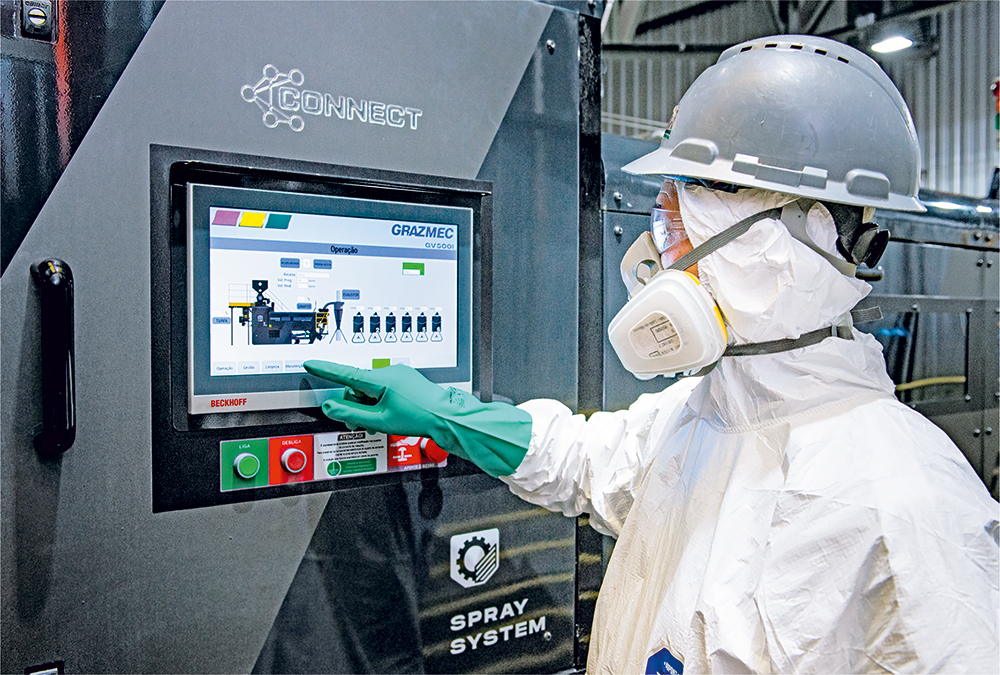
The CX5140 embedded PC from Beckhoff, with an Intel Atom quad-core processor running at 1,91 GHz and equipped with TwinCAT 3 automation software, provides the necessary computing power, while the associated I/O system is formed by EL1819 and EL2809 high-density (HD) digital input and output EtherCAT terminals.
The machine parameters can be conveniently accessed via a CP2916 multi-touch, built-in control panel with 15,6-inch display, optimally supported by the HTML 5-based operator interface created with a TF2000 TwinCAT HMI. As a result, significantly more formulations can now be stored with a greater number of liquid and powder components, extending flexibility in terms of machine functionality and usable seed. Moreover, manuals and demonstration videos are stored directly on the machine to simplify system operation, cutting down on process and maintenance times.
As part of Grazmec’s IoT strategy, the cost and consumption reports generated by the production control system open up new ways of managing and analysing data. With TwinCAT IoT communication provided by Beckhoff’s TF6701, the machine data is sent to the Grazmec server via the MQTT (MQ Telemetry Transport) protocol for this purpose. This can then be analysed together with information such as daily updates on the quantities of treated seed and consumed treatment compounds, allowing more informed decisions to be made in the process.
Other IoT benefits, according to Grazmec, include enhanced remote control and maintenance capabilities that also make the system more straightforward and efficient. De Mattos sums it up by saying, “The state-of-the-art control technology from Beckhoff will allow the devices to be used in entirely new applications. The TwinCAT software, in particular, opens up a wide range of possibilities when it comes to upgrades, continuous improvements, ease of use and excellent quality.”
| Tel: | +27 11 795 2898 |
| Email: | info@beckhoff.co.za |
| www: | www.beckhoff.com |
| Articles: | More information and articles about Beckhoff Automation |






© Technews Publishing (Pty) Ltd | All Rights Reserved
 printer friendly version