



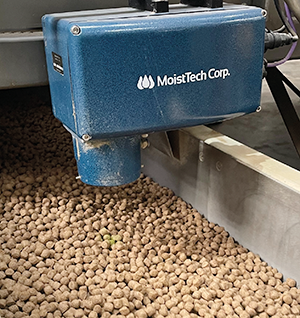
Moisture is important in many manufacturing processes, but when it comes to food processing, excess moisture can ruin products and create unnecessary waste, economic losses and decreased productivity. With continuous online moisture measurement, food production plants can realise substantial monetary savings.
Knowing the moisture content of the materials used throughout the food and baking process has become a critical component in the industry as many raw materials sold today are based upon weight. MoistTech moisture sensors can provide a quick test of the moisture levels of the manufacturer’s raw ingredients, effectively saving purchasing plants a lot of money.
While moisture is the major focus, the company also supplies analysers for the continuous online measurement of protein, fat/oil, sugar, seasonings, caffeine and other constituents or elements that absorb NIR (near infrared) beams.
Realising that many food processing companies use various primary reference measurements, either in-house or outsourced, MoistTech’s NIR moisture sensors are easy to set up and use, providing instant and precise measurements due to elimination of constituent losses in handling. Instant measurements also provide manufacturers with savings in analysis costs, delivery times and shipping costs.
It is also important to know the moisture content during the mixing stage in the food manufacturing process, as water affects the quality and consistency of the end product. Variations and excess moisture in mixes can result in clumping and out-of-spec recipe formulas. Testing food moisture during this time will allow adjustments to be made throughout the mixing process to manage moisture levels.
Manufacturers strive to have the best finished product. The amount of water a product has affects the taste, appearance, consistency and stability, as well as the shelf life. Testing the moisture levels of the final product assures manufacturers that they have the highest quality product and consistency.
Whether finished products have too much or too little moisture is a concern for food manufacturers. Where food items are sold by weight, moisture reduces costs, can make the item lower in fat/calories and prevent it from being too dry. Adding too much water, though, can affect the crunch and make the item taste stale, or even worse, contribute to bacteria/mould growth.
Sensing moisture content throughout the process also provides food manufacturers with cost savings in energy and fuel, as well as minimising product waste. With continuous NIR online moisture testing, manufacturers can monitor moisture levels and precisely control ovens, dryers, roasters and fryers to optimise the production process and minimise energy requirements.
NIR technology and food production
Although the discovery of NIR is attributed to William Herschel in the late 19th century, the first industrial application was not until the 1950s. NIR spectroscopy and imaging are fast and non-destructive analytical techniques that provide chemical and physical information of virtually any matrix. NIR can tell us things about a product in a similar way to visible light. When light hits a product, it will interact in various ways. Transmitted light will pass through the product while backscattered light will reflect from it. Light will also be absorbed by the product. Absorption is the key to effective moisture measurement analysis techniques.
A crucial aspect
Immediate ROI is seen with the installation of a moisture measurement system, as the plant controllers instantaneously notice the reduced waste, energy usage and overall increase in product quality.
When evaluating moisture measurement systems, be sure to check for features that will benefit your operation. The best ones to look for are: one-time calibration; multi-application; immediate results; equipment included; state-of-the-art technology; and easy installation.
MoistTech is experienced with requirements in the production of foods and snack foods. All sensor calibrations, measurement wavelengths, algorithms and sensor optical requirements are pre-set at the factory. Typical accuracy is around 0,1% moisture and outputs can be adjusted to optimise PLC or recording requirements.
| Tel: | +27 11 452 1390 |
| Email: | sales@seco-pi.com |
| www: | www.seco-pi.com |
| Articles: | More information and articles about SECO Process Instrumentation |






© Technews Publishing (Pty) Ltd | All Rights Reserved
 printer friendly version