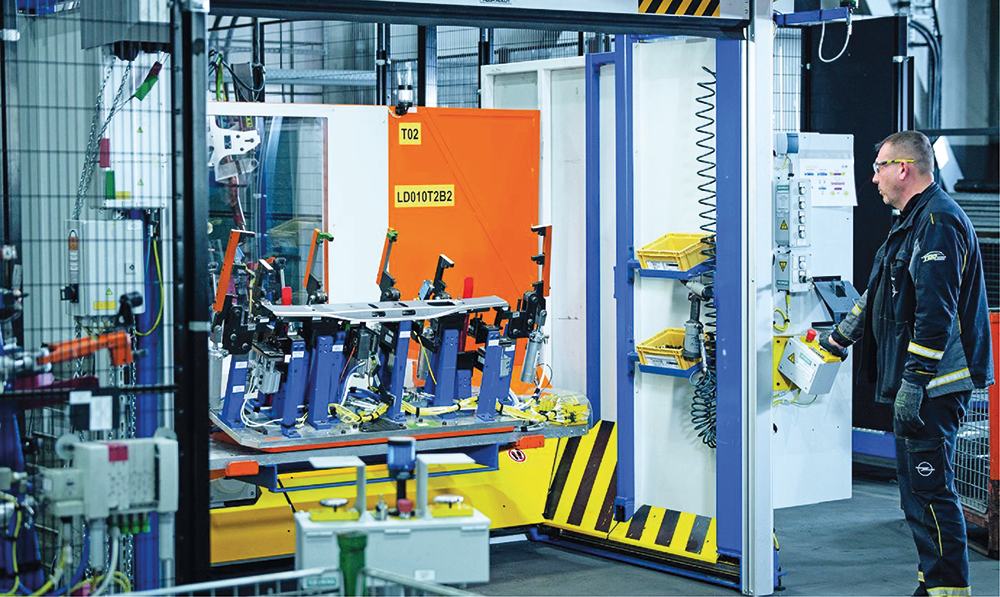
Opel’s factory in Rüsselsheim relies on innovative technology in production. At a welding robot, various stamped and deep-drawn metal sheets are welded to form a supporting element of the bodywork. A 3D camera from ifm electronic monitors the position and the fixing of the sheet metal parts.
The O3D sensor
ifm’s O3D302 vision sensor is a 3D camera with integrated image evaluation. The resolution of the PMD image sensor is 176 by 132 pixels. For each of the 23 232 pixels the sensor supplies a precise distance value – up to 25 times per second. In contrast to laser scanners, this sensor has no moving parts, making it especially robust, small and cost-effective.
Since the 3D image is evaluated in the sensor, external image evaluation is not needed. The distance between the clamp and the sensor is evaluated via definable positions in the camera image (regions of interest). The integrated evaluation detects if the tension lever is open or closed. The events are transferred to the controller using the Ethernet interface via TCP/IP, Profinet IO or EtherNet/IP. Using the Vision Assistant software, the user can easily set the sensor parameters, define regions of interest, or configure the output function, for example.
Looking down from the top
Two of these sensors are installed above the welding system, both looking down to the sheet metal to be welded. Fabian Gulla, application engineer for image processing and robotics in plant construction at Opel, explains: “We use the sensor for distance measurement and have defined several regions of interest, which we detect. The advantage of the O3D is that you only need one sensor and can then redefine the regions of interest in the software. Then we simply use the distance measurement for detection.”
Visualisation and space saving
For transparency in the process, Opel has installed a monitor for visualisation in the plant. Besides graphic process visualisation, the O3D can also provide a live image. The advantage of the ifm sensor is that positions can be assigned to the clamps and components visualised in the image. A red-green colour change symbolises to the operator if a workpiece has been placed and if the clamp is open or closed.
Since now only one sensor is needed for the detection of several positions and this sensor is installed high above the plant, there are special advantages for the construction of the plant.
Prospects
The experience at the Opel plant will have a positive influence on future plant construction. “The cooperation with ifm has been excellent,” concludes Gulla. “We had several meetings directly with the developers, so we could gain insight into how the sensor works, what we needed to note and what size objects could be reliably detected. The use of the O3D sensor provides us with completely new possibilities.
“Fewer sensors, simpler plant construction, no interference due to weld spatter – the vision sensor as a monitoring system provides numerous advantages and considerably reduces the plant cost by reducing cabling, installation requirements and I/O points at the controller. Our other production plants can also be equipped with this vision sensor and thus optimised.”
Market opportunity for sensors in humanoid robots
Sensors & Transducers
A new IDTechEx report forecasts the market for sensors in humanoid robots will exceed $6,59 billion by 2037, driven by perception sensors, force/torque sensors, encoders and inertial measurement units across a growing range of commercial robot platforms.
Read more...The wireless route to safer, more efficient mining operations Emerson Automation Solutions
Editor's Choice Sensors & Transducers
Modern wireless level measurement technologies are helping mining operations improve process control, increase safety and reduce installation costs. Emerson’s Rosemount 3408 wireless non-contacting radar level transmitter uses 80 GHz frequency-modulated continuous wave radar with HART communication to reach remote assets where cabling is impractical.
Read more...Pressure sensor for robust measurement and clear communication ifm - South Africa
Pressure Measurement & Control
ifm’s G1/2 PF pressure sensor monitors highly viscous or abrasive media directly on the system, with a robust ceramic measuring cell, a rotatable display and a flush design that prevents clogging.
Read more...Vibration sensor with CANopen interface for mobile machines ifm - South Africa
Maintenance, Test & Measurement, Calibration
ifm’s 3-axis VMB301 condition monitoring sensor integrates into the vehicle network via CANopen, delivering real-time bearing, vibration and temperature data to help mobile machines avoid costly damage and downtime.
Read more...Telco sensors for harsh environments
Sensors & Transducers
Telco sensors are designed to operate where moisture, particulate contamination and surface fouling would disable conventional sensors, with a range including an adjustable five-metre infrared proximity sensor for harsh industrial environments.
Read more...The data-driven path to sustainable manufacturing ifm - South Africa
Editor's Choice Sensors & Transducers
Smart automation is closing the gap between operational efficiency and environmental responsibility, and the data to do it is already inside the plant. With ifm’s sensing and digitalisation technologies, manufacturers can turn machine intelligence into measurable sustainability gains.
Read more...Expanding visibility in mining operations Emerson Automation Solutions
Editor's Choice Sensors & Transducers
Advances in wireless communications, condition monitoring and sensing technologies are helping mining operators extend measurement into previously under-monitored areas, improving equipment reliability, process performance and water stewardship.
Read more...Fiber-optic amplifiers for precise object detection ifm - South Africa
Sensors & Transducers
The OCF fibre-optic amplifier detects even the smallest or most transparent objects in confined spaces, making proven fibre-optic technology easier and more user-friendly than before.
Read more...Inductive ring sensors monitor material flow in feeding technology ifm - South Africa
Level Measurement & Control
Inductive ring sensors detect metallic parts moving through tubes at up to 35 m/s, whatever their size, enabling precise counting, flow control and reliable detection of blockages or misfeeds.
While every effort has been made to ensure the accuracy of the information contained herein, the publisher and its agents cannot be held responsible for any errors contained, or any loss incurred as a result. Articles published do not necessarily reflect the views of the publishers. The editor reserves the right to alter or cut copy. Articles submitted are deemed to have been cleared for publication. Advertisements and company contact details are published as provided by the advertiser. Technews Publishing (Pty) Ltd cannot be held responsible for the accuracy or veracity of supplied material.










 printer friendly version