



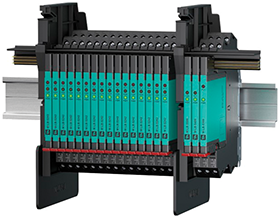
Surge voltages have many possible causes. Electronics can receive sustained damage from lightning strikes, transients caused by switching operations and load drops and interruptions to the supply. There are other effects in addition to the direct destruction of components, in particular the risk posed to plant availability and the resulting consequences, such as production downtime, which drives operating costs up. Surge protection systems must therefore form an integral part of process engineering plants. In addition, current standards such as EN 62305 (SANS 62305) require that the effectiveness of these systems be checked regularly. Up to now, this check has usually been carried out manually on-site, which is costly for large plants in particular and requires trained personnel and tools such as a test kit. However, the test results do not give any indications of prior damage to the protection module and its state of wear. It has previously only been possible to rate the tested devices as ‘good’ or ‘bad’. To meet the different safety requirements of the signal line market, Pepperl+Fuchs offers two surge protection systems with different functions.
Surge protection with condition monitoring
The M-LB-5000 surge protection system with condition monitoring function monitors signal lines automatically and continuously. The patented diagnostics use a special algorithm to detect the different load situations that cause the surge protection system to wear. This includes counting the number of times the gas discharge tube has ignited, detecting the silicon temperature of the suppressor diodes and measuring the interior temperature of the surge voltage protection module.
When the protection module has reached 90% of its useful life, this is indicated by a yellow diode. The protection modules are therefore replaced neither too early nor too late: replacing them too early leads to an unnecessarily high replacement frequency, while replacing them too late leads to the plant having phases without sufficient surge protection if defective modules are not replaced immediately. This optimises the availability of the surge protection functionality and of the plant and at the same time minimises maintenance costs.
The M-LB-5000 modules are mounted on a standard DIN mounting rail. The devices each consist of a base module and the actual protection module. The system also has an insulating partition to maintain clearance when mounting Ex and non-Ex modules on a DIN mounting rail. All modules have a width of only 6.2 mm and allow simple commissioning without special aids. In addition to the protection and base modules, there are three function modules. The maintenance module reports when a yellow LED lights up on at least one protection module, indicating that this module should be replaced. The fault module indicates when at least one device has a fault (red LED) and needs to be replaced directly. The third unit is a power module that powers the protection modules via the power rail. The error messages are also sent to the function modules or the control panel via the power rail.
Terminal block with surge protection
Pepperl+Fuchs has developed the M-LB-2000 for applications requiring only minimum specifications, plus loop connect. It has a form factor very similar to the M-LB-5000 and is designed to be attached directly to the DIN mounting rail. The main differences are that the module cannot be diagnosed or replaced without interrupting the signal line. A loop disconnect function is achieved when the module is plugged in via two easily accessible switches on the front.
The M-LB-2000, which is also only 6.2 mm wide, not only saves a lot of space in the switch cabinet, it practically replaces the terminal block with surge protection. This means that disconnect terminal blocks are no longer necessary, saving costs. The certificates range from ATEX, IECEx, Zone 1 and SIL 3.
Conclusion
The M-LB-5000 surge protection system’s diagnostics use a special algorithm to detect different load situations and send a signal when the protection module has reached 90% of its life cycle. This significantly increases the efficiency of the protective function and keeps maintenance costs to a minimum. The modularity of the device enables the protection module to be replaced without tools and without interrupting operation.
The M-LB-2000 with loop disconnect function is designed for significantly lower requirements in surge protection. With a width of 6.2 mm, it saves just as much space in the switch cabinet and can be used as a replacement for the terminal block with surge protection.
| Tel: | +27 10 430 0250 |
| Email: | [email protected] |
| www: | www.pepperl-fuchs.com/en-za |
| Articles: | More information and articles about Pepperl+Fuchs |






© Technews Publishing (Pty) Ltd | All Rights Reserved
 printer friendly version